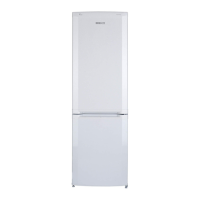
This document is an installation, operation, and food storage instruction manual for a Beko Fridge Freezer, model CS5342APW, with a capacity of 7.4 cu ft.
Function Description:
The Beko CS5342APW is a combi fridge freezer designed for the short-term storage of fresh food and drinks in its fridge compartment, and for freezing and storing pre-frozen food in its freezer compartment. The freezer compartment is *** rated, indicating its suitability for long-term storage of commercially frozen foods and for freezing fresh food. The appliance is designed to provide efficient cooling and freezing while offering various features for user convenience and food preservation. It includes adjustable shelves, crisper bins, and door shelves for organized storage. The appliance also features a thermostat knob for temperature adjustment and an interior light.
Important Technical Specifications:
- Model: CS5342APW
- Capacity: 7.4 cu ft
- Energy Efficiency Class: A+
- Energy Consumption: 212 kWh/year
- Net Storage - Vol Fresh Food: 132 liters (4.6 cu ft)
- Net Storage - Vol Frozen Food: 57 liters (1.9 cu ft)
- Total Net Vol: 185 liters (6.5 cu ft)
- Frozen Food Compartment Rating: 4 STAR
- Conservation Time from Failure: 18 hours
- Freezing Capacity Fresh Food: 3 kg (6.4 lb) / 24 hours
- Climate Class: SN-ST
- Operating Noise Level: 38 dB(A)
- Electrical Requirements: The appliance requires a 13 A fused plug. It is designed to operate on a voltage and frequency shown on the rating plate. The main supply via a suitable switched and fused socket is recommended. A replacement fuse cover must be the same colour as that visible on the pin face of the plug.
- Dimensions (Clearances for installation):
- From Cookers: 2" (50 mm)
- From Radiators: 12" (300 mm)
- From Refrigerators or Larder Fridge: 1" (25 mm)
Usage Features:
- Installation: The appliance should be transported in an upright position. It requires sufficient room for air circulation, with plastic wall spacers fitted to the condenser at the back. The fridge/freezer should be located on a smooth surface, and the two front feet can be adjusted for stability and to avoid excessive vibration and noise. It is crucial not to connect the appliance to electricity until all packing and transit protectors, including polystyrene blocks, have been removed.
- Temperature Adjustment: The thermostat knob (Item 5) controls operating temperatures, ranging from 1 (coldest position) to 5 (warmest position). The average temperature inside the fridge should be around +5°C (+41°F).
- Food Storage Arrangement:
- Fridge Compartment: Suitable for short-term storage of fresh food and drinks. Cooked dishes should be in airtight containers. Fresh wrapped produce, fruits, and vegetables should be cleaned and stored in crisper bins. Bottles can be placed in the door section. Raw meat should be wrapped in polythene bags and placed on the lowest shelf, stored for two to three days. Hot food and beverages must cool before being placed in the fridge.
- Freezer Compartment: *** rated, suitable for freezing and storing pre-frozen food. Frozen food should not be left at room temperature to thaw; slow thawing in the fridge is recommended.
- Making Ice Cubes: Fill the ice cube tray 3/4 full with water and place it in the Ice Bank. Loosen frozen trays with the handle of a spoon, never use sharp edged objects.
- Reversing the Door: The manual provides detailed instructions for reversing the doors, which involves removing various screws, hinges, and plugs, then reattaching them on the opposite side. This process may require assistance.
- Energy Saving Tips:
- Ensure the appliance is installed in a well-ventilated area, away from heat sources.
- Avoid placing warm food in the appliance.
- Do not leave the door(s) open unnecessarily.
- Defrost frozen food in the fridge compartment to assist cooling.
- Problem Solving: The manual includes a section to troubleshoot common issues such as the appliance not operating, blown/circuit breaker tripped, temperature control issues, and wired plug problems.
Maintenance Features:
- Cleaning and Care:
- Unplug the appliance before cleaning.
- Use mild cleaning agents; avoid abrasive substances, soap, household cleaner, detergent, or wax polish.
- Use a damp cloth with a solution of one teaspoon of bicarbonate of soda to one pint of water for cleaning the interior and wiping dry.
- Ensure no water enters the temperature control box.
- Clean the condenser at the back of the appliance regularly with a vacuum cleaner.
- Check door seals regularly for cleanliness and freedom from food particles.
- Do not use sharp instruments or abrasive materials for cleaning.
- To remove a door tray, remove all contents and then simply push the door tray upwards from the base.
- The plastic defrost water container at the back of the appliance should be cleaned at all times.
- Defrosting:
- Fridge Compartment: The fridge compartment defrosts automatically. Defrost water runs to a drain tube at the back of the appliance. The plastic drain tray fitted above the compressor motor should not be removed on models with auto-defrost fridge.
- Freezer Compartment: Defrosting is straightforward and without mess, thanks to a special defrost collection basin. Defrost twice a year or when a frost layer of around 7 (1/4") mm has formed. Food should be wrapped in several layers of newspaper and stored in a cool place. Do not use pointed or sharp-edged objects, or knives/forks to remove the frost. Use a plastic scraper or wooden utensil. Sponge out the defrost water collected in the bottom of the freezer compartment.
- Replacing the Interior Light Bulb: Unplug the appliance. Switch off at the socket outlet and pull out the mains plug. Use a flat-tipped screwdriver to remove the light diffuser cover. Unscrew the old bulb and replace it with a new 15 watt (max) screw cap (SES) bulb.
- Guarantee Details: The product comes with a guarantee covering breakdown repairs for twelve months from the date of original purchase. This covers faulty materials, defective components, and manufacturing defects, as well as the cost of functional replacement parts and labour. It does not cover transit damage, accessories, consumable items, or repairs due to unauthorised repair or inexpert installation.

 Need help?
 General

 To Next Page