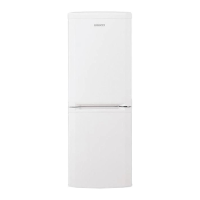
Need help?
Do you have a question about the Beko CSK321CA and is the answer not in the manual?
Ensure all packing and transit protectors are removed before connecting the appliance.
Leave appliance to stand for 4 hours after horizontal transport to allow compressor oil to settle.
Ensure old appliances with locks/latches are left safe to prevent child entrapment.
The appliance must only be used for its intended purpose as specified by the manufacturer.
Do not dispose of the appliance on a fire due to flammable insulation and non-CFC substances.
Do not use the appliance in unheated rooms like garages or sheds.
Reading instructions carefully ensures optimal performance and avoids invalidating the guarantee.
Verify voltage and frequency on rating plate match your supply before plugging in.
Ensure the appliance is properly earthed for electrical safety.
Only qualified technicians should perform electrical repairs to avoid risks.
Appliance uses R 600a, an environmental friendly but flammable gas; handle cooling system with care.
Do not use mechanical devices to accelerate defrosting, only manufacturer-recommended ones.
Avoid damaging the refrigerant circuit to prevent gas leakage.
Do not use electrical appliances inside food storage compartments unless manufacturer-recommended.
Transport the appliance only in an upright position with intact packing.
If transported horizontally, allow 4 hours settling time before operation.
Protect the appliance against rain, moisture, and other atmospheric influences.
Avoid touching condenser metal wires at the back to prevent injury.
Do not sit or stand on the appliance; it is not designed for this.
Ensure the mains cable is not caught under the appliance during or after moving.
Prevent children from playing with the appliance or tampering with controls.
Install appliance in rooms with ambient temperatures between 10°C and 32°C for optimal operation.
Avoid placing near cookers, radiators, or direct sunlight to prevent strain on functions.
Ensure sufficient clearance around the appliance for free air circulation (see Item 2 diagram).
Use the back airing lid to set the distance between the refrigerator and the wall (see Item 3 diagram).
Position on a smooth surface and adjust front feet for levelling to prevent vibration.
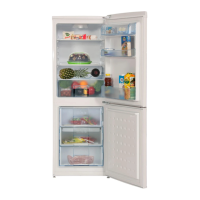
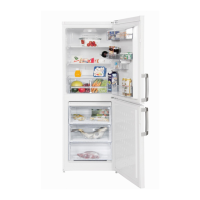
Familiarize yourself with appliance components like thermostat, shelves, crispers, and drawers (Item 1).
Fridge compartment is for short-term storage of fresh food and drinks.
Freezer compartment is **** rated for freezing and storage of pre-frozen food.
Store dairy products in the dedicated compartment within the door liner.
Store cooked dishes in airtight containers for optimal freshness.
Keep fresh produce on shelves and clean fruit/vegetables in crispers.
Bottles can be conveniently stored in the door section.
Store raw meat on the lowest shelf, wrapped, to avoid cross-contamination with cooked food.
Do not cover removable shelves to allow free air circulation and maximize efficiency.
Avoid storing vegetable oil on door shelves; keep food packed and covered.
Allow hot food and beverages to cool before refrigerating to prevent appliance strain.
Do not freeze fizzy drinks or consume flavoured ice too cold.
Some fruits/vegetables suffer damage near 0°C; wrap them to prevent this.
Store high-proof alcohol upright in sealed containers; avoid inflammable propellants.
Control operating temperature using the thermostat knob, from MIN to MAX settings.
Aim for an average fridge temperature of around +5°C for optimal food preservation.
Internal temperature can vary between sections; this is normal.
Periodically check cabinet temperature with a thermometer to ensure desired levels.
Frequent door openings raise internal temperatures; close doors promptly.
Set thermostat midway initially and monitor temperature for desired storage.
Do not load appliance immediately; wait for correct storage temperature to be reached.
Perform final checks: levelling, dry interior, clean, and power connection before use.
A noise from the compressor starting up is normal during operation.
Slight undulation of the cabinet top is normal due to manufacturing and not a defect.
Freezer is suitable for long-term storage of commercial and home-frozen foods.
In case of power failure, do not open the door; food is safe for up to 18 hours.
Avoid freezing too large a quantity at once for best quality preservation.
Do not exceed the appliance's 24-hour freezing capacity for optimal results.
Placing warm food causes continuous compressor operation, potentially leading to excessive cooling.
Keep thermostat at medium when freezing fresh food; small quantities need no adjustment.
Take care not to mix already frozen food with fresh food.
Fill ice cube tray 3/4 full with water; loosen frozen trays with a spoon handle.
Fridge compartment defrosts automatically; water drains via a collection container (Item 6).
Water droplets may form and refreeze; do not use sharp objects to remove them.
Check drain tube for blockages by food particles if defrost water does not drain.
Ensure drain tube is correctly placed in the collecting tray to prevent spills (Item 7).
Defrost freezer twice a year or when frost layer reaches 7mm; switch off appliance.
Wrap all food in newspaper and store in a cool place during defrosting.
Containers of warm water may be placed in the freezer to speed up defrosting.
Do not use sharp objects like knives or forks to remove frost.
Never use hairdryers, heaters, or other electrical appliances for defrosting.
Switch off power, unscrew faulty bulb, and replace with E14 15W max bulb (Item 10).
Switch off power before cleaning; use mild solutions and wipe dry.
Never use sharp instruments, abrasives, or harsh cleaners for cleaning.
Use a damp cloth with bicarbonate of soda solution for interior cleaning.
Ensure no water enters the temperature control box during cleaning.
If not used for long periods, switch off, clean, and leave door ajar.
Polish metal parts with silicone wax (car polish) to protect paint finish.
Remove dust from the condenser at the back of the appliance annually with a vacuum cleaner.
Check door seals regularly to ensure they are clean and free from food particles.
Never clean with unsuitable materials like petroleum products or abrasive materials.
Lift the dairy cover by an inch and pull it off from the side opening.
Remove contents from door tray, then push upwards from base to remove.
Switch off power, detach compressor stud, lift tray, clean, dry, and reassemble.
Pull drawer out, tilt upwards, then pull completely out.
Follow numerical order (Item 11) for repositioning the door.
Clean and defrost the appliance regularly as instructed.
Keep raw meat and poultry below cooked food and dairy products to prevent contamination.
Remove unusable leaves from vegetables and wipe off soil.
Leave lettuce, cabbage, parsley and cauliflower on the stem.
Wrap cheese in greaseproof paper then a polythene bag, excluding air, for best results.
Wrap raw meat and poultry loosely in polythene or aluminium foil to prevent drying.
Wrap fish and offal in polythene bags.
Wrap foods with strong odours or prone to drying in polythene bags or containers.
Wrap bread well to keep it fresh.
Chill white wines, beer, lager and mineral water before serving.
Check contents of the freezer regularly.
Keep food for shortest time possible and adhere to 'Best Before' and 'Use by' dates.
Store commercially frozen food according to packet instructions.
Always choose high quality fresh food and ensure it is thoroughly clean before freezing.
Prepare fresh food for freezing in small portions to ensure rapid freezing.
Wrap all food in aluminium foil or freezer quality polythene bags, excluding air.
Wrap frozen food immediately after purchasing and put it into the freezer as soon as possible.
Defrost food in the fridge compartment.
Do not store bananas in the fridge compartment.
Store melon in fridge for short periods only, wrapped to prevent flavour transfer.
Do not cover shelves with materials that may obstruct air circulation.
Do not store poisonous or dangerous substances; appliance is for edible foodstuffs only.
Do not consume food refrigerated for an excessive length of time.
Store cooked and fresh food separately; do not mix in the same container.
Do not let defrosting food or food juices drip onto other food.
Avoid leaving the door open for long periods to prevent increased running costs and ice formation.
Do not use sharp objects like knives or forks to remove ice.
Do not put hot food into the appliance; let it cool down first.
Do not put liquid-filled bottles or sealed cans with carbonated liquids into the freezer, as they may burst.
Do not exceed the maximum freezing loads when freezing fresh food.
Give children ice-cream and water ices directly from the freezer carefully to avoid 'freezer burns'.
Do not freeze fizzy drinks.
Do not try to keep frozen food which has thawed; eat within 24 hours or cook and refreeze.
Remove items from the freezer with dry hands.
Appliance noises like humming, bubbling, and clicking are normal during operation.
Ensure appliance is level, free-standing, and components are secure to reduce noise.
Check plug, power supply, fuse, circuit breaker, and temperature control if appliance is not operating.
Contact the dealer if the appliance still does not operate after checks; charges may apply if no fault is found.
Brand is BEKO, appliance type is COMBI.
Details gross, usable, and freezer usable volumes.
Provides refrigerator useful volume and freezing capacity (kg/24 h).
Appliance is rated Energy Class A.
Specifies power consumption (kWh/year) and autonomy (h).
Noise level is specified as 41 dB(A) re 1 pW.
Ecological refrigerating agent used is R600a.
 General
| Brand | Beko |
|---|---|
| Model | CSK321CA |
| Category | Refrigerator |
| Language | English |


 To Next Page