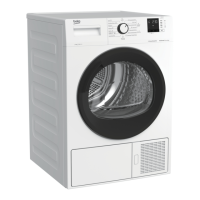
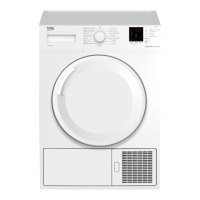
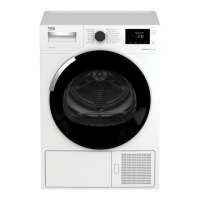
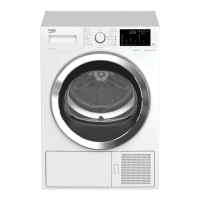
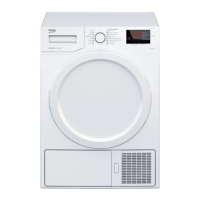
This document describes the Beko DS 8133 G dryer, a household appliance designed for drying laundry. It is not suitable for commercial use. The dryer is manufactured with high quality and technology, aiming to provide optimal results while adhering to environmentally friendly conditions.
Function Description
The Beko DS 8133 G is a tumble dryer that operates by circulating hot air to remove moisture from laundry. It is equipped with a condenser unit, which collects the accumulated water during the drying cycle into a water tank. This water can either be drained manually after each cycle or automatically via a drain hose. The dryer offers various programs and auxiliary functions to cater to different fabric types and user preferences.
Important Technical Specifications
- Model Code: DS 8133 G
- Capacity (max.): 8 kg (dry laundry weight before washing)
- Dimensions:
- Height (Min. / Max.): 84.6 cm / 86.6 cm (adjustable feet)
- Width: 59.7 cm
- Depth: 58.9 cm
- Net weight: 34 kg (± 4 kg)
- Voltage: See type label
- Rated power input: See type label
- Energy Efficiency Class: B (Scale from A+++ most efficient to D least efficient)
- Annual Energy Consumption: 561 kWh (based on 160 drying cycles of the standard cotton program at full and partial load)
- Type of Control: Automatic
- Condensation Efficiency Class: B (Scale from G least efficient to A most efficient)
- Average Condensation Efficiency (standard cotton program):
- Full load: 85%
- Partial load: 85%
- Weighted Condensation Efficiency (standard cotton program at full and partial load): 85%
- Sound Power Level (standard cotton program at full load): 66 dB(A) re 1 pW
- Standard Cotton Programme: This is the standard drying program for normal wet cotton laundry, considered the most efficient in terms of energy consumption.
- Programme time at full load: 142 minutes
- Programme time at partial load: 80 minutes
- Weighted programme time at full and partial load: 107 minutes
- Energy consumption at full load: 4.75 kWh
- Energy consumption at partial load: 2.53 kWh
- Power consumption (off-mode): 0.5 W
- Power consumption (left-on mode): 1.0 W
- Duration of left-on mode: 30 minutes
Usage Features
The dryer is operated via a control panel featuring a program selection knob, remaining duration indicator, On/Off button, Start/Pause button, End duration button, and Sound warning button.
Main Programs:
- Cottons: For durable cotton laundry, dried at normal temperature. Includes "Extra dry," "Cupboard dry," and "Iron dry" options.
- Synthetics: For less durable synthetic laundry, dried at normal temperature. Includes "Cupboard dry" and "Iron dry" options.
Extra Programs:
- Jeans: For jeans that are spun at high speeds.
- Sport: For synthetic, cotton, or mixed fabric sportswear.
- Shirts 15': For delicate shirts, minimizing wrinkles for easier ironing.
- BabyProtect: For baby clothes, if drying is permitted on the label.
- Delicates: For delicate items or hand-washable laundry at low temperatures. It is recommended to use a laundry bag to prevent wrinkles and damage.
- Freshen Up: A 10-minute ventilation program without hot air, used to remove odors from cotton and linen clothes.
- Timed programs: Allows selection of 10, 20, 40, or 60-minute drying durations at low temperatures, regardless of the drying level.
Auxiliary Functions:
- Sound warning cancel: Disables sound notifications upon program completion.
- End duration: Delays the program end by up to 24 hours. Laundry can be added or removed during the countdown.
- Child Lock: Prevents children from tampering with the dryer by deactivating all buttons except On/Off. Activated by pressing "Sound Notification" and "End Duration" buttons simultaneously for 3 seconds.
Warning Symbols:
- Fiber filter cleaning: Indicates the lint filter needs cleaning after a program.
- Water tank: Indicates the water tank needs emptying. If it fills during a program, the dryer goes into stand-by.
- Loading door open: Blinks when the loading door is open.
Loading and Operation:
- Laundry should be sorted by fabric type and thickness.
- Zippers, hooks, buckles, and buttons should be fastened.
- Items with metal accessories should be turned inside out.
- Do not overload the dryer; refer to the "Programme selection and consumption table" for correct load capacities.
- Never stop the dryer before the program completes. If necessary, remove laundry quickly and lay it out to dissipate heat.
- Ensure adequate ventilation in the room to prevent gas accumulation.
Maintenance Features
Regular maintenance is crucial for extending the product's life and reducing common problems.
Lint Filter / Loading Door Inner Surface Cleaning:
- Frequency: After each drying cycle.
- Procedure:
- Open the loading door.
- Remove the lint filter by pulling it up and opening it.
- Clean lint, fiber, and cotton raveling by hand or with a soft cloth.
- Close the filter and place it back.
- The lint filter housing can be cleaned with a vacuum cleaner.
- The entire inner surface of the loading door and gasket should be cleaned with a soft damp cloth.
- Deep Cleaning: If a layer builds up on the filter pores, wash the lint filter with warm water to remove it, then dry completely before reinstalling.
Sensor Cleaning:
- Frequency: Four times a year.
- Procedure:
- Open the loading door.
- Allow the machine to cool down if hot.
- Wipe the metal surfaces of the dampness sensors with a soft cloth dampened with vinegar, then dry.
- Caution: Do not use metal tools or solvents/cleaning agents due to fire/explosion risk.
Water Tank Draining:
- Frequency: After each drying cycle.
- Procedure:
- Pull out the drawer and carefully remove the water tank.
- Drain the water.
- If lint accumulates in the funnel, clean it under running water.
- Place the water tank back into its seat.
- Note: Condensed water is not drinkable. If direct drain connection is used, manual draining is not needed.
Condenser Cleaning:
- Frequency: After every 30 drying cycles or once a month.
- Procedure:
- If a drying process has occurred, open the door and wait for the machine to cool.
- Unlock the two condenser locks after opening the kick plate.
- Pull out the condenser.
- Clean the condenser under pressurized water (e.g., shower armature) until water drains clear.
- Place the condenser back, ensuring locks are fastened securely.
- Close the kick plate cover.
Troubleshooting:
The manual provides a comprehensive troubleshooting section for common issues like prolonged drying time, wet laundry, failure to start, program interruptions, laundry shrinkage, and warning light indicators. It advises users to consult the dealer or Authorized Service Agent if problems persist, and never attempt repairs themselves.

 Need help?

 To Next Page
 General