Need help?
Do you have a question about the Beko MN13790PX and is the answer not in the manual?
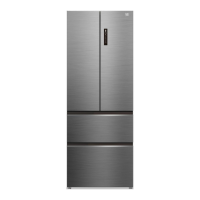
This document provides operating instructions for a Beko Multi-Door Household Refrigerator, model MN13790PX. It covers safety information, product features, handling and placement guidelines, operation notes, food storage recommendations, ice-making instructions, accessory disassembly and assembly, maintenance, and troubleshooting.
The refrigerator is designed for household use and features a computer-controlled intelligent temperature system with air cooling and frost-free operation. It utilizes environmentally friendly R600a refrigerant and materials without CFCs, with 80% of its main components being recyclable. The design includes transparent drawers for easy visibility of contents, height-adjustable tempered glass shelves that are wear-proof, heat-proof, and practical, and a concealed condenser for a flat back design that is easy to clean and maximizes space utility. The appliance is equipped with an efficient, quiet international brand compressor and special case foaming technology, resulting in low noise and energy consumption, making it suitable for family use.
The manual emphasizes several warnings to ensure safe operation. It states that ventilation openings must remain clear and advises against using mechanical devices or other means to accelerate defrosting, except those recommended by the manufacturer. Users are warned not to damage the refrigerant circuit or use electrical appliances inside food storage compartments unless they are of the recommended type. Storing explosive substances like aerosol cans with flammable propellants is prohibited. Liquid beverages or food in glass containers should not be placed in the freezing chamber to prevent cracking. After a power outage, the refrigerator should not be powered on again for at least 5 minutes to protect the compressor. In case of any live part, abnormal noise, smell, smoke, or other abnormality, the appliance should be powered off immediately, and the after-sales service department contacted. Users should avoid placing hands or fingers under the refrigerator, especially at the rear bottom, due to sharp parts. Children must not play or climb on the refrigerator and should be supervised by parents. The door handle should always be used to open or close the door to prevent finger jamming. The appliance is designed to operate within specific ambient temperature ranges depending on its climate type (SN, N, ST, T).
The appliance requires a power supply uniform with the nameplate specifications and a standard independent 3-hole socket (above 10A, reliably grounded). One socket should not be shared by multiple appliances to prevent overheating and fire. The power cord should never be pulled by hand; instead, the power connector should be held to unplug it. Wet hands should not touch the power cord or connector to avoid electric shock. The power cord must not be squeezed by the refrigerator or heavy loads, nor should it be bent excessively, as damage can lead to fire or electric shock. If the power cord is damaged, the after-sales service department must be contacted. Flammable, explosive, corrosive acid, or alkaline substances are not allowed inside the refrigerator. The refrigerator is for indoor use only, and placing liquid containers on top is forbidden as spillage could affect electrical insulation, leading to shock or fire. Disassembly or modification without permission is prohibited, and repairs must be performed by a specialist. In case of flammable gas leakage, the valve should be closed, the window opened for ventilation, and the refrigerator connector should not be unplugged immediately to avoid electric sparks. The manual also cautions that refrigerating appliances may not operate consistently in extended periods below their designed cold temperature range, potentially leading to defrosting or warming of frozen food. It reminds users not to exceed food manufacturers' recommended storage times and to take precautions (e.g., wrapping frozen food in newspaper) to prevent temperature rise during defrosting or maintenance. Users are advised on actions to take when the appliance is temporarily or permanently switched off (emptying, cleaning, drying, and propping doors ajar).
When handling the refrigerator, at least two people are required, with one lifting the top rear and the other handling the bottom. The lower runners can damage floors, so care is needed when moving. For long-distance moves, internal accessories should be secured with adhesive tape to prevent damage from crashing. The refrigerator should be placed on a flat, firm surface, and the adjusting legs should be used to level it if the ground is uneven. It should be located in a dry, well-ventilated environment, away from direct sunlight and heat sources. The manual specifies leaving at least 10cm clearance on the sides and 30cm at the top for proper heat dissipation. Insufficient clearance can affect heat dissipation, increase energy consumption, and potentially damage the wall or other items. The foam base should be removed for better bottom heat dissipation and fire prevention. The refrigerator should not be placed in excessively cold environments where it might freeze.
Before first use, all packing materials, especially the foam base, must be removed. The interior and exterior of the refrigerator should be cleaned with a warm, wet cloth (neutral detergent can be added). After leveling and cleaning, the refrigerator should stand for about 5 hours before plugging it in. It should then cool for 2 to 3 hours before storing food. In hot weather, it may take 24 hours for food to fully freeze, and the refrigerating condition should be checked on the second day. Any plastic odor will dissipate after a while. The appliance should be placed in the coolest area of the room, away from heat-producing appliances or heating ducts, and out of direct sunlight. Hot foods should be cooled to room temperature before being placed in the appliance to prevent the compressor from running longer and to avoid food spoilage. Foods should be properly wrapped and containers wiped dry to reduce frost buildup. Storage bins should not be lined with foil, wax paper, or paper toweling, as this interferes with cold air circulation and reduces efficiency. Organizing and labeling food helps reduce door openings and extended searches.
The display panel features indicators for the refrigerator room, freezer room, and temperature display. It includes icons for "Power Cool" (quick cooling), "Power Freeze" (quick freezing), and "ECO" (energy saving) modes. Buttons are provided for "Set/Function" (temperature zone/function selection), "Regulate" (temperature adjustment), and "3"Unlock" (press for 3 seconds to unlock).
Upon initial power-on, the refrigerator defaults to 5°C for the refrigerator compartment and -18°C for the freezer compartment.
The child lock automatically activates after 30 seconds of no key operation, with the child lock icon lighting up and other characters turning off. After 5 minutes, the child lock icon also turns off, and the display enters protection mode. Pressing any key exits screen saver mode. To deactivate the child lock, press and hold "Unlock for 3 seconds."
In the unlocked state, repeatedly press "Set/Function" until the refrigerator temperature zone lights up. Then, press "Regulate" to adjust the temperature. The temperature cycles through "08"-"07"-"06"-"05"-"04"-"03"-"02"-"OF"-"08". Select the desired temperature and wait 5 seconds for it to be confirmed. "OF" indicates the product is turned off, with no cooling.
In the unlocked state, repeatedly press "Set/Function" until the freezer temperature zone lights up. Then, press "Regulate" to adjust the temperature. The temperature cycles through "-15"-"-16"-"-17"-"-18"-"-19"-"-20"-"-21"-"-22"-"-23"-"-24"-"-15". Select the desired temperature and wait 5 seconds for it to be confirmed.
In the unlocked state, repeatedly press "Set/Function" until the "quick cooling" icon flashes. Stop button operation and wait 5 seconds to activate quick cooling. The same action exits the function. Quick cooling automatically exits after 2 hours. While active, the refrigerator compartment displays 2°C. Other function settings or opening the refrigerator door for more than 3 minutes can automatically exit quick cooling.
In the unlocked state, repeatedly press "Set/Function" until the "Quick Freeze" icon flashes. Stop button operation and wait 5 seconds to activate quick freeze. The same action exits the function. Quick freeze automatically exits after 4 hours. While active, the freezer displays -32°C. Other function settings or opening the freezer door for more than 3 minutes can automatically exit quick freeze.
In the unlocked state, repeatedly press "Set/Function" until the "energy saving" icon flashes. Stop button operation and wait 5 seconds to activate energy saving. The same action exits the function. After 10 seconds of activation, the display's remaining characters automatically extinguish, and the refrigerator enters a low energy consumption state.
The refrigerator retains its working state at the time of a power cut and resumes that state upon power restoration.
If the refrigerator or freezer door is not properly closed or remains open for over 1 minute, a buzzer will sound. Pressing any key stops the alarm temporarily, but it will sound again after 1 minute if the door remains open. Closing the door stops the alarm.
If the freezer temperature exceeds -12°C, the corresponding temperature area lights up, and the digital area flashes. Pressing any key displays the freezer temperature; pressing again or waiting 10 seconds restores the normal display.
The refrigerator enters display protection mode after 30 seconds of no key operation, and the keypad locks automatically. Pressing any key exits this mode.
Any replacement or maintenance of LED lamps must be performed by the manufacturer, its service agent, or a similarly qualified person.
Regular maintenance is recommended.
The manual provides a guide for common issues and their remedies, distinguishing between actual failures requiring attention and non-failures that are normal operational phenomena.
 General
| Model Number | MN13790PX |
|---|---|
| Freezer position | Top |
| Freezing capacity | 4 kg/24h |
| Energy efficiency class | F |
| Number of Shelves | 4 |
| Color | Inox |
| Type | Refrigerator |
| Noise level | 39 dB |
| Width | 60 cm |
| Height | 185 cm |
| Total Capacity | 302 l |
| Defrosting Type | Manual |

 To Next Page