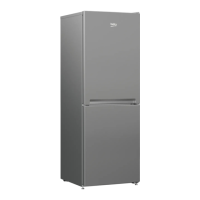
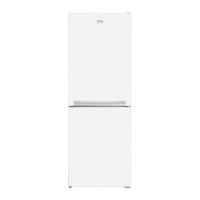
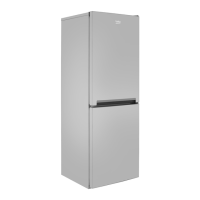
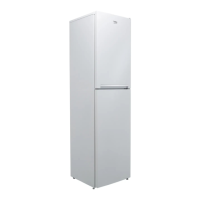
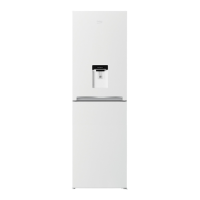
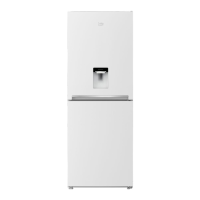
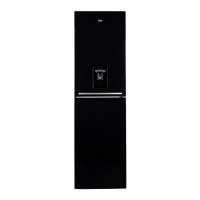
This document is a user manual for a Beko refrigerator, covering models CFG4552W, CFG4552S, CFG4552B, and CCFM4552W. It provides essential information for safe operation, installation, usage, and maintenance of the appliance.
Function Description
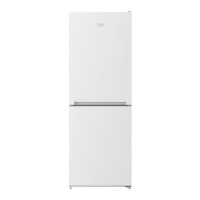
The Beko refrigerator is designed for storing and freezing edible foodstuffs. It features a fridge compartment and a freezer compartment. The cooling system utilizes non-CFC/HFC natural substances (R600a) and cyclopentane in the insulation, making it environmentally friendly. The appliance is designed to function in ambient temperatures up to 43°C (90°F). It incorporates Freezer Guard technology, which prevents frozen food in the freezer from thawing even if the ambient temperature falls to -15°C. However, at temperatures below 0°C, food in the fridge compartment may freeze, so controlled consumption of fridge items is advised in such conditions.
The refrigerator includes a temperature setting knob for regulating the interior temperature. The fridge compartment defrosts automatically, with defrost water collecting in a channel at the back and draining through a tube. The freezer compartment is frost-free, eliminating the need for manual defrosting. The appliance is equipped with a lighting source to assist users in placing foodstuffs.
Usage Features
- Temperature Control: The refrigerator's internal temperature is regulated by a thermostat with settings from 1 (warmest) to 5 (coldest). The average fridge temperature should be around +5°C. Users can adjust the thermostat based on desired temperature, ambient temperature (higher than 25°C requires maximum setting, lower than 25°C requires minimum setting), and frequency of door openings.
- Food Storage: The appliance is intended for storing and freezing edible food. It is recommended to place chilled/frozen food into the appliance as quickly as possible after purchase, especially in summer, using a cool bag if necessary. Defrosting frozen food in the fridge compartment can help cool the fridge.
- Energy Saving Tips:
- Ensure the appliance is installed in a well-ventilated area.
- Minimize the time between purchasing chilled/frozen food and placing it in the appliance.
- Do not leave the door(s) open longer than necessary and ensure they are properly closed.
- Defrost frozen food in the fridge compartment to utilize its cooling effect.
- For maximum loading capacity and energy efficiency, the freezer compartment should be loaded without using top shelf lids and with only the bottom drawer in place.
- Initial Operation: When operating the cooler/freezer for the first time, it should be run empty for the initial six hours, and the door should not be opened frequently.
- Door Reversal: The user manual provides detailed instructions for reversing the doors, which can be helpful for installation in different kitchen layouts. A QR code is provided to watch a video demonstrating the process.
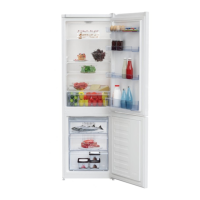
- Internal Components: The refrigerator includes cabinet shelves, a defrost water collection channel with a drain tube, a salad crisper, frozen food storage drawers, adjustable feet, door shelves, an egg tray, a bottle shelf, and a fan. The baskets/drawers in the chill compartment should always be in use for low energy consumption and better storage. Food contact with the temperature sensor in the freezer compartment should be avoided to prevent increased energy consumption.
Maintenance Features
- Cleaning:
- Always unplug the appliance before cleaning.
- Do not use gasoline, benzene, sharp abrasive instruments, soap, household cleaner, detergent, or wax polish for cleaning.
- For non-No Frost products, do not clean water drops or frost on the rear wall of the fridge compartment; do not apply oil or similar agents.
- Use a slightly damp microfiber cloth for outer surfaces to avoid scratching.
- Clean the cabinet interior with lukewarm water and wipe dry. A solution of one teaspoon of bicarbonate of soda to one pint of water can be used for interior cleaning.
- Ensure no water enters the lamp housing or other electrical items.
- Regularly check door seals for cleanliness and absence of food particles.
- To remove door racks, empty them and push them upwards from the base.
- Avoid cleaning outer surfaces and chromium-coated parts with chlorine-containing agents, as chlorine causes corrosion.
- Do not use sharp, abrasive tools, soap, household cleaning agents, detergents, kerosene, fuel oil, or varnish on plastic parts to prevent damage to prints. Use lukewarm water and a soft cloth.
- Defrosting (Fridge Compartment): The fridge compartment defrosts automatically. If defrost water does not drain, check for food particles blocking the drain tube and clear it using the provided plastic plunger. If the frost layer reaches about 7mm (1/4 inch), reduce the thermostat setting (e.g., from 4 to 1) to restart automatic defrosting.
- Long-Term Storage: If the refrigerator will not be used for a long period, unplug it, remove all food, clean it, and leave the door ajar.
- Plastic Surface Protection: Avoid placing liquid oils or oil-cooked meals in unsealed containers in the refrigerator, as they can damage plastic surfaces. If spills occur, clean and rinse the affected area immediately with warm water.
- Illumination Lamp Replacement: To change the bulb/LED, contact an Authorized Service agent. The lamps are specifically designed for appliance illumination and are not suitable for household room illumination, being able to withstand temperatures below -20°C.
- Troubleshooting: The manual includes a troubleshooting guide to address common issues not related to faulty workmanship, such as the refrigerator not working, condensation, increased operating noise, or the refrigerator running too often/long. It advises checking power connections, thermostat settings, door closure, and ambient conditions before contacting service.
- Self-Repair: The manual specifies that some simple failures, such as replacing door handles, door hinges, trays, baskets, and door gaskets, can be handled by the end-user following instructions in the manual or on support.beko.com. For safety, the product should be unplugged before attempting any self-repair. Repairs for other components, such as the compressor or cooling circuit, must be addressed by authorized professional repairers. Unauthorized repairs will void the warranty and may pose safety risks.


 To Next Page
 General
 Weight and Dimensions