It is important to become familiar with the use of hand brakes. When properly adjusted, hand brakes are an efficient
braking system. Keep the rim and brake shoes clean and free from wax, lubricants and dirt at all times. Keep brakes
properly adjusted and in good working condition at all times.
Check your Brakes
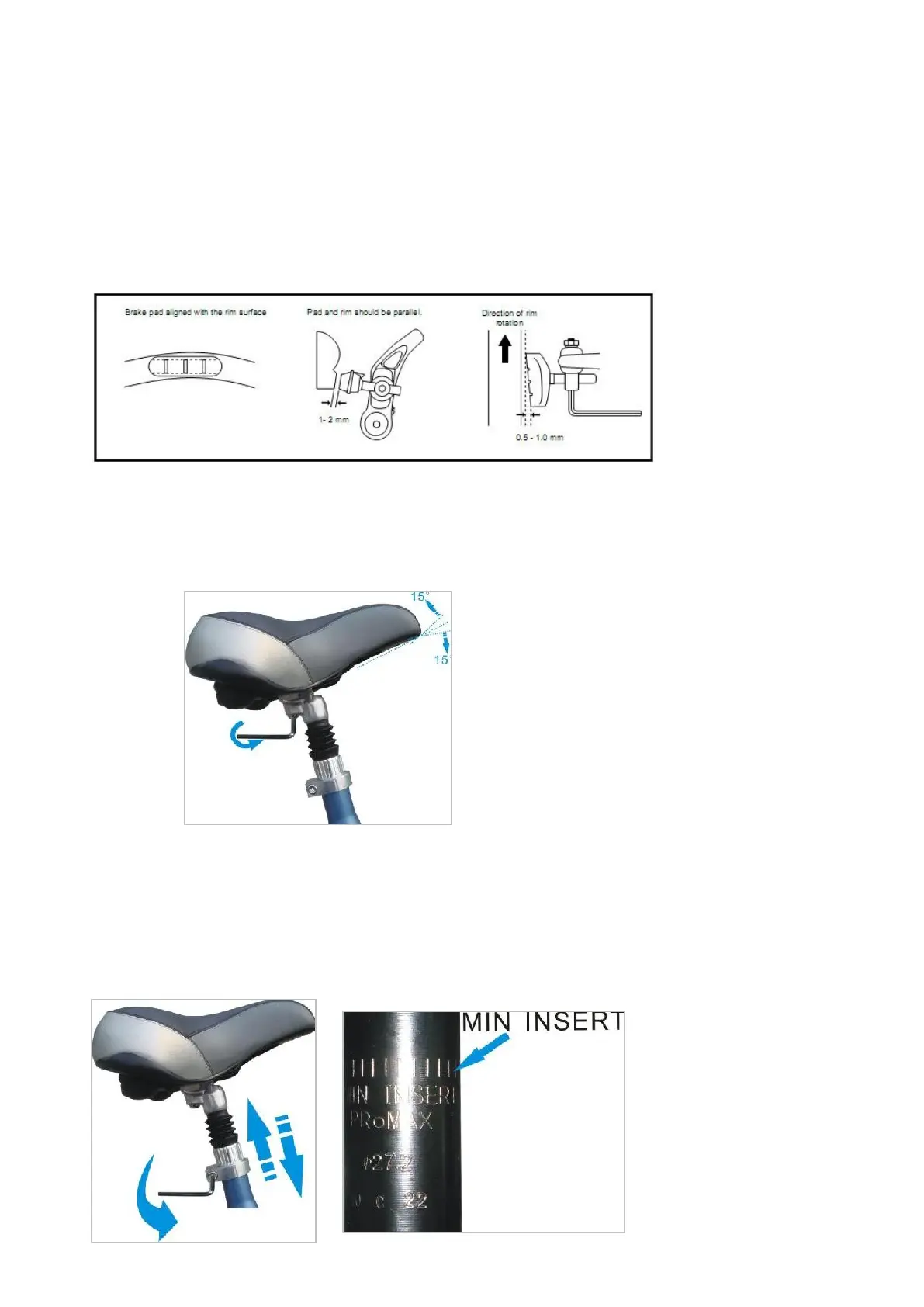
Press each brake lever to make sure that there is no binding and that the brake pads press hard enough on the rims to
stop the bike. The brake pads should be adjusted so they are 1 mm to 2 mm away from the rim when the brakes are
not applied. Brake pads should be centered on the rim and “toed-in” so the rear portion of each brake pad is about
0.5 - 1.0 mm farther from the rim than the front portion of the brake pad.
Ⅰ-5. Cushion Adjustment
1. Loosen the lock bolt to adjust cushion angle with a 5mm internal hexagonal wrench as shown in the figure. Range of
adjustment is -15°~15°.
Note: it is commonly better to adjust the cushion horizontally to the ground line.
2. As shown in Figure 1, loosen the lock bolt with a 5mm internal hexagonal wrench to adjust cushion height to a proper
position. If a quick-release seat post clamp is used, pull the quick-release lever only.
Hint: What is proper height? Heel can be freely put on pedal with leg straight. When cycling pedal action is done, knees can
be slighted bent (show in Figure 3). Feet can touch the ground without standing.
Note: When adjusting seat post upwards, safety line cannot be exceeded. Safety line (11111111) should be in the frame
tube (as Figure 2).
T
ightening torque of seat post clamp should not be less than 18N.m


 To Next Page
 Loading...