ENcrnB LunnrcerroN
Svsrnu.
43
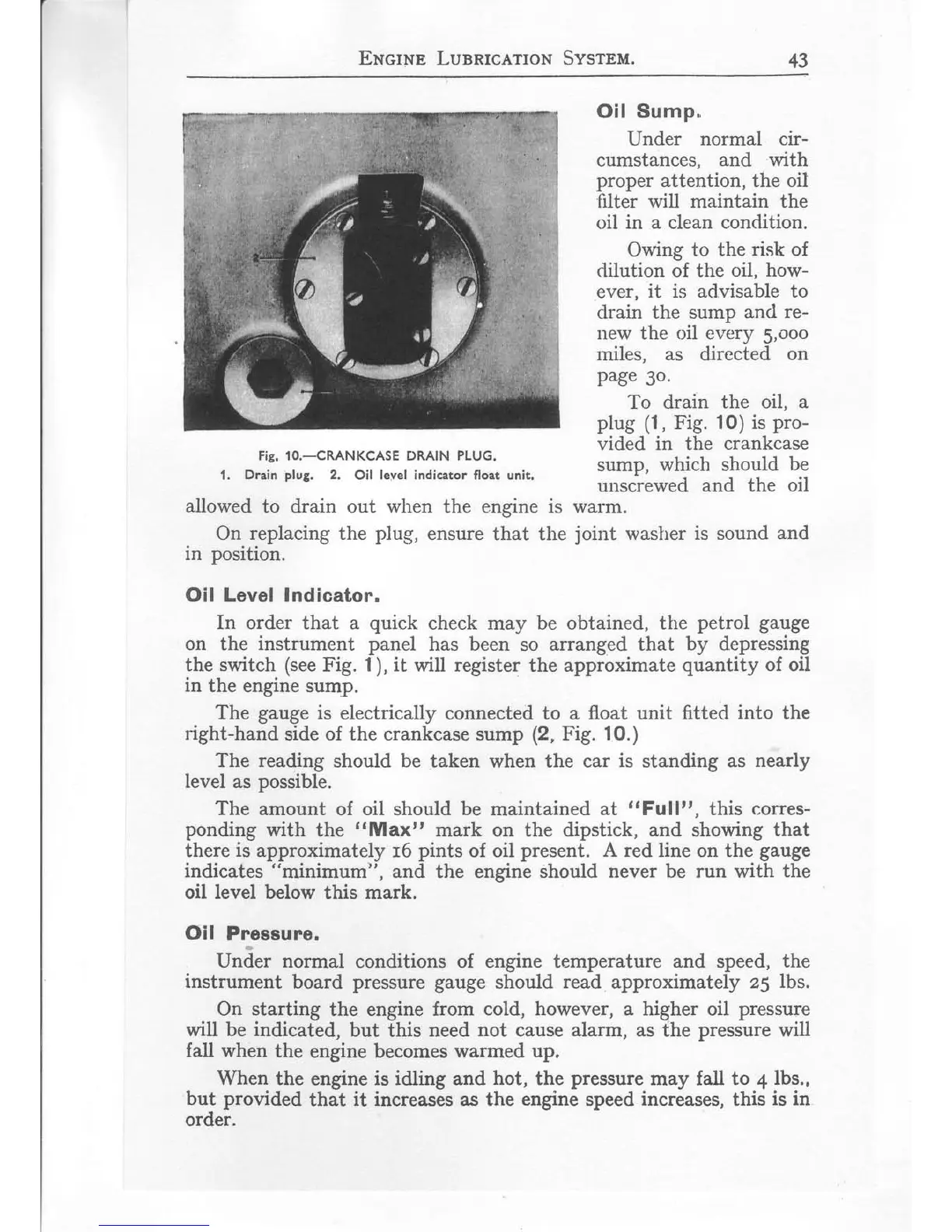
Fie. I0.-CRANKCASE DRAIN PLUG.
f.
Drain
plug.
2.
Oil
leyel
indicator float unit.
Oil $ump,
Under
normal cir-
cumstances,
and with
proper
attention, the oil
filter will maintain
the
oil in a clean
con<lition.
Owing
to the
risk of
clilution
of the
oil,
how-
ever,
it
is
advisable to
drain
the surnp
and re-
uew the
oil every
S,ooo
rniles, as directed
on
page
30.
To
drain
the oil, a
plug (1
,
Fig.
1O) is
pro-
vided in the
crankcase
surnp,
which should
be
unscrewed
and the oil
allowed
to drain out when the engine is
warm.
On
replacing
the
plug,
ensure that the
joint
washer
is sound
and
in
position.
Oil Level lndicator.
In order
that
a quick
check
may
be obtained, the
petrol gauge
on the
instrument
panel
has been
so
arranged that
by
depressing
the switch
(see
Fig.
1), it
will register
the
approximate
quantity of oil
in
the engine suqp.
The
gauge
is
electrically
connected to
a float unit
fitted
into
the
right-hand
side
of
the
crankcase
sump
(2,
Fig.
10.)
The
reading
should be
taken when the
car
is
standing
as
nearly
level
as
possible.
The amount of oil should be
maintained
at
rtFullt',
this
corres-
ponding
with the
r'Maxtt
mark on
the
dipstick, and showing
that
there
is
approximately
16
pints
of oil
present. A red
line on the
gauge
indicates "minimum",
and
the engine should
never be run with
the
oil level below
this mark.
Oil
Pressure,
Unier normal
conditions of engine temperature and speed,
the
instrument
board
pressure gauge
should
read
approximately zg
lbs.
On
starting
the engine
from
cold, however, a higher oil
pressure
will be indicated,
but
this need
not
cause alarm, as the
pressure
will
fall
when
the
engine
becomes warmed up.
When
the engine
is idling
and
hot, the
pressure
may
fall
to
4
lbs.,
but
provided
that
it increases as the
engine
speed
increases,
this
is in
order.


 To Next Page
 Loading...