Inches and Eighths to Decimals of a Foot
Examples: From Table: 2 feet, 7-1/8 inches = 2.59 feet.
From Table: 8.38 feet = 8 feet, 4-1/2 inches.
6.3 To Measure a Difference in Elevation From One Set-up
To find the difference of elevation between two points which can be observed from
one position, set up and level your instrument about midway between these points.
Be sure that a leveling rod held on both opposite points can be read when your
telescope is level. Each point should not be greater than 150 to 200 feet away from
the instrument or you may have difficulty reading the rods. The height of the line of
sight (horizontal crosshair) above or below each of the points is found by reading the rod.
A line of sight 69 inches above A and 40 inches above B is shown above (Fig 6A).
Therefore, B is higher than A by 29 inches.
Berger Instruments • 76 • Berger Instruments
5. PREPARING TELESCOPE FOR USE
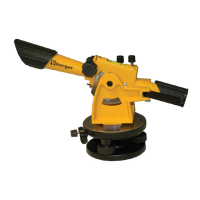
The telescope magnifies the image many times, so the field of view is limited.
Therefore, line up the telescope to your target by sighting along the telescope barrel
much as you would aim a rifle. BE SURE THAT HORIZONTAL CLAMP SCREW HAS BEEN
LOOSENED BEFORE TRYING TO ROTATE THE INSTRUMENT.
With the object in the field of view, gently tighten any loosened clamps. If the
distant object appears indistinct, just rotate the focusing knob located on the top of
the telescope until the object appears sharp.
If the telescope bubble is level, the horizontal crosshair will indicate a horizontal or
level line of sight. Thus all objects in line with the horizontal crosshair are at the same
elevation as the telescope. With a transit-level, if the telescope clamp (alongside the
telescope) is loosened and the leveling latch opened, pointing the telescope up and
down will indicate a vertical line. This action is used in “plumbing” flagpoles, columns, etc.
You will probably want to practice by repeating the steps described so that you will
know the location of the various clamps and screws and be able to handle your
instrument automatically.
6. LEVELING & DIFFERENCE OF ELEVATION
Much of your work will probably be concerned with relative heights of objects - the
top of a foundation to be truly level or a sewer pipe to have a uniform pitch.
Your instrument, properly leveled, will enable you to
determine and maintain a level line.
You will need a graduated rod which can be held in a
vertical position. The 8 foot architects rod supplied in
the outfit should provide a good length for most jobs
and be easy to read.
6.1 Leveling Rods
Two types of level rods are available: architects'
(graduated in feet, inches, and eighths of an inch), and
engineers' (graduated in feet, tenths, and hundredths
of a foot). Either type is available in 8 foot, 13 foot, or
16 foot lengths.
6.2. Inches and Decimal Portions of a Foot
Leveling and measurements of distances are often carried out in decimal portions of
a foot (hundredths), whereas building plans are usually given to carpenters and
masons in feet, inches, and fractions of an inch. To convert dimensions, remember
that 8 hundredths of an inch (0.08 ft.) is equal, very nearly, to one inch. Also, 1/8 inch
is very nearly equal to one hundredth of a foot (0.01 ft.). The table (Fig. 5), “Inches
and Eighths to Decimals of a Foot”, converts one system to the other.
Fig. 4
Fig. 5
Fig. 6
B 29” higher than A
D 12’3”7/8 higher than C
In. 0 1/8 1/4 3/8 1/2 5/8 3/4 7/8
0 .00 .01 .02 .03 .04 .05 .06 .07
1 .08 .09 .10 .11 .12 .14 .15 .16
2 .17 .18 .19 .20 .21 .22 .23 .24
3 .25 .26 .27 .28 .29 .30 .31 .32
4 .33 .34 .35 .36 .38 .39 .40 .41
5 .42 .43 .44 .45 .46 .47 .48 .49
6 .50 .51 .52 .53 .54 .55 .56 .57
7 .58 .59 .60 .61 .62 .63 .64 .65
8 .67 .68 .69 .70 .71 .72 .73 .74
9 .75 .76 .77 .78 .79 .80 .81 .82
10 .83 .84 .85 86 .88 .89 .90 .91
11 .92 .93 .94 .95 .96 .97 .98 .99


 To Next Page
 Loading...