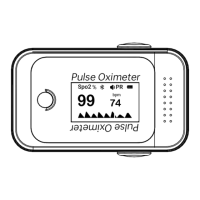
The Berry Fingertip Pulse Oximeter, model BM1000, is a small, compact, simple, reliable, and durable physiological monitoring device designed for intermittent checks of oxygen saturation (SpO2) and pulse rate in adults within clinical environments, outpatient departments, sickrooms, recovery, and healthcare organizations, as well as community medical treatment centers. It is not intended for continuous monitoring or for use on injured skin tissue.
Function Description
The pulse oximeter operates on the principle of Photoelectric Oxyhemoglobin Inspection Technology, measuring arterial oxygen saturation via oximetry. It uses two beams of different wavelengths of light (666nm visible red light and 905nm near-infrared light) focused on the human nail tip via emitters. A photosensitive element obtains a measured signal, and the amount of light absorbed relates to the amount of oxygen in the blood during pulses. A microprocessor calculates the ratio of the two absorbed spectrums and compares the results with saturation values in memory to determine blood oxygen saturation.
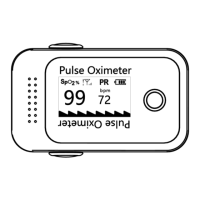
The device features an OLED display that shows SpO2 percentage, pulse rate (bpm), a plethysmogram wave, network indicator, and battery status. It is powered by two AAA alkaline batteries.
Usage Features
- Battery Installation: To install batteries, push the white button on the back cover and slide it off. Insert two AAA batteries, matching the plus (+) and minus (-) signs to avoid damage. Slide the cover back on. Remove batteries if the device will not be used for extended periods. Replace batteries when the power indicator flickers.
- Measurement: Press the Power/Function button to turn on the device. Place one finger into the rubber hole of the oximeter, ensuring the finger is thoroughly plugged in with the nail upward. The LED part of the sensor should be closer to the wrist, and the fingernail should be opposite the light emitter. Remain motionless during the reading. The SpO2 and Pulse Rate values will be displayed on the OLED screen once stable.
- Display Orientation: Press the Power/Function button to rotate the display orientation.
- IMEI and SIM Card Number: Press and hold the Power/Function button for more than 3 seconds to display the IMEI and SIM card number. Press again to exit.
- Invalid Value Display: If no finger is inserted, the display will show "-----".
- Automatic Shut-off: The device automatically shuts down after 10 seconds of no finger insertion or after data upload is complete.
- Data Upload: When measurement is finished and a network is available, data upload starts automatically, indicating "Success" or "Failed." Failed uploads are saved and re-uploaded later.
- Lanyard Use: Thread the thinner end of the lanyard through the hanging hole, then thread the thicker end through the threaded end and pull tightly.
- Users must be adequately trained before use.
- The oximeter is for assessing physiological conditions in conjunction with clinical symptoms, not for treatment.
- Ensure patient safety when used with electrical surgery equipment.
- EXPLOSION HAZARD: Do not use in the presence of flammable anesthetics, explosive substances, vapors, or liquids.
- Forbidden in MRI or CT scanning due to potential burning from induced current.
- No alarm function; not suitable for continuous monitoring.
- No modifications allowed; maintenance by manufacturer-approved personnel only.
- Shut off power before cleaning. Prohibited high-pressure/high-temperature disinfection. Use only recommended cleaning agents/disinfectants.
- Not waterproof; keep dry and prevent liquid infiltration.
- Fragile; avoid pressure, jostling, strong vibrations, or mechanical damage. Store appropriately when not in use.
- Dispose of the oximeter and accessories according to local regulations or hospital policy.
- Use AAA alkaline batteries; do not use carbon or poor-quality batteries. Remove batteries during long periods of non-use.
- A functional tester cannot assess accuracy.
- Patients operating the device should read the manual or consult a doctor. Discontinue use and seek medical attention if discomfort occurs.
- Discharge static electricity before use to prevent damage.
- Keep away from radio receivers during use.
- Use the specified configuration to avoid enhanced electromagnetic radiation or reduced anti-electromagnetic interference.
- Avoid close proximity or stacking with other devices unless verified to operate normally.
- Ensure the tested surface (finger) is clean and free of wounds.
- Federal law restricts sale by order of a physician.
- Check for damage before use; do not use if damaged.
- Do not place on extremities with arterial catheters or venous syringes.
- Do not perform SpO2 and NIBP measurements on the same arm simultaneously; NIBP measurements can affect SpO2 readings.
- Do not use for patients with pulse rates below 30bpm, as this may lead to incorrect results.
- Ensure the sensor's test window is fully covered by the measuring instrument. Clean and dry the measurement part before storage.
- Cover the sensor with opaque material under strong light to prevent inaccurate measurements.
- Ensure the tested finger has no contamination or scarring.
- Disinfection is recommended between patients to prevent cross-contamination.
- Incorrect sensor placement can affect accuracy. Hold the device parallel to the heart for best measurements.
- Do not use if the temperature exceeds 41°C.
- Change sensor location and check skin integrity and circulatory status at least every 2 hours.
Factors Affecting Measurement Accuracy
- Measurements depend on the absorption of specific wavelength rays by oxidized hemoglobin and deoxyhemoglobin. Non-functional hemoglobin concentration can affect accuracy.
- Shock, anemia, hypothermia, and vasoconstrictive drugs can decrease arterial blood flow to unmeasurable levels.
- Pigments or deep colors (e.g., nail polish, artificial nails, dyes, pigmented cream) can cause inaccurate measurements.
Maintenance Features
- Cleaning: Clean the product with cotton or a soft cloth moistened with water. Wipe dry with a soft cloth and allow to air dry.
- Disinfection: Recommended disinfectants include 70% ethanol, 70% isopropanol, and 2% glutaraldehyde solution. Clean the product as described above, then disinfect with a cotton or soft cloth moistened with one of the recommended disinfectants. Wipe off residual disinfectant with a water-moistened soft cloth and allow to air dry.
- Do not immerse the oximeter or accessories in water or disinfectant.
- Disinfect only when necessary to avoid long-term damage.
- Do not use unrecommended cleaning agents/disinfectants.
- Do not disinfect via high-pressure or high-temperature methods.
- Always shut off power and remove batteries before cleaning and disinfecting.
Important Technical Specifications
- Display Mode: OLED
- SpO2:
- Measurement range: 0~100%
- Accuracy: ±3% (70%~100%)
- Pulse Rate:
- Measurement range: 25~250bpm
- Accuracy: ±2bpm
- Pulse Rate accuracy verified against SpO2 simulator.
- Low Perfusion:
- Range: 0.5%~20%
- SpO2 Accuracy: ±3% (70%~100%)
- PR Accuracy: 25~250bpm ±2bpm
- Electrical Specifications:
- Working Voltage: D.C.2.2V~D.C.3.4V
- Battery Type: Two 1.5V AAA alkaline batteries
- Battery Life: Over 500 measurements and uploads under normal conditions.
- Product Specifications:
- Size: 58 (H) × 34 (W) × 30(D) mm
- Weight: 50g (includes two AAA batteries)
- Environment Requirements:
- Temperature:
- Operation: +5~+40°C
- Transport and Storage: -10~+50°C
- Humidity:
- Operation: 15%~80% (noncondensing)
- Transport and Storage: 10%~90% (noncondensing)
- Atmospheric Pressure:
- Operation: 860hPa~1060hPa
- Transport and Storage: 700hPa~1060hPa
- LED Wavelength: 660nm/905nm
- Output Power: <0.1mW
- SpO2 ARMS Specification:
- 70% - 80%: 1.65
- 80% - 90%: 1.22
- 90% - 100%: 1.11
- Expected Service Life: 3 years
The device is classified as Type BF APPLIED PART and does not contain an alarm function. It should be sent to a separate collection facility for recovery and recycling when discarded.


 To Next Page
 General