
 Need help?
Do you have a question about the Bestcare PL350CT and is the answer not in the manual?
Unpack the folded patient lift from its shipping box.
Attach the lift's stand base to the main mast using screws and nuts.
Remove the pin that locks the mast in its folded position.
Raise the patient lift's mast from its folded position to the upright stance.
Secure the mast in its upright position using the designated pin.
Detach the pin that secures the lift's boom.
Take out the pin connecting the lower actuator to the mast.
Connect the lower end of the actuator assembly to the mast.
Attach the upper end of the actuator to the lift's boom.
Insert and secure the spreader bar onto the boom.
Follow a separate guide to connect the TiMotion Electronics controller.
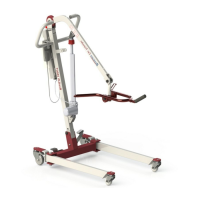
The device depicted is a patient lift, specifically the PL350CT model, designed to assist in the safe and efficient transfer of individuals with limited mobility. Its primary function is to provide a secure and stable means of lifting and moving patients, reducing the physical strain on caregivers and enhancing patient safety during transfers. This type of lift is commonly used in various care settings, including hospitals, nursing homes, and private residences, to facilitate tasks such as moving a patient from a bed to a wheelchair, from a wheelchair to a toilet, or for repositioning within a bed.
The patient lift operates as a mechanical aid, leveraging a robust frame and an actuator system to perform lifting operations. The core components include a sturdy base with wheels for mobility, a vertical mast, an adjustable boom, and a spreader bar. The lifting mechanism is powered by an actuator, which extends and retracts to raise and lower the boom. The spreader bar, attached to the boom, is where slings are connected to cradle the patient.
The device is designed for ease of assembly and configuration for first use, as detailed in the provided instructions. The initial setup involves securing the stand to the mast, which forms the foundational upright structure of the lift. This connection is made using a screw and nut system, tightened with specialized EZ-Tools to ensure stability. Once the mast is securely attached to the base, it is lifted into an upright position and locked into place with a quick-release pin, ensuring the mast remains vertical during operation.
The boom, which extends horizontally from the top of the mast, is then prepared. The instructions indicate the removal of a securing pin for the boom and a lower actuator pin on the mast, suggesting a pre-assembly or packaging configuration that needs to be adjusted for operational readiness. The actuator, the electromechanical component responsible for the lifting action, is then installed. Its lower end is attached to the mast using a pin and a retaining ring, ensuring a secure pivot point. The upper end of the actuator is subsequently connected to the boom, again using a quick-release pin, thereby establishing the complete lifting linkage.
Finally, the spreader bar, which is the interface for patient slings, is inserted into a tube on the boom. This connection is critical for patient safety, requiring precise alignment of holes and securing with a pin and retainer ring. This multi-step assembly process ensures that each component is correctly positioned and secured, forming a cohesive and safe patient lifting system.
The PL350CT patient lift is engineered with several features to enhance its usability and safety during patient transfers. Its mobile base, equipped with wheels, allows for easy maneuverability across various floor surfaces, enabling caregivers to position the lift precisely where needed. The ability to move the lift effortlessly is crucial for efficient patient care, as it minimizes the need for manual repositioning of the patient or the lift itself.
The adjustable boom is a key operational feature, allowing for variations in lifting height and reach. This adjustability accommodates different patient sizes, bed heights, and transfer scenarios, providing versatility in its application. The actuator-driven lifting mechanism ensures a smooth and controlled ascent and descent, which is vital for patient comfort and to prevent sudden movements that could cause distress or injury. The use of quick-release pins for securing various components, such as the mast and the upper end of the actuator, suggests a design focused on quick and tool-free adjustments or disassembly for storage or transport.
The spreader bar, designed to connect with various types of patient slings, offers flexibility in accommodating different patient needs and body types. The secure attachment of the spreader bar with a pin and retainer ring emphasizes the importance of safety in its design, ensuring that the sling remains firmly in place during a lift.
The overall design, with its clear assembly steps and emphasis on secure connections, indicates a user-friendly approach for caregivers. The mention of "EZ-Tools" for tightening screws suggests that the necessary tools for initial setup are either provided or that the design facilitates easy tightening, further simplifying the configuration process. The final step, referring to a "Quick Setup Guide to TiMotion Electronics" for controller installation, highlights the integration of an electronic control system, which typically provides intuitive buttons or a joystick for operating the lift, allowing for precise control over the lifting and lowering functions. This electronic control system is a standard feature in modern patient lifts, offering enhanced control and ease of operation compared to manual or hydraulic systems.
While the provided document primarily focuses on the initial configuration, several aspects of the device's design imply considerations for maintenance and longevity. The robust construction, evident from the detailed assembly of the mast, boom, and base, suggests a durable product built to withstand repeated use in demanding care environments. The use of pins and retaining rings for securing critical components indicates a design that allows for relatively straightforward disassembly for inspection, cleaning, or replacement of parts if necessary.
The electromechanical actuator, while not explicitly detailed in terms of maintenance, typically requires periodic checks for smooth operation, lubrication of moving parts, and inspection of electrical connections. The integration of TiMotion Electronics implies a sophisticated control system that may include diagnostic capabilities, potentially simplifying troubleshooting and maintenance of the electronic components.
The mobile base with wheels, while providing mobility, also necessitates routine inspection of the casters for wear and tear, ensuring they roll freely and lock securely. The structural integrity of the frame, including all bolted and pinned connections, would require regular visual checks to ensure no loosening or damage has occurred over time. The instructions' emphasis on securely tightening screws and inserting pins correctly during initial setup underscores the importance of proper assembly for both immediate safety and long-term structural integrity, which is a foundational aspect of preventative maintenance.
The patient lift's design, with its modular components (mast, boom, actuator, spreader bar), suggests that individual parts could be replaced if they become worn or damaged, rather than requiring the replacement of the entire unit. This modularity is a common maintenance-friendly feature in medical equipment, contributing to cost-effectiveness and extending the lifespan of the device. Regular cleaning of the frame and components, as is standard for medical devices, would also be a key maintenance activity to ensure hygiene and prevent the accumulation of dirt or debris that could impair function. The overall design appears to facilitate access to key components, which is beneficial for routine inspection and maintenance tasks.
 General
| Weight Capacity | 350 kg |
|---|---|
| Lifting Height | 26"-70" |
| Material | Steel |
| Maximum Lifting Capacity | 350 kg |
| Power Supply | 24V rechargeable battery |

 To Next Page