34
WHO classification:
In accordance with the guidelines/definitions of the World
Heath Organization and the latest findings, the measure-
ments can be classified and assessed according to the fol-
lowing table.
However, these standard values serve only as a general guide-
line, as the individual blood pressure varies in dierent people
and dierent age groups etc.
It is important to consult your doctor regularly for advice. Your
doctor will tell you your individual values for normal blood
pressure as well as the value above which your blood pres-
sure is classified as dangerous.
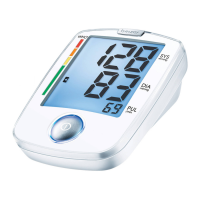
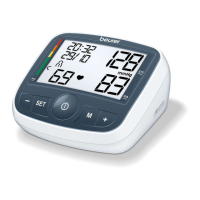
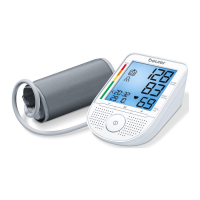
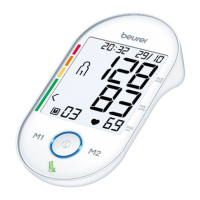
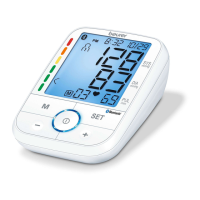
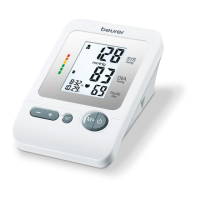
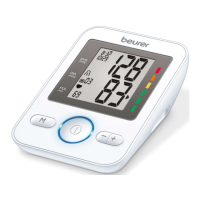
The bar chart on the display and the scale on the unit show
which category the recorded blood pressure values fall into.
If the values of systole and diastole fall into two dierent WHO
categories (e.g. systole in the ‘High normal’ category and dias-
tole in the ‘Normal’ category), the graphical WHO classification
on the unit always shows the higher category; for the example
given this would be ‘High normal’.
Blood pressure
value category
Systole
(in mmHg)
Diastole
(in mmHg)
Action
Grade 3:
severe hyperten-
sion
≥ 180 ≥ 110 seek medical
attention
Blood pressure
value category
Systole
(in mmHg)
Diastole
(in mmHg)
Action
Grade 2:
moderate hyper-
tension
160 – 179 100 – 109 seek medical
attention
Grade 1:
mild hypertension
140 – 159 90 – 99 regular monito-
ring by doctor
High normal 130 – 139 85 – 89 regular monito-
ring by doctor
Normal 120 – 129 80 – 84 self-monitoring
Optimal < 120 < 80 self-monitoring
Source: WHO, 1999
7. Saving, displaying and deleting
measurements
The results of every successful measurement are stored to-
gether with the date and time. If there are more than 60 meas-
urements, the oldest measurements are lost.
•
Switch on the device with the START/STOP button .
•
Select the desired user memory ( or ) by pressing the
function buttons -/+.
•
If you press the memory button M, the average value of
all the stored measured values in the user memory will be
displayed. If you press the memory button M again, the


 To Next Page