16
ficient pressure is being applied to compress the chest, but also whether the chest has been released
again in order to simulate the pumping eect of the heart.
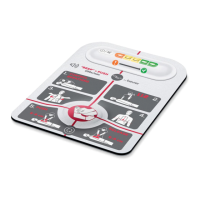
The LifePad
®
is not only intended to motivate more people to provide first aid, but also to support inex-
perienced first-aiders in performing cardiopulmonary resuscitation.
4. WARNINGS AND SAFETY NOTES
Contraindications
• Do not use the LifePad
®
if the patient has suered an obviously fatal injury.
• Do not use the LifePad
®
if you are sure that the patient is breathing normally – even if they
are not responding.
• Do not use the LifePad
®
on people under the age of 12.
• Never delay treatment to find out the exact age of the patient.
General warnings
• Even if resuscitation is initiated immediately, this does not guarantee that the patient will
survive, even if it is performed optimally. In some cases, the underlying problem causing
the cardiac arrest means that the patient will not survive, despite the best care.
• Patients with serious injuries should not be moved. Without using the LifePad
®
, the layper-
son (user) should also not move the patient on another ground.
• Rib fractures and other injuries are common, but acceptable consequences of resuscita-
tion given that the alternative is death due to cardiac arrest. After resuscitation, all patients
should be assessed for injuries caused during resuscitation.
• In addition to the above-mentioned consequences, skin abrasions, bruises and wounds
on the chest can often occur during resuscitation. Despite this, do not stop performing the
compressions, but continue CPR until professional help arrives.
• Check the LifePad
®
surface for integrity before starting resuscitation to prevent sharp edg-
es or dangerous areas.
• In the event of a defect, perform the cardiac massage without the assistance of the LifePad
®
.
Do not delay or interrupt the start of first aid measures to rectify the defect. Continue to
follow the instructions for carrying out CPR illustrated by the pictograms.
• Even if the device fails, continue cardiac massage at a pressure frequency of at least 100
per minute until clear signs of life are once again perceptible or the emergency doctor takes
over.The pressure must be high enough to achieve a pressure depth on the chest of 50 mm
to 60 mm.
• The LifePad
®
is only intended to support the emergency services (which have been alerted)
and cannot completely replace them.
• The LifePad
®
is not intended to replace possible training measures in the field of first aid.
Prior knowledge is a benefit, but not absolutely necessary for use.
• Keep packaging material away from children. There is a risk of suocation.
• The LifePad
®
is not a toy. Store the LifePad
®
out of the reach of children.
• To reduce the risks associated with strong electromagnetic fields, such as device failure,
do not use the LifePad
®
near strong high-frequency signals or portable and/or mobile HF
devices.
• The use of accessories, converters and cables other than those intended for the LifePad
®
may result in increased HF emissions or decreased immunity of the LifePad
®
.
• To avoid unnecessarily shortening the service life of the LifePad
®
, only switch it on when
treating a patient.
• If you pull out the battery strip prematurely, the battery life can no longer be guaranteed.


 To Next Page
 Loading...