
 Need help?
Do you have a question about the BIGTREETECH TMC2130 V3.0 and is the answer not in the manual?
Configuration details for operating the driver in STEP/DIR mode.
Guidance on wiring the driver for SPI communication.
Instructions on how to adjust the driver current using the potentiometer.
Example of firmware settings for TMC2130 in SPI mode.
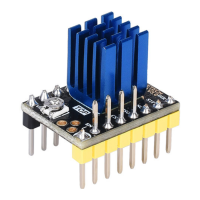
The BIGTREETECH TMC2130-V3.0 is a high-performance two-phase stepper motor driver chip designed for 3D printers and other applications requiring precise motor control. It offers both a standard SPI interface and a simple step/dir interface, providing flexibility in how it can be integrated into a system. A key advantage of this driver is its ability to operate with very low noise and to drive high loads without losing steps, which is crucial for applications demanding accuracy and quiet operation.
One of the primary usage features of the TMC2130-V3.0 is its high resolution, supporting up to 256 subdivisions per full step. This allows for extremely smooth and precise motor movements, reducing vibrations and improving the overall quality of prints or movements. The driver's support for SPI interface control enables advanced configuration and real-time adjustments, giving users greater control over motor behavior.
The TMC2130-V3.0 incorporates several innovative technologies to enhance its performance. "StealthChop" is a standout feature that ensures extremely quiet operation, making the motor work under extremely low sound levels. This is particularly beneficial in environments where noise reduction is a priority, such as home 3D printing setups. The noise level of the motor can be kept below 10dB, which is significantly lower than that of traditional current controllers.
Another important feature is "SpreadCycle," a PWM chopped mode that automatically switches between slow and fast attenuators. This technology ensures that the stepper motor has a smooth transition without dead zone current when passing zero, resulting in almost no jitter. SpreadCycle also sets up a hysteresis attenuation function, where the average current reflects the configured normal current in a sine wave. This eliminates transition periods at the zero crossing of the sine, reducing current and torque fluctuations and making the current waveform more similar to a sine wave. Consequently, the motor operates more smoothly and stably compared to traditional constant chopper modes.
The driver also includes "coolStep," a current control feature designed for energy savings, potentially reducing power consumption by up to 75%. This is achieved by dynamically adjusting the motor current based on the load, optimizing efficiency without compromising performance. Additionally, the TMC2130-V3.0 supports passive braking and freewheeling modes, offering further control over motor deceleration and idle states.
For maintenance and configuration, the device offers a potentiometer for adjusting the driver current (Vref). Rotating the potentiometer clockwise reduces Vref and thus the driver current, while rotating it counterclockwise increases Vref and the driver current. It's important to measure the exact Vref voltage when the main board is supplied with 12V or 24V. Users should exercise caution when adjusting the potentiometer to avoid irreversible damage, as continuous rotation beyond the maximum or minimum values will cause it to cycle back to the opposite extreme.
Firmware configuration is a critical aspect of using the TMC2130-V3.0 in SPI mode. For example, with Marlin-2.0 on a BIGTREETECH SKR V1.3 board, users need to modify specific lines in the Configuration.h and Configuration_adv.h files to enable and configure the TMC2130 drivers for each axis (X, Y, Z, and extruders). This involves defining the driver type, current, microsteps, and RSENSE values for each motor. The pins_BIGTREE_SKR_V1.3.h file also needs to be checked to ensure the correct SPI pin assignments for MOSI, MISO, and SCK. After making these firmware changes, the firmware must be compiled and uploaded to the motherboard.
When selecting the SPI operation mode for hardware, careful soldering is required to avoid burns and ensure no residual tin residue remains, which could lead to short-circuits. Proper wiring sequence and IO port connections are essential, as incorrect wiring will prevent the drive from functioning. It is also crucial to insert the driver into the motherboard in the correct direction to prevent damage. Finally, adequate heat dissipation, typically involving a heatsink and fan, is necessary to ensure the driver operates reliably and prevents overheating.
The TMC2130-V3.0 is designed with full protection and diagnostics features, contributing to its reliability and ease of troubleshooting. These integrated safeguards help protect the driver and the motor from potential issues, ensuring a longer lifespan and consistent performance.
 General
| Driver Type | TMC2130 |
|---|---|
| Configuration | SPI |
| Maximum Current (RMS) | 1.2A |
| Microstepping | up to 1/256 |
| Interface | SPI |
| Step Modes | Full, Half, 1/4, 1/8, 1/16, 1/32, 1/64 |
| Features | StealthChop2, SpreadCycle, CoolStep |
| Protection Features | Overtemperature |
| Compatibility | 3D printers, CNC |

 To Next Page