To Next Page

S
stevensmichaelAug 6, 2025
What to do if Biobase BOV-V230F shows '-------' on display?
- NNatasha PriceAug 6, 2025
If your Biobase Oven is displaying '-------', it indicates that the sensor is broken and needs to be replaced.

What to do if Biobase BOV-V230F shows '-------' on display?
If your Biobase Oven is displaying '-------', it indicates that the sensor is broken and needs to be replaced.
Why is my Biobase BOV-V230F Oven not heating up?
If the temperature isn't rising inside your Biobase Oven, several factors could be responsible: * The set temperature might be too low. Try readjusting and setting the desired temperature. * The heater could be broken and require replacement. * A faulty temperature controller may be the cause, in which case, it should be changed. * The temperature sensor might be loose; ensure it is screwed in tightly. * The temperature sensor itself could be defective, necessitating a replacement.
How to fix Biobase Oven when it doesn't have power?
If your Biobase Oven isn't receiving power, the issue might stem from a poor connection of the plug or a break in the power line. Ensure the plug and line are securely connected. Alternatively, the fuse protector may be broken, requiring a replacement.
What to do if Biobase BOV-V230F temperature cannot reach setting point?
If your Biobase Oven's temperature is failing to reach the set point, it could be due to: An exhaust port that is fully opened. Shut off the exhaust port. The container being overfilled, which prevents proper hot air convection. Decrease the amount of sample to improve convection.
What to do if Biobase Oven fan doesn’t work?
If the fan in your Biobase Oven isn't working, it could be due to a broken fan motor. Stop using the oven and check the electric capacity and the motor itself.
How to resolve no temperature rising alarm in Biobase BOV-V230F Oven?
If there's no temperature rising alarm in your Biobase Oven, check if the set temperature of the detached temperature limiter is low. Readjust the temperature to 30? above the setting temperature. Alternatively, the detached temperature limiter sensor might be broken and needs to be replaced.
What to do if Biobase BOV-V230F displays STOP?
If your Biobase Oven displays 'STOP', it means the time is up. Press the program key for 3 seconds to start the oven.
Manual intended for lab technologists operating the instrument. Keep manual safe for reference.
Company responsibility for safety, reliability, performance based on specific requirements for maintenance.
Company not liable for equipment failure or damage due to misuse or external factors.
Place in a ventilated room, 10cm from walls, ensuring air convection. Avoid flammables.
Ventilate during first use for fumes. Clean with dry cloth, avoid corrosives.
Ensure proper grounding, check fuse, and do not place explosive materials.
Manage door opening impact on temperature and turn off power post-use.
Features cold-rolled steel exterior and stainless steel interior with round angles.
Includes observation window, adjustable shelves, PID controller, and over-temperature protection.
Identifies key components like displays, indicators, and input keys on the temperature controller.
How to set temperature and time using the control panel keys and displays.
Explanation of various control parameters like SP, ST, SC, P, I, D, and their functions.
Procedure for initiating and understanding the temperature auto-tuning process.
Lists common phenomena, their causes, and recommended treatment methods.
Details the warranty period, exclusions, and conditions for repair.
This document serves as the user manual for the BIOBASE Forced Air Drying Oven, models BOV-V30/45/65/125/230/625F. It is intended for laboratory technologists operating the instrument, providing essential information for safe and effective use, installation, operation, and troubleshooting. Adherence to the instructions is crucial for maintaining the product's safety, reliability, and performance, as well as for ensuring warranty coverage.
The Forced Air Drying Oven is designed for various laboratory applications requiring precise temperature control and efficient drying. Its primary function is to provide a controlled environment for drying samples, sterilizing glassware, or performing other heat-treatment processes. The "Forced Air" designation indicates that the oven utilizes a fan to circulate heated air within the chamber, ensuring uniform temperature distribution and efficient heat transfer to the samples. This forced convection mechanism helps to accelerate drying times and maintain consistent conditions throughout the oven's interior, which is particularly beneficial for sensitive samples or processes requiring high accuracy. The oven is equipped with a PID microprocessor intelligent temperature controller, allowing for precise setting and maintenance of the desired temperature. This advanced control system contributes to the oven's ability to achieve high precision temperature control, minimizing fluctuations and ensuring stable operating conditions.
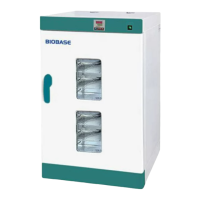
Key usage features of the BIOBASE Forced Air Drying Oven include its robust construction and user-friendly interface. The external material is cold-rolled steel with an anti-bacteria powder coating, providing durability and a hygienic surface. The inner chamber is made of stainless steel and features a round angle structure, which facilitates cleaning and prevents the accumulation of contaminants. Adjustable shelves are provided, allowing users to customize the internal space to accommodate various sample sizes and quantities. A double-layer glass observation window is integrated into the door, enabling users to monitor the drying process without opening the door and disturbing the internal temperature. The adjustable airtight buckle lock ensures a secure seal, maintaining the internal temperature and preventing heat loss.
The control panel is designed for intuitive operation, featuring a digital display for both measured and set temperatures. Users can easily set the desired temperature and time parameters using the dedicated keys. The control panel also includes indicators for alarms, main control output, and auto-tuning, providing clear feedback on the oven's status. The auto-tuning function is a significant feature, allowing the oven to automatically calculate and optimize its heating rate to achieve high-precision temperature control. This process involves the instrument learning the system's thermal characteristics to minimize overshoot and maintain stable temperatures. During auto-tuning, it is important not to open the door, operate the pump, reset, or shut off the power to ensure accurate calibration.
Installation and operating conditions are critical for the oven's performance and safety. The equipment should be placed in a well-ventilated, shaded, and cool room, with at least 10 cm of clearance from walls to ensure proper air circulation. It is imperative not to place flammable or explosive materials near the oven, as it does not have explosion-proof capabilities. For initial use, slight fumes and odors may be present due to the spray and rust-proof coating; opening doors and windows for a period is recommended until these dissipate. The power supply must match the specified voltage and be reliably grounded to ensure electrical safety. Overloading the internal chamber with objects should be avoided to allow for adequate air convection, which is essential for hot air circulation and the discharge of humid exhaust gas. When opening the door or inserting items for extended periods, it is advisable to lower the temperature setting or turn off the power temporarily to prevent temperature fluctuations and potential losses.
Maintenance features are designed to ensure the longevity and optimal performance of the oven. Regular cleaning of the surface with a dry cloth is recommended; corrosive materials such as acids or alkalis should not be used. The oven is equipped with a fuse box, and in case of power failure, users should check and replace the fuse with the same type after cutting off the power. The manual also provides a comprehensive troubleshooting guide for common issues, such as no power supply, no temperature rise, or fan malfunction, offering clear causation and treatment methods. For instance, if there is no power, checking the plug connection and fuse protector is advised. If the temperature does not rise, potential causes include low setting temperature, a broken heater or temperature controller, or a loose/broken temperature sensor. The guide also addresses issues like the fan not working or error messages on the display, providing practical solutions.
The oven also includes safety features such as over-temperature protection and an optional independent temperature protector, which enhance operational safety. The PID controller's alarm functions (AL1 and AL2) can be configured to alert users to temperature deviations, further contributing to safe operation. The ability to adjust parameters like proportional band (P), integral time (I), and derivative time (D) allows for fine-tuning the temperature control to suit specific experimental requirements and system characteristics. For example, increasing the proportional band can help stabilize oscillating temperatures, while adjusting integral time can address static deviations. The "Pr" parameter, representing upper limit constant temperature power percentages, can be adjusted to prevent temperature overshoots or improve heating speed, depending on the application.
In summary, the BIOBASE Forced Air Drying Oven is a reliable and precise instrument for laboratory drying and heat treatment. Its forced air convection, intelligent temperature control, robust construction, and user-friendly design make it suitable for a wide range of applications. Adherence to the detailed instructions for installation, operation, and maintenance, as outlined in this manual, is essential for ensuring the oven's safety, performance, and durability.
 General
| Shelves | 2 |
|---|---|
| Timing Range | 1~9999min |
| Timer | 1~9999min |
| Material | Stainless steel |
| Temperature Range | RT+5~250°C |
| Temperature Stability | ±0.5°C |
| Power Supply | AC220V, 50/60Hz |