76
the space (figure 3).
3. If the tool does not pull
through freely, attach the
spring scale to the end of the
cone, and try to pull the tool
through the rail by pulling on
the attached spring scale using
12 lbs. of force. Use care when
pulling. If the tool
suddenly pulls through the
opening, you may lose your
balance and fall, or the tool
may fall on you.
4. Repeat steps 2 and 3 to check
all other openings within
the same rail. - Repeat test on all Rails
5. Interpret test result and record the results on the data sheet.
Interpret Test 1 Results:
If the large end of the cone does not pass through any of the
openings, this space passes the test (figure 4a).
If the large end of the cone does pass through any of the
openings, this space fails the test (figure 4b).
If a test is a close call, and you have trouble deciding whether
the bed system passes or fails, make your best decision and 3
mark the result with an asterisk (*) next to your answer to
show that it was a close call.
Repeat Test 1:
On the other rails: Repeat the test for all other rails on the bed.
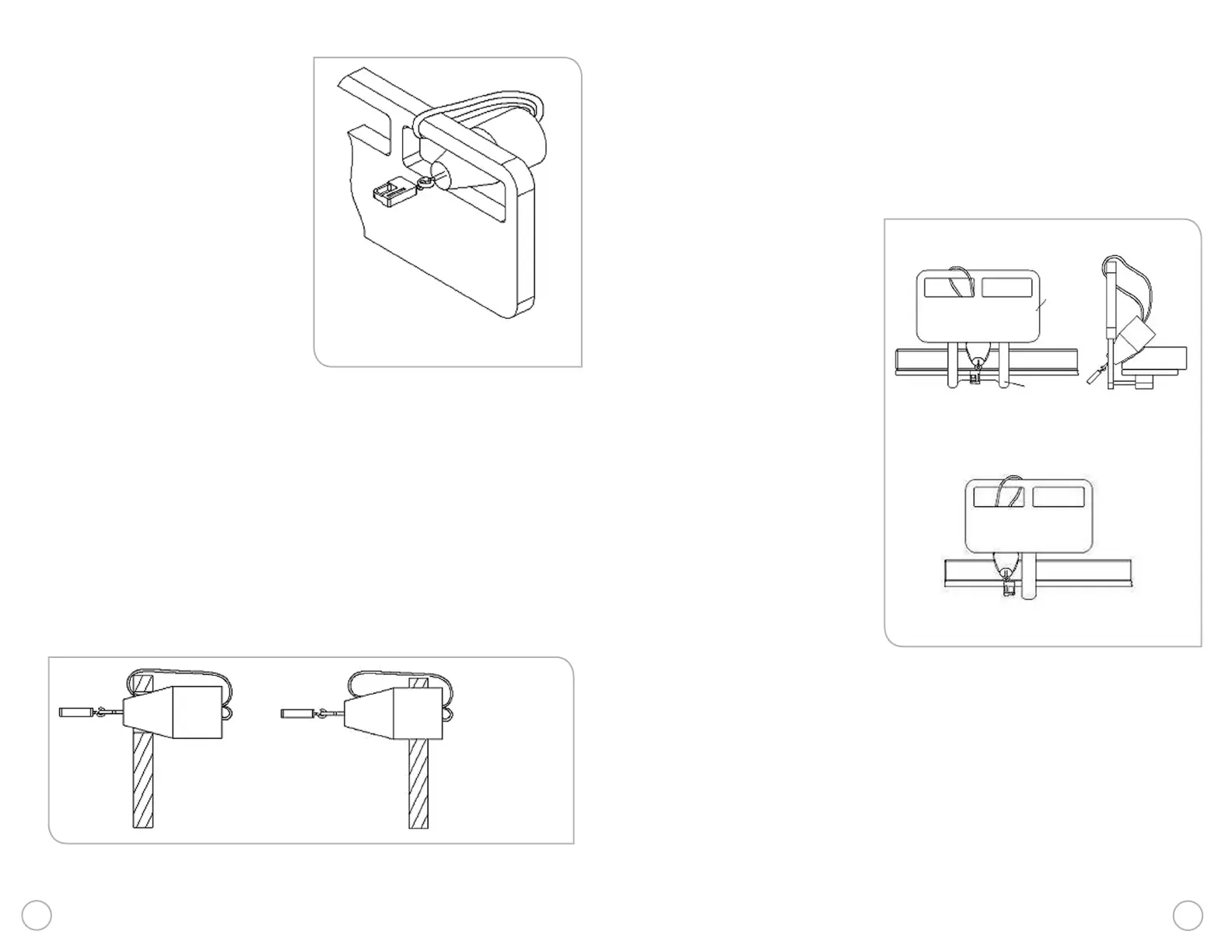
Figure 3: Test 1, within rail.
Figure 4a:
Test 1 Pass, large
end of cone does
not pass through
rail opening.
Figure 4b:
Test 1 Fail,
large end
of cone does
pass through
rail opening.
Zone 2: Potential head entrapment between the
bottom of the rail and the top of the compressed
mattress, and between the rail supports or next to a
single support.
The tools needed to do this test include the cone with safety strap
and spring scale.
Prepare for Test 2:
1. Lock the wheels.
2. Put the bed in the flat,
horizontal position. Fully
raise all bed rails.
3. Put the bed at a
comfortable working
height position.
Do Test 2:
1. Firmly push the
mattress away from
the rail being
measured until it stops.
2. Identify the space where
the test will be done (see
Figure(s) 5a and 5b).
3. Raise and lower the head
and foot sections of the
bed. If the spaces where
the test will be done don't
change as the
bed moves, the test will be done in the flat position.
a. If the space changes when the head and foot sections are raised
and lowered, the test will be done in the bed position where the
space is the largest.
4. Attach the safety strap of the cone to the rail being tested.
Make sure the strap is short enough to keep the tool from injuring
your feet if it falls.
Figure 5a: Test 2, between rail
and top of compressed mattress.
Figure 5b: Test 2, for single support.
Siderail
Support


 To Next Page
 Loading...