EasyManua.ls Logo

BIRD MicroBlender 3800 - Page 8

Default Icon
46 pages
Print Icon
To Next Page IconTo Next Page
To Previous Page IconTo Previous Page
Loading...
OVERVIEW
OF
THE
3800
MICROBLENDER
OPERATION
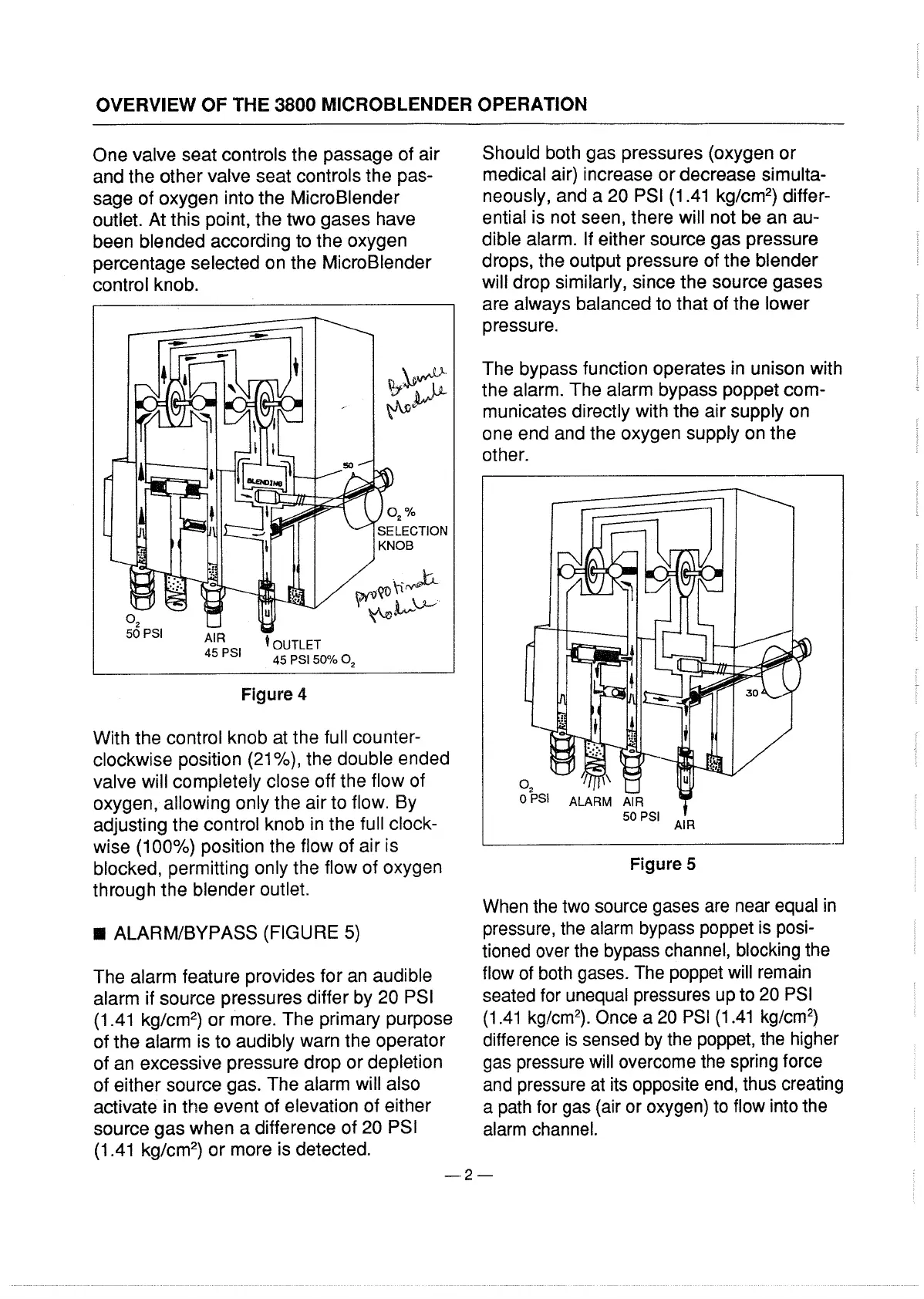
One
valve
seat
controls
the
passage
of
air
and
the
other
valve
seat
controls
the
pas-
sage
of
oxygen
into
the
MicroBlender
outlet.
At
this
point,
the
two
gases
have
been
blended
according
to
the
oxygen
percentage
selected
on
the
MicroBlender
control
knob.
Αι
"OUTLET
45
PSI
50%
O,
Figure
4
With
the
control
knob
at
the
full
counter-
clockwise
position
(21%),
the
double
ended
valve
will
completely
close
off
the
flow
of
oxygen,
allowing
only
the
air
to
flow.
By
adjusting
the
control
knob
in
the
full
clock-
wise
(100%)
position
the
flow
of
air
is
blocked,
permitting
only
the
flow
of
oxygen
through
the
blender
outlet.
m
ALARM/BYPASS
(FIGURE
5)
The
alarm
feature
provides
for
an
audible
alarm
if
source
pressures
differ
by
20
PSI
(1.41
kg/cm?)
or
more.
The
primary
purpose
of
the
alarm
is
to
audibly
warn
the
operator
of
an
excessive
pressure
drop
or
depletion
of
either
source
gas.
The
alarm
will
also
activate
in
the
event
of
elevation
of
either
source
gas
when
a
difference
of
20
PSI
(1.41
kg/cm?)
or
more
is
detected.
Should
both
gas
pressures
(oxygen
or
medical
air)
increase
or
decrease
simulta-
neously,
and
a
20
PSI
(1.41
kg/cm?)
differ-
ential
is
not
seen,
there
will
not
be
an
au-
dible
alarm.
If
either
source
gas
pressure
drops,
the
output
pressure
of
the
blender
will
drop
similarly,
since
the
source
gases
are
always
balanced
to
that
of
the
lower
pressure.
The
bypass
function
operates
in
unison
with
the
alarm.
The
alarm
bypass
poppet
com-
municates
directly
with
the
air
supply
on
one
end
and
the
oxygen
supply
on
the
other.
TT
Y
©
|
_
©
À
\
O
ry
“A
è
13
A
=
η
D
\
СС
Ars
Е:
(Gz:
ES7
O,
OPS!
ALARM
AIR
50PSI
AIR
Figure
5
When
the
two
source
gases
are
near
equal
in
pressure,
the
alarm
bypass
poppet
is
posi-
tioned
over
the
bypass
channel,
blocking
the
flow
of
both
gases.
The
poppet
will
remain
seated
for
unequal
pressures
up
to
20
PSI
(1.41
kg/cm’).
Once
a
20
PSI
(1.41
kg/cm?)
difference
is
sensed
by
the
poppet,
the
higher
gas
pressure
will
overcome
the
spring
force
and
pressure
at
its
opposite
end,
thus
creating
a
path
for
gas
(air
or
oxygen)
to
flow
into
the
alarm
channel.
2

Related product manuals