724-746-5500 | blackbox.com
Page 25
SOFTWARE UPGRADE
• Output
-Rated voltage: 5 VDC ± 5%, 5W
-Rated current: 1 A DC
-6-inch cable terminated with 2.5 mm barrel plug, center positive
• Isolation: 500 VDC
• Environment: 0–40°C; 5–95% relative humidity, non-condensing
A.6 TRANSMISSION LINE
Single Twisted Pair
A.7 LINE CODING
TC-PAM (Trellis Coded Pulse Amplitude Modulation)
A.8 LINE INTERFACE
Transformer coupled, 2500 VRMS isolation
A.9 LINE PHYSICAL CONNECTION
RJ-45, 2-wire polarity insensitive pins 4 and 5
A.10 TEMPERATURE RANGE
32–122°F (0–50°C)
A.11 HUMIDITY
5–95% non-condensing
A.12 ALTITUDE
0–15,000 feet (0–4,600 meters)
A.13 DIMENSIONS
6.22 W x 1.25 H x 4.75 D in. (157 W x 318 H x 120 D mm)
724-746-5500 | blackbox.com
Page 4
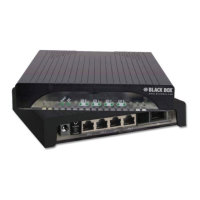
Black Box Long Range Ethernet Extender
RADIO FREQUENCY INTERFERENCE STATEMENTS
FEDERAL COMMUNICATIONS COMMISSION AND INDUSTRY CANADA RADIO
FREQUENCY INTERFERENCE STATEMENTS
This equipment generates, uses, and can radiate
radio-frequency energy, and if not
installed and used properly, that is, in strict accordance with the manufacturer’s
instructions, may cause interference to radio communication. It has been tested and
found to comply with the limits for a Class A computing device in accordance with the
specifications in Subpart B of Part 15 of FCC rules, which are designed to provide rea-
sonable protection against such interference when the equipment is operated in a
c
ommercial environment. Operation of this equipment in a residential area is likely to
cause interference, in which case the user at his own expense will be required to take
whatever measures may be necessary to correct the interference.
Changes or modifications not expressly approved by the party responsible for compli-
ance could void the user’s authority to operate the equipment.
This digital apparatus does not exceed the Class A limits for radio noise emission from
d
igital apparatus set out in the Radio Interference Regulation of Industry Canada.
Le présent appareil numérique n’émet pas de bruits radioélectriques dépassant les
l
imites applicables aux appareils numériques de la classe A prescrites dans le Règle-
ment sur le brouillage radioélectrique publié par Industrie Canada.



 To Next Page