2 3
This device complies with part 15 of the FCC rules. Operation is subject to the following two conditions: (1) this device may not cause harmful interference, and (2) this device must accept
any interference received, including interference that may cause undesired operation.
This equipment has been tested and found to comply with the limits for a Class B digital device, pursuant to part 15 of the FCC Rules. These limits are designed to provide reasonable
protection against harmful interference in a residential installation. This equipment generates, uses and can radiate radio frequency energy and, if not installed and used in accordance with
the instructions, may cause harmful interference to radio communications. However, there is no guarantee that interference will not occur in a particular installation. If equipment does cause
harmful interference to radio or television reception, which can be determined by turning the equipment off and on, the user is encouraged to try to correct the interference by one or more of
the following measures:
• Reorient or relocate the receiving antenna.
• Increase the separation between equipment and receiver.
• Connect the equipment into an outlet on a circuit different from that to which the receiver is connected.
• Consult the dealer or an experienced radio/TV technician for help.
Changes or modifications not approved by the party responsible for compliance could void user’s authority to operate the equipment.
SAFETY GUIDELINES /
DEFINITIONS
DANGER: Indicates an imminently hazardous situation which, if not avoided, will
result in death or serious injury.
WARNING: Indicates a potentially hazardous situation which, if not avoided, could
result in death or serious injury.
CAUTION: Indicates a potentially hazardous situation which, if not avoided, may
result in minor or moderate injury.
CAUTION: Used without the safety alert symbol indicates potentially hazardous
situation which, if not avoided, may result in property damage.
RISK OF UNSAFE OPERATION. When using tools or equipment, basic safety
precautions should always be followed to reduce the risk of personal injury. Improper
operation, maintenance or modification of tools or equipment could result in serious
injury and property damage. There are certain applications for which tools and
equipment are designed. Black & Decker strongly recommends that this product NOT
be modified and/or used for any application other than for which it was designed.
Read and understand all warnings and operating instructions before using any tool
or equipment.
IMPORTANT SAFETY
INSTRUCTIONS
READ ALL INSTRUCTIONS
WARNING: Read all instructions before operating power station. Failure to
follow all instructions listed below may result in electric shock, fire and/or serious
injury.
GENERAL SAFETY WARNINGS AND INSTRUCTIONS
• This unit was designed for household use only.
WARNING – TO REDUCE THE RISK OF FIRE, ELECTRIC SHOCK, BURST
HAZARD, OR INJURY TO PERSONS OR PROPERTY:
• Avoid dangerous environments. Don’t use appliances in damp or wet locations.
Don’t use appliances in the rain.
• Keep children away. All visitors should be kept at a distance from work area.
• Dress properly. Do not wear loose clothing or jewelry. They can be caught in
moving parts. Rubber gloves and substantial, non-skid footwear are recommended
when working outdoors. Wear protective hair covering to contain long hair.
• Use safety glasses and other safety equipment. Use safety goggles or safety
glasses with side shields, complying with applicable safety standards. Safety
glasses or the like are available at extra cost at your local dealer.
• Store idle appliance indoors. When not in use, appliances should be stored
indoors in dry, and high or locked-up place – out of reach of children.
• Don’t abuse cord. Never carry appliance by cord or yank it to disconnect from
receptacle. Keep cord from heat, oil, and sharp edges.
• Disconnect appliances. Disconnect the appliance from the power supply when not
in use, before servicing, and when changing accessories.
• Ground Fault Circuit Interrupter (GFCI) protection should be provided on the
circuits or outlets to be used. Receptacles are available having built in GFCI
protection and may be used for this measure of safety.
• Use of accessories and attachments. The use of any accessory or attachment
not recommended for use with this appliance could be hazardous. Refer to the
accessory section of this manual for further details.
• Stay alert. Use common sense. Do not operate appliance when you are tired or
impaired.
• Check for damaged parts. Any part that is damaged should be replaced by the
manufacturer before further use. Contact the manufacturer at (877) 571-2391 for
more information.
• Do not operate this appliance near flammable liquids or in gaseous or explosive
atmospheres. Motors in these tools normally spark, and the sparks might ignite
fumes.
• Never submerge this unit in water; do not expose it to rain, snow or use when wet.
• To reduce risk of electric shock, disconnect the unit from any power source before
attempting maintenance or cleaning. Turning off controls without disconnecting will
not reduce this risk.
• This equipment employs parts (switches, relays, etc.) that produce arcs or
sparks. Therefore, if used in a garage or enclosed area, the unit MUST be placed
not less than 18 inches above the floor.
SPECIFIC SAFETY INSTRUCTIONS FOR CHARGING
THIS UNIT
• IMPORTANT: This unit is delivered in a partially charged state. Fully charge unit
before using for the first time with a household extension cord (not supplied) for a
full 24 hours or until the green LED Battery Status Indicator lights or flashes.
• All ON/OFF switches should be in the OFF position when the unit is charging or not
in use. Make sure all switches are in the OFF position before connection to a power
source or load.
Extension cords
WARNING: Use of improper extension cord could result in a risk of fire and electric
shock. When using an extension cord, make sure that the pins of the extension cord
are the same number, size and shape as those in the charger; and be sure to use one
heavy enough to carry the current your product will draw. An undersized cord will
cause a drop in line voltage resulting in loss of power and overheating. The following
table shows the correct size to use depending on cord length and nameplate ampere
rating. If in doubt, use the next heavier gage. The smaller the gage number, the
heavier the cord.
MINIMUM GAGE FOR CORD SETS
Volts Total Length of Cord in Feet
120V 0-25 26-50 51-100 101-150
(0-7.6m) (7.6-15.2m) (15.2-30.4m) (30.4-45.7m)
240V 0-50 51-100 101-200 201-300
(0-15.2m) (15.2-30.4m) (30.4-60.9m) (60.9-91.4m)
Ampere Rating Extension Cord Length
More Not more
0’-25’ 26’-50’ 51 ’-100 ’ 101’ -150 ’
Than Than American Wire Gage (AWG)
0 - 6 18 16 16 14
6 - 10 18 16 14 12
10 - 12 16 16 14 12
12 - 16 14 12 Not Recommended
• When an extension cord is used, make sure that:
– a) the pins of extension cord are the same number, size and shape as those
in the charger,
– b) the extension cord is properly wired and in good electrical condition,
– c) the wire size is large enough for the AC rating of the charger.
CAUTION – TO REDUCE THE RISK OF PROPERTY DAMAGE: Pull by connector
rather than cord when disconnecting the extension cord from the unit; and by plug
when disconnecting the extension cord from an AC outlet.
SPECIFIC SAFETY INSTRUCTIONS FOR JUMP
STARTERS
WARNING – BURST HAZARD
Do not use the unit for charging dry-cell batteries that are commonly used with
home appliances. These batteries may burst and cause injury to persons and damage
property. Use the unit for charging/boosting a lead-acid battery only. It is not intended
to supply power to a low-voltage electrical system other than in a starter-motor
application.
• Use of an attachment not supplied, recommended or sold by manufacturer
specifically for use with this unit may result in a risk of electrical shock and injury
to persons.
WARNING – RISK OF EXPLOSIVE GASES:
• Working in the vicinity of a lead acid battery is dangerous. Batteries generate
explosive gases during normal battery operation. For this reason, it is of the utmost
importance that each time before using the jump-starter you read this manual and
follow instructions exactly.
• To reduce the risk of battery explosion, follow these instructions and those
published by the battery manufacturer and manufacturer of any equipment you
intend to use in the vicinity of the battery. Review cautionary markings on these
products and on the engine.
CAUTION – TO REDUCE THE RISK OF INJURY OR PROPERTY DAMAGE:
• NEVER ATTEMPT TO JUMP-START OR CHARGE A FROZEN BATTERY.
• Vehicles that have on-board computerized systems may be damaged if vehicle
battery is jump-started. Before jump-starting, read the vehicle’s owner’s manual to
confirm that external-starting assistance is suitable.
• When working with lead acid batteries, always make sure immediate assistance is
available in case of accident or emergency.
• Never smoke or allow a spark or flame in vicinity of vehicle battery, engine or
power station
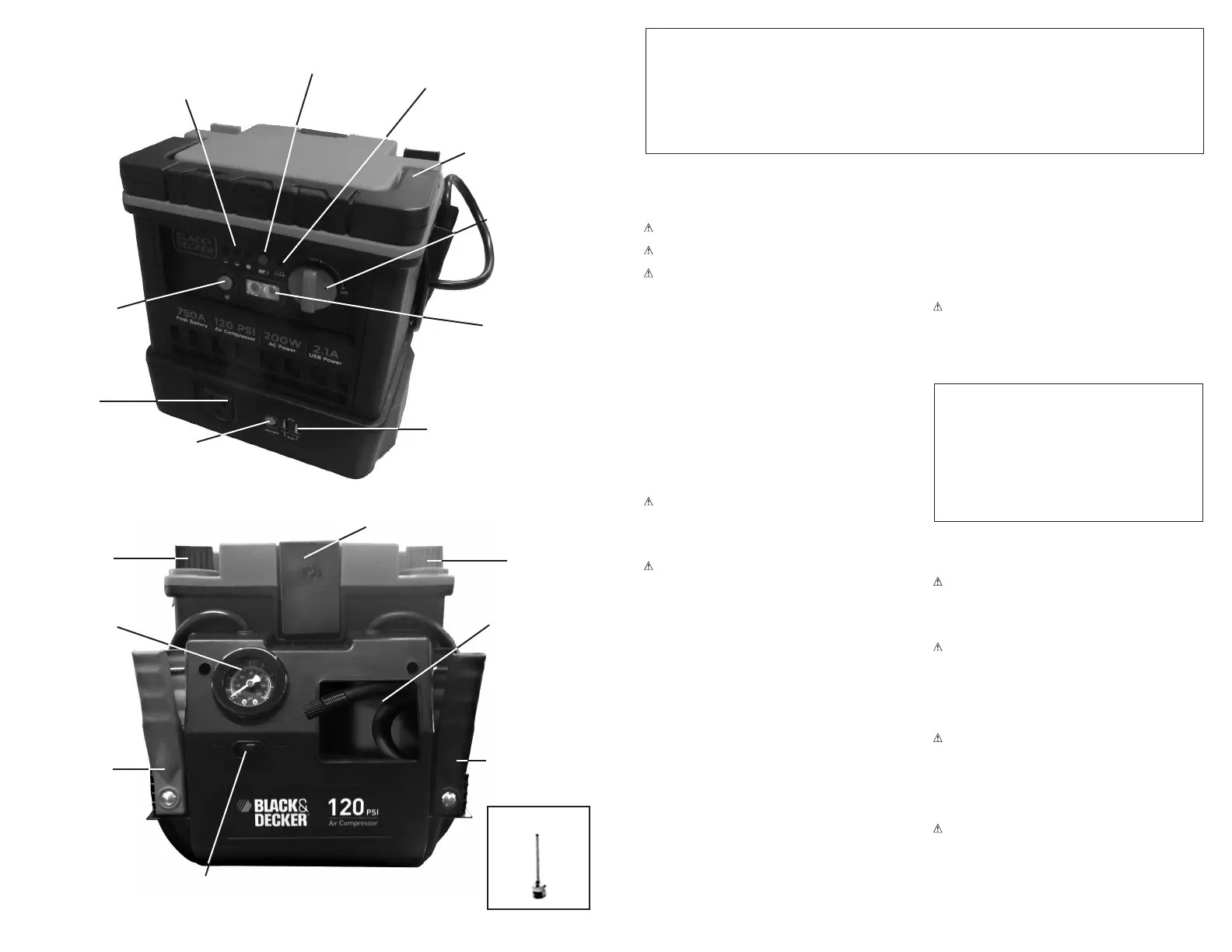
POSITIVE (+)
RED CLAMP
NEGATIVE (–)
BLACK CLAMP
TAB FOR
NEGATIVE (–)
BLACK CLAMP
BUILT-IN 120 VOLT AC CHARGER
(UNDER PROTECTIVE COVER)
TAB FOR
POSITIVE (+)
RED CLAMP
AIR PRESSURE
GAUGE
COMPRESSOR POWER SWITCH
AIR HOSE AND
SURE FIT
®
NOZZLE
CONNECTOR
IN STORAGE
COMPARTMENT
NOZZLE ADAPTER
REVERSE
POLARITY
INDICATOR
JUMP STARTER
POWER SWITCH
BATTERY STATUS LED
INDICATORS
BATTERY POWER
LEVEL BUTTON
LED LIGHT
POWER BUTTON
TWO LED AREA
LIGHTS
FOLD-AWAY
HANDLE
THREE-PRONG
120 VOLT AC
OUTLET
TRANSLUCENT
INVERTER/USB
POWER BUTTON AND
INVERTER POWER/
FAULT INDICATOR
USB CHARGING
PORTS
FEATURES


 To Next Page
 Loading...