Need help?
Do you have a question about the Blagdon Minipond 12000 and is the answer not in the manual?
Guidance on pump compatibility, flow rates, and optimal pump placement for filter performance.
Important electrical safety advice, compliance with building regulations, and RCD requirements.
Steps to identify and fix common issues causing leaks in the filter system.
Common causes and solutions for cloudy or brown water conditions in the pond.
Identifying and rectifying the causes of green water, often related to UVC performance.
Checks for electrical faults and connections when the UVC light fails to operate.
Identifying and resolving issues causing reduced water flow into or out of the filter.
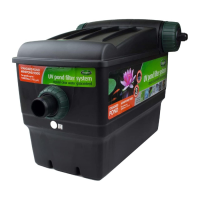
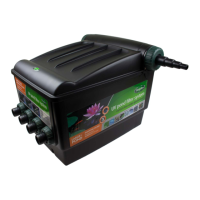
The Blagdon Minipond UV pond filter system, available in 9000 and 12000 models, is designed to create a clean and healthy environment for fish in water gardens. This filtration system utilizes advanced technology with a unique six-stage filter design to minimize maintenance while ensuring optimal water quality.
The Minipond UV pond filter system operates through a comprehensive six-stage filtration process:
High-Performance UVC: The system incorporates a high-performance Ultraviolet Clarifier (UVC) that effectively clears green water algae. This UVC unit is crucial for maintaining clear pond water by clumping together microscopic algae, making them easier for the mechanical filtration stages to remove. The UVC bulb needs to be replaced yearly, ideally in the spring, to ensure its effectiveness. The Quartz sleeve, which protects the UVC bulb, should be regularly cleaned to prevent lime scale build-up, especially in hard water areas.
Spray Bar Oxygenation: Water entering the filter passes through a spray bar, which oxygenates the water. This process is vital for creating an ideal environment for beneficial bacteria to thrive. Oxygenation also helps in breaking down organic waste and improving overall water health.
Graded Foam Filter Pads: The system includes multiple graded foam filter pads designed to remove dirt and waste particles from the pond water. These pads are arranged in layers, with coarser foams trapping larger debris and finer foams capturing smaller suspended particles. The foams are most effective when partially blocked, so cleaning should only occur when the foam chamber is full and water begins to significantly overflow into the cartridge chamber.
Ceramic Biological Filter Media: Following the mechanical filtration, water flows through ceramic biological filter media. This media provides a large surface area for beneficial bacteria to colonize. These bacteria are essential for the biological filtration process, converting harmful toxins like ammonia and nitrite into less harmful nitrates, thus preventing their build-up in the pond.
Replaceable Polymer Wool Pad: A replaceable polymer wool pad is included to remove fine waste particles and polish the water, giving it a crystal-clear appearance. This stage ensures that even the smallest suspended debris is captured before the water returns to the pond.
Carbon Impregnated Pad: The final stage involves a carbon-impregnated pad, which removes chemical pollutants and colorants from the water. This helps to maintain water clarity and eliminate any undesirable odors or discoloration caused by dissolved organic compounds. The carbon pad has a limited lifespan and should be replaced every six weeks as it becomes saturated with pollutants.
The Minipond filter is designed for flexible installation and ease of use:
Installation Flexibility: The filter can be installed either below or above ground, with water returned directly to the pond or via a waterfall. When installed below ground, the filter body is hidden, offering a discreet solution. For above-ground installations, the filter outlet hose should be smooth bore and installed with a minimum drop of 15cm over a maximum length of 1 meter to ensure proper drainage and prevent overflow. The UVC electronics and access points must always remain above ground level to protect against flooding.
Pump Connection: The filter requires a pump to transfer dirty water from the pond. It is recommended to place the pump at the opposite end of the pond from the filter for optimal filtration results. The pump's flow rate should be within the recommended limits for the specific filter model to ensure efficient operation and prevent overflow. An optional inline flow control valve can be used to reduce excessive pump flow if necessary.
Hose Connections: The inlet hose should be secured with a jubilee clip, and any unwanted hosetails of smaller diameter should be cut off to prevent flow restriction. Warming the hose in boiling water can aid in fitting. Short hose lengths and avoiding kinks or folds are crucial for maintaining optimal flow and filter performance.
Wet Testing: Before connecting the UVC or electrical supply, a wet test of the filter under operating conditions is mandatory. This involves running the filter with the pump for 24 hours to check for any leaks, ensuring a secure and functional setup.
UVC Operation Check: To verify the UVC lamp is working, the spray bar can be removed, and a piece of plain paper held up to the UVC outlet. A faint blue reflection should be visible, especially at dusk, as UVC lamps emit a dim blue light during normal operation. A micro switch protects against UVC light exposure when the cover is removed.
Electrical Safety: All electrical installations must comply with local building regulations and safety standards. A Residual Current Device (RCD) with a tripping current not exceeding 30mA must be incorporated into the supply circuit. The UVC unit should never be immersed in water and must be located at least 1 meter from the pond edge.
The Minipond filter is designed for minimal but essential maintenance to ensure continuous performance:
Filter Cleaning: The large hinged lid provides easy access for viewing and removing filter media for cleaning.
UVC Bulb and Quartz Sleeve Maintenance:
Annual Inspection: Once a year, the entire Minipond filter should be dismantled and inspected for wear or damage. Any parts showing signs of wear should be replaced to ensure the filter's longevity and optimal performance.
Winter Storage: The filter can be operated year-round if the pump flow is maintained, which is the best option. Alternatively, for winter storage, the filter can be switched off, following the annual maintenance procedure, and stored in a frost-free location like a house or garage until spring. This prevents damage from freezing temperatures.
Troubleshooting: The manual provides a detailed troubleshooting guide for common issues such as filter leaks, cloudy/brown water, green water, UVC light not illuminating, and poor flow. This guide helps users diagnose and resolve problems effectively before contacting customer support or returning the product.
 General
| Brand | Blagdon |
|---|---|
| Model | Minipond 12000 |
| Category | Water Filtration Systems |
| Language | English |


 To Next Page