The pressure switch is factory fitted during manufacturing process and must not be tampered
with, disassembled or removed. Any user interference will void warranty.
Be aware of the danger posed by the protected equipment. When working in the vicinity of
electrical equipment observe corresponding safety rules and instructions. Working on
electrical installations may be performed only by qualified persons.
Install the T Series so that the pressure switch is not exposed to aggressive chemical
substances (caustic, acids, solvents, corrosive substances etc.) and in direct influence of
weather conditions.
Always place the pressure switch in the lower part of the risk area to avoid direct flames and
heat. The pressure switch cannot be in direct contact or be in immediate proximity with parts
which heat to temperatures of more than 80 °C (176 °F).
TxxxES MODELS ONLY
min. 0.3 bar (4 psi) / max. 1 bar (14 psi)
Resistive load AC-12, DC12
Inductive load AC-14, DC14
IP65 with cable connector and seal
from -20 °C up to 80 °C (-4 °F to 176 °F)
EN60947 – Low-voltage switchgear and control gear
IEC 68-2-78 Permissible air humidity (4K4H per EN 60721-3-4)
IEC 60068-2-6 Vibration resistance 10 g (10…….2,000 Hz)
IEC 60068-2-27 Shock resistance 30 g
heavy duty, higher power rating, monitoring function, NO/NC
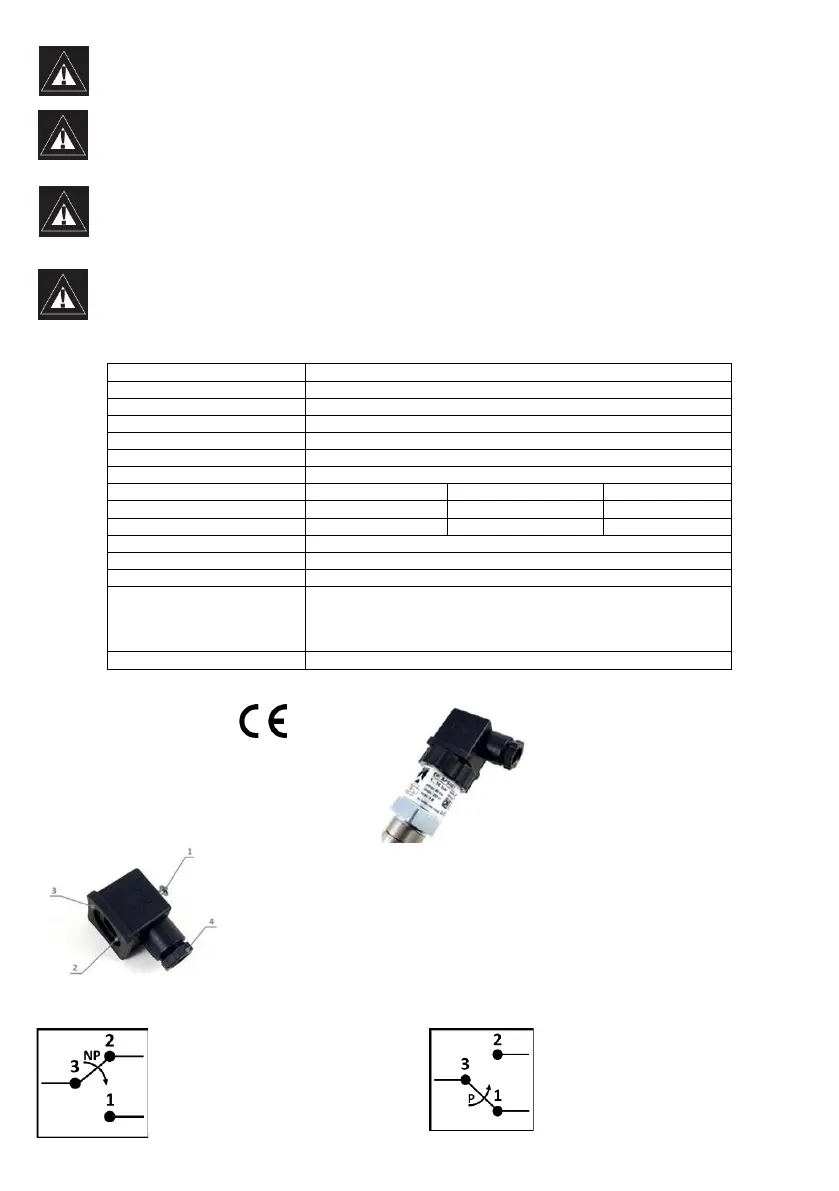
1. Fixing screw; use a screwdriver for installation and removal of the connector.
Tightening torque max. 5 Nm.
2. Electrical connector; use flat head screwdriver to remove from the connector body and
connect the electrical cable.
3. Gasket
4. Sealing nut to fix the electrical cable. Below the sealing nut is a grommet. Screw the
sealing nut tight in order to seal the electrical cable properly.
Cable connector
Pressure Switch models
TxxxES
When supplied and before actuation
(pressurized)
This is the configuration of the
Pressure Switch on models TxxxES
When actuation has occurred
(not pressurized)
This is the configuration of the
Pressure Switch on models TxxxES


 To Next Page
 Loading...