The Blease Datum 'L' Series Anaesthesia Vaporizer is a medical device designed for use in the fresh gas supply of a continuous flow anaesthetic machine. It provides accurate concentrations of anaesthetic gases, specified via a dial on the front of the vaporizer. The fresh gas supply should be maintained between 0.5 and 15 l/m. Due to its high internal resistance, the vaporizer is unsuitable for use directly within a breathing system.
Function Description:
The vaporizer contains an anaesthetic drug in liquid form within a vapour chamber. Wicks ensure that the upper part of the chamber remains filled with a saturated vapour of the drug. A concentration control regulates the gas flow through a vapour control valve, a bypass valve, and the vapour chamber to produce the required concentration. When the control is set to zero, the bypass remains open, and the vapour chamber is completely isolated from the patient gas flow. Setting the control to a desired concentration opens a valve, allowing flow into the vapour chamber. A temperature-compensating device varies the dilution ratio, maintaining a substantially constant output concentration regardless of temperature. The vaporizer is designed and tested for use only with the specific drug named on its front panel. Incorrect drug usage can lead to incorrect dosage. The device is designed to comply with BS4272:Part 3:1989 regarding the effects of Intermittent Positive Pressure Ventilation (IPPV) on output.
Important Technical Specifications:
The Datum 'L' Vaporizer comes in various models (Selectatec Standard, Cagemount Standard, Drager Standard, and their respective Key Fill and Quik-Fil versions).
- Weight: Approximately 7.3 kg to 7.5 kg depending on the model.
- Capacity: 250 ml +/- 25.
- Dimensions (Height x Width x Depth):
- Selectatec Standard: 225 mm x 114 mm x 200 mm
- Cagemount Standard: 220 mm x 137 mm x 190 mm
- Drager Standard: 225 mm x 100 mm x 175 mm
- Selectatec Key Fill: 225 mm x 114 mm x 200 mm
- Cagemount Key Fill: 220 mm x 137 mm x 190 mm
- Drager Key Fill: 225 mm x 104 mm x 175 mm
- Selectatec Quik-Fil: 225 mm x 114 mm x 210 mm
- Cagemount Quik Fil: 220 mm x 137 mm x 200 mm
- Drager Quik-Fil: 225 mm x 100 mm x 185 mm
- Concentration Control:
- Halothane, Isoflurane, and Enflurane models: Graduated in increments of 0.2%Vol. from 0 to 2%Vol., and in increments of 0.5%Vol. from 2 to maximum %Vol.
- 8% Sevoflurane models: Graduated in increments of 0.25%Vol. from 0 to 2%Vol., and in increments of 0.5%Vol. from 2 to 8%Vol.
- The control is marked '0' at the zero (off) position. The vaporizer must not be used when the control is set between zero and the first graduation mark.
- Output Accuracy: Accurate to ±20% of the set concentration or ±5% of the maximum graduation (whichever is greater) at sea level at 22°C ±3°C.
- Gas Flow Resistance (at zero concentration, ambient air 22°C, 1013mBar):
- 1 l/min: 1-3 cm H2O
- 2 l/min: 5-7 cm H2O
- 4 l/min: 10-18 cm H2O
- 8 l/min: 25-35 cm H2O
- Temperature Compensation: Effective between 15°C and 30°C (58°F and 86°F). A sudden temperature change requires a two-hour stabilization period before use.
- Barometric Pressure: Calibrated at sea level (760 mmHg, 1013 mbar). Output varies with barometric pressure according to the formula: V = S% x 101.3 / P (where V is delivered concentration, S% is set concentration, P is atmospheric pressure in kPa). Normal variations are usually clinically insignificant.
- Gas Composition Effects:
- Calibrated with air at 5 l/min. Output may vary with different gas compositions due to density and viscosity changes.
- Oxygen: Slight rise in output, unlikely to exceed 15% of set value or 0.3 volume percentage. Greater at high flows.
- Nitrous Oxide: Slight fall in output, unlikely to exceed 15% in normal conditions.
- Carbon Dioxide: Negligible effect at or below 5%.
- Helium: Likely to reduce output concentration; an analyser is recommended for accurate concentrations.
- This device must not be used with anything other than Dry Medical Gases.
Usage Features:
- Concentration Control: The dial automatically locks at the zero position. To set a concentration, push the dial inwards and rotate it counterclockwise to the desired graduation. When not in use, the control should be turned to zero to prevent vapour delivery.
- Filling and Draining:
- The vaporizer must be secured in an upright position during filling and draining. It must not be tipped.
- Only suitably skilled and trained personnel should fill the vaporizer.
- The concentration control must be set to zero during filling or draining.
- The anaesthetic agent name on the supply must match that on the front of the vaporizer.
- Do not overfill the vaporizer. If overfilled, it must be withdrawn from service.
- The liquid level must always be visible and between the minimum and maximum marks on the level indicator.
- Anaesthetic agents are poisonous and should not be spilled. Expired gases should be extracted by an approved scavenging system.
- Drained anaesthetic agent must be discarded as a hazardous chemical and never reused.
- Standard Screw Cap Filler: Unscrew the filler cap, remove the supply bottle cap, and fill slowly. Replace and tighten the filler cap. For draining, unscrew the filler cap, place a receptacle, undo the drain screw, allow liquid to drain, then tighten the drain screw and replace the filler cap.
- Keyed Filler: Ensure filler control is closed. Loosen clamp screw, remove slipper block. Screw filler adaptor onto supply bottle. Insert adaptor into filler port. Tighten clamp screw. Raise bottle above filler port. Open filler control port by pulling lever clockwise. Fill to required level. For draining, ensure filler control is closed. Loosen clamp screw, remove slipper block. Screw filler adaptor onto supply bottle. Insert adaptor into filler port. Tighten clamp screw. Keep bottle below filler port. Open filler port by pulling lever clockwise. Close filler port by pushing lever back. Loosen clamp screw, remove bottle adaptor. Replace slipper block and tighten clamp screw. A small amount of spillage is normal when removing the adaptor.
- Quik-Fil Filler: Ensure drain plug screw is tightened and concentration control is off. Remove yellow protective cap from agent bottle and black filler cap from vaporizer. Insert bottle nozzle into filler block, aligning keys with slots. Rotate bottle. Press bottle fully into filler block. Fill until maximum level is reached and air return bubbles cease. Release bottle, withdraw, and replace caps.
- Installation:
- Cagemount Model: Secure to the backbar of the anaesthetic machine using provided studs, nuts, washers, and spacers. Lightly grease tapers with oxygen-safe grease. Push gas tubing onto tapers and tighten nuts. Ensure all joints are gas-tight. For non-interlocking models, only one vaporizer should be connected.
- Selectatec®-Compatible Interlock Model: Position vaporizer against backbar, aligning gas connection ports and button plates. Lower onto backbar and ensure it is seated. Lock by pushing down and turning the locking lever fully clockwise. Ensure it is securely locked and level. This model is compatible with Ohmeda TEC®4, TEC®5, and Penlon PPV® Sigma® Selectatec® interlock-compatible models ONLY. The interlock function is void if used with a non-interlock device.
- Drägerwerk® AG-Compatible Model: Position vaporizer against backbar, aligning gas connection ports and button plates. Lower onto backbar and ensure it is seated. Lock by turning the locking lever fully clockwise. Ensure it is securely locked and level.
- Removal: Unlock the vaporizer by turning the locking lever fully counterclockwise and lift it clear of the backbar.
- Pre-Use Check: Before use, check that the vaporizer(s) are correctly fitted, locking mechanisms are engaged, and control knobs rotate through their full range. Turn off vaporizers. Check flow direction. Ensure correct agent is used and filler port is tightly closed. If fitted with a pressure relief valve, perform leak tests by setting oxygen flow (6-8 l/min), occluding the common gas outlet with the vaporizer off (no leak, flowmeter bobbin dips), and repeating with each vaporizer on (no liquid leak from filler port). Turn off vaporizer(s) and oxygen flowmeter.
Maintenance Features:
- Cleaning: Clean the exterior of the vaporizer only with a clean damp cloth.
- Draining Halothane: Halothane versions should be drained weekly if in regular use, and the liquid disposed of as a hazardous chemical. This prevents thymol accumulation, which can decrease output concentration and have deleterious effects on the patient.
- General Draining: All vaporizers should be drained of anaesthetic agent if not in regular use, and the liquid disposed of as a hazardous chemical.
- Output Concentration Check: While Blease has stringent internal quality control, hospitals may perform comparison checks against an anaesthetic agent analyser. When doing so, consider clinical use conditions, proper sampling, reliability of test equipment, effects of carrier gas composition, and effects of altitude and ambient temperature. All Blease vaporizers are calibrated at sea level. If low readings are recorded on Selectatec® units, consider cross leaks or leaks to atmosphere before doubting the vaporizer. Contact Blease Technical support if in doubt.
- Service: The Blease Datum® is designed for reliable function without expensive regular maintenance. However, Isoflurane, Enflurane, and Sevoflurane vaporizers require a full service after 10 years, and Halothane vaporizers after 5 years. Servicing must only be performed by qualified service personnel with written authorization from the manufacturer. No unauthorized modifications or dismantling should be attempted.
- Training: Blease offers training courses for engineers and technicians on servicing Blease vaporizers, covering leak testing, seal replacement, internal cleaning, major sub-assembly replacement, and output regulation. The Blease Datum® Service Manual describes these procedures.
- Component Replacement: Broken, worn, missing, or contaminated components must be replaced immediately. Contact the Blease distributor for service advice.

 Need help?
 General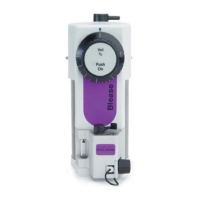

 To Next Page
