
 Need help?
Do you have a question about the Blichmann Engineering Therminator and is the answer not in the manual?
Details the types and installation of NPT and GHT threaded fittings for wort and water connections.
Guides on installing the universal stainless steel mounting bracket for the heat exchanger.
Steps for cleaning and sanitizing the unit before its first use.
Procedures for cleaning and sanitizing the exchanger before and after each brew.
Proper methods for storing the Therminator to ensure longevity and prevent issues.
Recommended maintenance for descaling and maintaining exchanger efficiency.
Instructions for operating the chiller using gravity feed from the brew kettle.
How to operate the Therminator when using a pump to move wort.
Guide to adjusting cooling water and wort flow rates for optimal chilling performance.
Specific considerations for operating the chiller in warmer climates with higher ground water temps.
Solutions for problems related to not reaching the desired wort temperature.
Troubleshooting steps for inadequate wort flow through the exchanger.
Addressing issues related to cleanliness and preventing contamination.
How to interpret and use the graph to predict chiller performance.
Details the manufacturer's limited warranty, exclusions, and customer responsibilities.
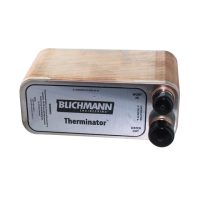
The Blichmann Engineering Therminator™ is a stainless steel wort chiller designed to rapidly cool wort for brewing. It is a plate heat exchanger that uses cooling water to reduce the temperature of hot wort, preparing it for fermentation. The device is intended for home use and is engineered for efficiency, speed, and ease of sanitation.
The Therminator™ operates as a counter-flow heat exchanger. Hot wort flows through one set of internal channels, while cold cooling water flows in the opposite direction through an adjacent set of channels. Heat is transferred from the wort to the cooling water across the thin stainless steel plates, effectively chilling the wort before it enters the fermentor. This design ensures maximum heat transfer efficiency, allowing for quick chilling and minimizing the risk of contamination. The device is designed to be continuously flooded with both wort and cooling water for optimal performance and to prevent wort oxidation. It can be integrated into both gravity-fed and pump-driven brewing systems.
The Therminator™ is equipped with ½” NPT male threads for the wort inlet/outlet and ¾” male garden hose threads (GHT) for the cooling water inlet/outlet. This allows for easy connection to various hose types and quick-connect fittings. For the wort side, it is recommended to use thread sealing tape with stainless NPT adapter fittings to prevent galling. No sealing tape is needed for the cooling water side due to the non-tapered garden hose threads.
A heavy-gauge stainless steel universal mounting bracket is included, allowing flexible installation of the unit (facing forward, rear, up, or down) to suit different brewing setups. It is crucial to secure all hoses with clamps or appropriate clamping devices and use hoses rated for the pressure and temperature of both wort and cooling water to prevent disconnections and potential burns or property damage.
For optimal performance, the exchanger should be installed with its fittings facing vertically, or with the wort inlet facing downward, to allow air to naturally purge from the unit. If operating in a gravity-fed system, the exchanger should be laid on its side, lower than the brew pot, and at the same level as or below the bottom of the fermentor to ensure it remains full of wort. A hose "pinch-valve" placed after the exchanger is recommended to control wort flow rate without exposing plates. In pump-driven systems, the exchanger should be placed after the pump to reduce cavitation and ideally on the hot side to minimize bacterial contamination.
The use of an in-line thermometer, such as the Blichmann Engineering ThruMometer, is highly recommended to accurately monitor wort outlet temperature and adjust cooling water flow rates to achieve the desired fermentation temperature (typically 68°F). Brewers in warmer climates may face challenges with elevated ground water temperatures. In such cases, pre-chilling the cooling water with an immersion chiller in an ice bath before it enters the Therminator™ can significantly improve chilling performance.
It is highly recommended to install a filter (e.g., stainless scouring pad, screen, or Y-strainer) before the chiller to prevent particulate matter like hops or trub from plugging the hoses, pump, or exchanger. After boiling, a strong whirlpool can be created in the brew pot to settle solids before draining and chilling the wort, which also enhances flavor and clarity.
Thorough cleaning and sanitation are critical for the Therminator™. Before first use, and before each subsequent use, the unit should be soaked in a sanitizing solution with fittings facing up to ensure all air is purged and all surfaces are wetted. Rocking the unit side-to-side helps purge entrapped air. It should then be drained and allowed to drip-dry. The unit should not be stored full of sanitizer or soaked for extended periods in cleaning solutions (1/2 to 1 hour is usually sufficient) to prevent potential galvanic corrosion. An alternative sanitation method is immersing the unit in boiling water for 10-15 minutes.
Immediately after each use, the wort side of the exchanger should be rinsed with hot tap water. It is recommended to rinse in the opposite direction of normal wort flow first to expel any particles, then reconnect and rinse in the normal flow direction. After rinsing, a ½ to 1 hour soak in hot Powdered Brewery Wash (PBW) is recommended to remove stubborn deposits and proteins. Circulating hot PBW through the exchanger in both directions, if possible, provides a more thorough cleaning. After cleaning, rinse thoroughly, soak in a sanitizing solution, drain, and drip-dry.
Periodic maintenance is necessary to address the accumulation of salts from cooling water and wort, which can reduce efficiency and increase contamination risk. Approximately every 6 uses or every 6 months, the unit should be soaked in a mild (5%) food-grade citric or phosphoric acid solution for ½ to 1 hour. The unit should be filled and drained periodically during this soak to ensure the fresh solution reaches all interior surfaces. After this, rinse thoroughly, drain, and drip-dry.
 General
| Type | Plate Chiller |
|---|---|
| Material | Stainless Steel |
| Weight | 3.5 lbs |
| Inlet/Outlet Size | 1/2 inch |
| Plate Count | 40 plates |

 To Next Page