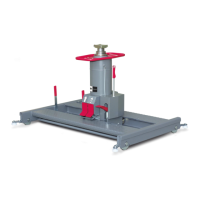
Construction and function
5.5 Operating station
The operator station on each lifting unit is located in front of the control panel.
5.6 Functional description
◼ With several mobile lifting units, heavy vehicles can be lifted and lowered for
maintenance and repair work.
◼ The lifting units can be moved manually on rollers.
◼ The bearing load will be absorbed by the wheels.
◼ Adjustable wheel forks allow adaptation to different sizes of wheel diameters.
◼ A lifting carriage driven by a hydraulic cylinder serves to lift and lower the load.
◼ Each lifting unit functions as a standalone and has a separate control with an
operating panel.
◼ The drive is wireless via built-in batteries.
◼ Each lifting unit has a radio module and is thus able to lift a vehicle together
with other lifting units.
5.7 Description of process engineering
The mobile lifting units are battery powered devices. Sets consisting of 2, 3, 4, 6 or 8 mobile
lifting units are required to lift a vehicle. All mobile lifting units have a fully-fledged control
system. The lifting units can be combined to form a lifting system. The operation of the entire
system is possible from any lifting unit. Control commands Up / Down will then apply to the
entire lifting system. When raising / lowering, an automatic synchronisation control is active.
The height measurement is carried out via a wire-actuated encoder, the transmission of data,
lifting height, and error status and control commands is done via radio to all lifting units.


 To Next Page
 Loading...