Hazardous Waste – Battery Disposal
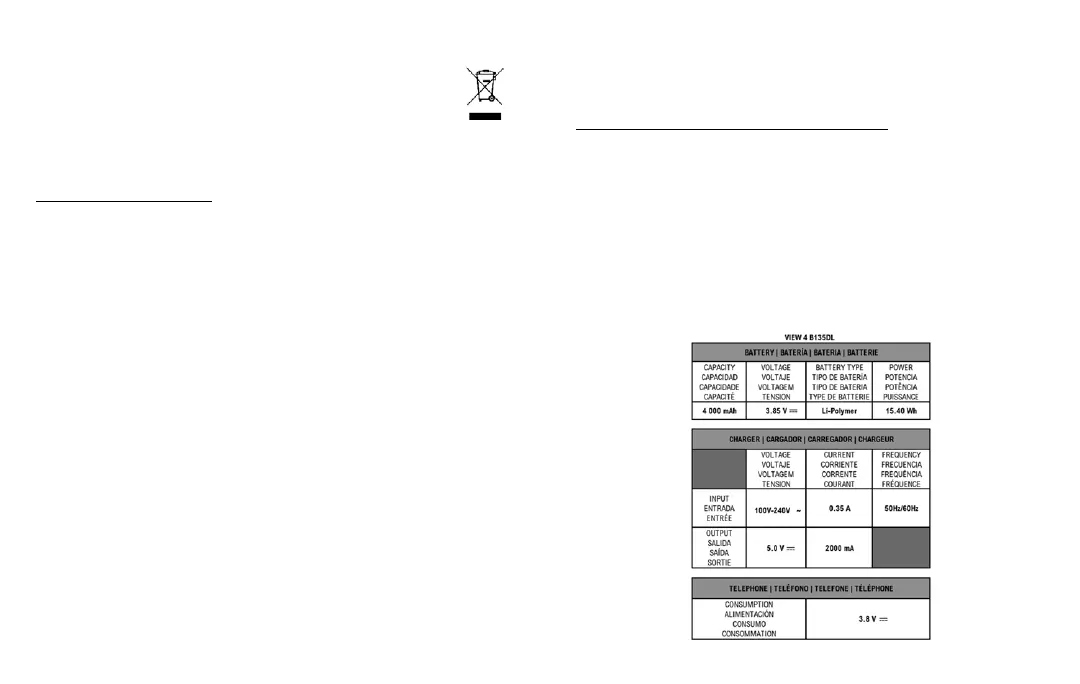
Warning: Do not throw away batteries with uncontrolled daily waste.
The marking in this manual indicates that the batteries in this product should not be disposed with
household trash at the end of its working life. If the batteries are not disposed of properly, the substances
included can cause harm to human health and the environment. Please follow environmental laws and
guidelines for proper waste disposal.
Cleaning and Maintenance
• Avoid using the handset and accessories in excessively moist areas to avoid malfunction.
• Use a soft, dry cloth to clean the handset, battery and charger.
• Do not use alcohol, thinner, benzene or any other solvent to clean the handset.
Safety precautions for power supply unit
Use the correct external power source
A product should be operated only from the type of power source indicated on the electrical ratings label. If you are
not sure of the type of power source required, consult your authorized service provider or local power company. For
a product that operates from battery power or other sources, refer to the operating instructions that are included
with the product.
This product should be operated only with the following designated power supply unit(s)
Handle battery packs carefully
This product contains a Lithium-ion battery. There is a risk of fire and burns if the battery pack is handled
improperly. Do not attempt to open or service the battery pack. Do not disassemble, crush, puncture, short circuit
the external contacts or circuits, dispose of in fire or water, or expose a battery pack to temperatures higher than
104°F (40°C). The operating temperature for the phone is -14°F (-10°C) to 104°F (40°C). Warning: Danger of
explosion if battery is incorrectly replaced.
To reduce risk of fire or burns, do not disassemble, crush, puncture, short circuit the external contacts, expose to
temperature above 104°F (40°C), or dispose of in fire or water. Replace only with specified batteries. Recycle or
dispose of used batteries according to the local regulations or reference guide supplied with your product.
Take extra precautions
• Do not disassemble or open crush, bend or deform, puncture or shred.
• Do not short circuit a battery or allow metallic conductive objects to contact battery terminals.
• The phone should only be connected to products that bear the USB-IF logo or have completed the USB-IF
compliance program.
• Do not modify or remanufacture, attempt to insert foreign objects into the battery, immerse or expose to water
or other liquids, expose to fire, explosion, or other hazards.
• Battery usage by children should be supervised.
• Only use the battery for the system for which it is specified.
• Only use the battery with a charging system that has been qualified with the system per CTIA Certification
Requirement for Battery System Compliance to IEEE1725. Use of an unqualified battery or charger may present
a risk of fire, explosion, leakage, or other hazards.
• Replace the battery only with another battery that has been qualified with the system per this standard,
IEEE-Std-1725. Use of an unqualified battery may present a risk of fire, explosion, leakage, or other hazards.
• Promptly dispose of used batteries in accordance with local regulations.
• Avoid dropping the phone or battery. If the phone or battery is dropped, especially on a hard surface, and the
user suspects damage, take it to a service center for inspection.
• Improper battery use may result in a fire, explosion, or other hazard.
If the battery leaks:
• Do not allow the leaking fluid to come in contact with skin or clothing. If already in contact, flush the affected
area immediately with clean water and seek medical advice.
• Do not allow the leaking fluid to come in contact with eyes. If already in contact, DO NOT rub; rinse with clean
water immediately and seek medical advice.
• Take extra precautions to keep a leaking battery away from fire as there is a danger of ignition or explosion.
Hearing Aid Compatibility (HAC) for Wireless Telecommunication Devices
This phone has a HAC rating of M4/T3
What is hearing aid compatibility?
The Federal Communications Commission has implemented rules and a rating system designed to enable people
who wear hearing aids to use these wireless telecommunications devices more effectively. The standard for
compatibility of digital wireless phones with hearing aids is set forth in American National Standard Institute (ANSI)
standard C63.19. There are two sets of ANSI standards with ratings from one to four (four being the best rating): an
“M” rating for reduced interference making it easier to hear conversations on the phone when using the hearing aid
microphone, and a “T” rating that enables the phone to be used with hearing aids operating in the tele-coil mode
thus reducing unwanted background noise.
How will I know which wireless phones are hearing aid compatible?
The Hearing Aid Compatibility rating is displayed on the wireless phone box. A phone is considered Hearing Aid
Compatible for acoustic coupling (microphone mode) if it has an “M3” or “M4” rating. A digital wireless phone is
considered Hearing Aid Compatible for inductive coupling (tele-coil mode) if it has a “T3” or “T4” rating.



 To Next Page