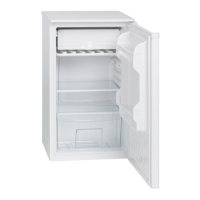
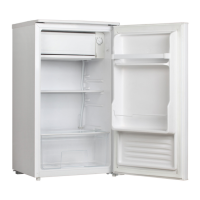
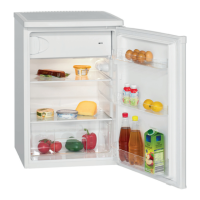
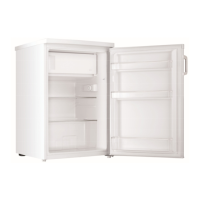
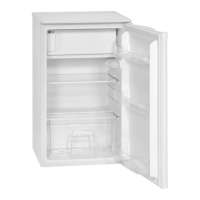
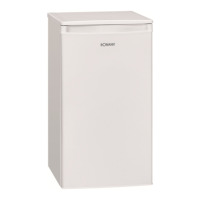
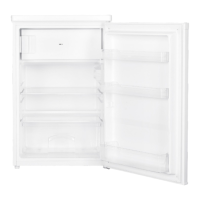
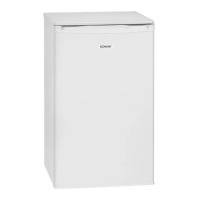
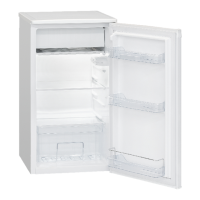
This document outlines the operation, maintenance, and safety guidelines for the BOMANN KS 261 Household Refrigerator with Ice Box. It is essential to read this manual thoroughly before initial use and keep it for future reference to ensure proper and safe operation of the appliance.
Function Description
The BOMANN KS 261 is a household refrigerator designed for private use, primarily for cooling and storing food items. It features a main refrigeration compartment and an integrated ice box. The refrigeration compartment is suitable for storing fresh food and drinks, while the ice box allows for short-term storage of already frozen food and the preparation of ice cubes. The appliance operates by maintaining a cool internal temperature, which can be adjusted via a temperature control located inside the fridge. The cooling process involves a compressor and a coolant circuit containing Isobutane (R600a), a natural and environmentally friendly refrigerant. An interior lamp illuminates the compartment when the door is opened.
Usage Features
- Temperature Control: The refrigerator is equipped with a temperature control knob, ranging from "0 - OFF" to "7 - MAX." Setting "0 - OFF" turns the device off. Turning the control clockwise from "1 - MIN" (warmest inside temperature) to "7 - MAX" (coldest inside temperature) regulates the internal temperature. The interior lamp activates automatically when the door is opened. For initial operation, it is recommended to set the control to the highest setting until the desired temperature is reached, then adjust to a medium setting for easier fine-tuning.
- Food Storage Recommendations: To prevent drying-out and transfer of odors or tastes, all food should be stored covered or packed. Suitable packing materials include polyethylene plastic bags or foil, plastic containers with lids, special elasticated plastic covers, and aluminum foil. Fresh packed items should be placed on the glass shelves, and fresh fruits and vegetables in the vegetable box. Bottles can be stored in the door racks. Meat should be well-packed and stored for a maximum of 2 to 3 days, avoiding contact with cooked dishes. Warm food should be allowed to cool down before being placed in the refrigerator.
- Ice Box Functionality: The ice box is designed for short-term storage of frozen food at temperatures up to -4°C and specifically for making ice cubes. Users should refer to the packaging of frozen food for recommended storage durations.
- Defrosting: Regular defrosting is necessary to ensure efficient cooling and energy saving. To defrost, turn the temperature control to "0 - OFF" and disconnect the plug. All food items should be removed and kept in a cool location. Once the ice has melted, the condensate should be poured away, and the interior of the device dried thoroughly before restarting operation. It is crucial to avoid using metal objects (e.g., knives) to remove ice from the vaporizer, as this can cause damage and serious malfunctions.
- Door Reversibility: The door opening direction can be reversed from the factory-set right-hand side to the left-hand side if required. This process involves disconnecting the device from the power supply, removing the top cover and hinges, relocating the lower hinge, and then reattaching the door and top cover. Careful alignment is necessary to ensure smooth door operation.
- Adjustable Components: The refrigerator includes height-adjustable glass shelves and adjustable feet to ensure the device is horizontally leveled on uneven surfaces.
Maintenance Features
- Cleaning and Care: For hygienic reasons, the interior and accessory parts of the refrigerator should be cleaned regularly. Before cleaning, always disconnect the plug or turn off/unscrew the fuse. Avoid using steam cleaners, as moisture can damage electrical components and hot steam can damage plastic parts. The device must be dry before restarting operation. Do not use essential oils, organic solvents, or abrasive cleaning agents, as these can damage plastic parts. The cleaning process involves removing all food, cleaning the interior with warm water and a mild detergent, and then thoroughly drying before restarting. The cooling coils should not be bent, and arenaceous abrasives should not be used.
- Bulb Replacement: The interior lamp has specifications of 220-240V, max. 10W. To replace a defective bulb, the device must be turned off by setting the temperature control to "0 - OFF," the plug disconnected, the lamp cover removed, the old bulb replaced, and then the cover reattached and the device reconnected.
- Troubleshooting: The manual provides a troubleshooting guide for common issues such as the device not working, loud operating noises, water on the bottom, or the interior lamp not working. This guide helps users identify possible causes and solutions before contacting a technician. For instance, if the device is not working, checks include verifying the plug connection, fuse, temperature control setting, ambient temperature, and ensuring proper door closure and ventilation.
- Energy Saving Tips: To optimize energy consumption, users are advised to disconnect the plug when not in use, avoid installing the device near heat sources, ensure sufficient ventilation, allow warm dishes to cool before placing them inside, avoid opening the door longer than necessary, set the temperature only as low as needed (ideal fridge temperature is 7°C), regularly defrost the device, and ensure the door sealing is in good order.
- Disposal: The product is marked in accordance with the European waste regulation 2002/96/EC - WEEE, indicating it should not be disposed of with regular household waste. Users are required to return the product to a collection point for recycling electric and electronic equipment, adhering to local regulations. Before disposal, the device should be disabled by disconnecting the mains plug, removing the plug, and disabling any spring or latch locks to prevent children from accidental entrapment.

 Need help?
 General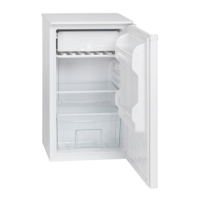

 To Next Page