This document provides operating instructions for the Bornemann SLH-5G screw pump, designed for hygiene applications in non-Ex areas. It covers general information, safety, layout and function, transportation and storage, preservation, set-up and connection, commissioning, operation, servicing, troubleshooting, putting out of operation, and disposal.
Function Description
The SLH-5G screw pump is designed to safely and efficiently pump various media. It operates by means of a motor, which drives the pump through a coupling. The pump assembly can include a profile frame or base plate, and may be equipped with an optional heating system for specific applications. A sealing supply system, if provided, supports the mechanical seals with lubrication and cooling through a closed circulation circuit. Measuring devices can be integrated to monitor temperature, pressure, vibrations, and fluid levels. The pump also comes standard with an i-ALERT machine monitoring device, which continuously measures vibrations and temperature.
Important Technical Specifications
Type: SLH-5G
Application: Hygiene application | non-Ex
Anticipated Service Life: 20 years
Pump Alignment Tolerances:
- Axial Offset (ΔKa):
- Size 2000: +1.0 mm
- Size 3000: +1.0 mm
- Size 4000: +1.0 mm
- Angle Offset (ΔSperm): (Values vary with RPM)
- Size 2000: 0.31 mm (750 rpm) to 0.16 mm (2800 rpm)
- Size 3000: 0.35 mm (750 rpm) to 0.18 mm (2800 rpm)
- Size 4000: 0.40 mm (750 rpm) to 0.21 mm (2800 rpm)
- Radial Offset (ΔKr): (Values vary with RPM)
- Size 2000: 0.31 mm (750 rpm) to 0.16 mm (2800 rpm)
- Size 3000: 0.35 mm (750 rpm) to 0.18 mm (2800 rpm)
- Size 4000: 0.40 mm (750 rpm) to 0.21 mm (2800 rpm)
Lubricating Oil Quantities (Bearing Casing):
- Size 2000: 0.60 I
- Size 3000: 1.20 I
- Size 4000: 2.40 I
Preservative Quantities (Bearing Casing):
- Size 2000: 2 I
- Size 3000: 3 I
- Size 4000: 6 I
Filter Mesh Size for Inlet Line (depending on viscosity):
- Start-up phase (all sizes): 1 mm (for 1-600 mm²/s and >600 mm²/s)
- Ongoing operation:
- Size 2000: 2 mm (1-600 mm²/s), 3 mm (>600 mm²/s)
- Size 3000: 4 mm (1-600 mm²/s), 6 mm (>600 mm²/s)
- Size 4000: 4 mm (1-600 mm²/s), 6 mm (>600 mm²/s)
Noise Level: Airborne sound level (LpA) ranges from approximately 60 dB to 100 dB depending on output demand (P in kW).
Warranty: 18 months after delivery or 12 months after commissioning, unless otherwise stipulated. Warranty becomes void due to non-compliance with the manual, not observing operating conditions from the data sheet, or unauthorized modifications.
Usage Features
Proper Use:
- Operate only in compliance with the manual and supplementary documents.
- All work must be performed by specialist personnel.
- Pump must be in technically perfect condition.
- Use exclusively for the agreed pumped medium and within specified operating limits.
- Observe limits for solids and gas content in pumped liquids.
- Ensure inlet and outlet lines are properly connected in the direction of flow.
- Avoid dry running; pump must be filled with medium before operation.
- Avoid cavitation by fully opening inlet and outlet side valves during operation.
- Operate with suitable non-return protection, differential pressure monitoring, and operating pressure limiting.
Set-up and Connection:
- Installation: Can be installed with machine feet, metal dowels (screwed), or anchor bolts (cast). Requires careful alignment of the pump assembly and coupling.
- Heat Insulation (optional): Must be installed to allow safe detection of leaks.
- Pipelines: Configure pipelines to avoid excessive forces and torques. Ensure pipelines are clean, strain-free, and leak-tight. Maintain recommended minimum straight lengths for inlet (A > 5 x DN) and outlet (B > 5 x DN) lines.
- Filter: A filter in the inlet line is required during commissioning and after maintenance, with specific mesh sizes depending on viscosity. A filter is also recommended for ongoing operation.
- Electrical Connection: Earth the pump assembly. Connect power lines for supply systems and motor according to the circuit diagram. Check the motor's direction of rotation before coupling.
Commissioning:
- Preparation: Remove preservative, check oil level, and prepare the heating system (if provided).
- Sealing Supply System: Prepare according to manufacturer's specifications, ensuring barrier fluid compatibility and proper circulation.
- Filling and Bleeding: Ensure the pump is filled with liquid medium and vented before switching on to prevent dry running.
Operation:
- Starting: Ensure proper commissioning, correct filter insert for ongoing operation, and activate heating (if applicable). Fully open inlet and outlet valves. Switch on motor and ensure smooth running. Monitor temperature change for hot pumped medium (< 2 K/min).
- Stopping: Switch off motor, close inlet and outlet valves. If a sealing supply system is present, switch it off after a 2-minute delay. Switch off heating if permitted by the process.
- Cleaning/Sterilising (CIP/SIP): Procedures vary based on medium temperature and presence of a sealing supply system. Ensure CIP/SIP medium compatibility. For temperatures > 80 °C, specific stopping and restarting procedures apply.
Maintenance Features
Monitoring (for trouble-free operation):
- Regularly check for deposits on surfaces (clean regularly).
- Ensure inlet and outlet valves are open.
- Verify filter in pipelines and ventilation filter in bearing casing are clean and free.
- Check supply pressure, mechanical seal for leakage, and proper function of sealing supply system (if present).
- Confirm proper function of safety equipment.
- Ensure no dry run or cavitation.
- Check for tightness and absence of unusual running noises or vibrations.
- Monitor for rigid body vibrations via foundation or pipeline connections.
Maintenance Schedule (Check at suitable intervals):
- General: Alignment of coupling, condition of elastic elements, temperature of rolling bearings (alarm at 100 °C, shutdown at 120 °C), sealing supply system and barrier fluid condition, legibility of warning signs.
- Corrosion Prevention: Inspect components in contact with transport medium for corrosion. Decommission pump and contact ITT Bornemann GmbH if corrosion is found.
- Performing Maintenance Work: Ensure safety, switch off drive system and secure against restart, close all interfaces to pumping process, relieve pressure, empty and clean pump and piping.
Lubrication:
- Lubrication Points: Oil inlet, oil sight glass, oil drain.
- Lubricant Type: Use only the lubricant specified on the material label on the pump. Incompatible lubricants can cause property damage.
- Refilling: Switch off pump, allow to cool, open oil inlet, fill until oil level is within specified limits in the oil sight glass, close oil inlet.
- Changing Lubricating Oil: Switch off pump, allow to cool, open oil drain, drain oil into a suitable container, close oil drain, refill with new oil.
- Maintenance Intervals (Oil Lubrication):
- Foods & Pharmaceuticals, Ambient Temp -40 °C to ≤ 40 °C, PAO oil:
- First 250 hours of operation (or latest after 3 months).
- Intermittent operation: every 4000 hours (or latest after 24 months).
- Continuous operation: every 8000 hours (or latest after 18 months).
Repairs:
- Warranty claims are void if the pump is opened by unauthorized personnel during the warranty period. Repairs must be performed by trained ITT Bornemann GmbH technicians.
- For repairs, a declaration of no objection regarding pumped material is required.
Ordering Spare Parts:
- Specify pump type, order number, serial number, position number of the part, name of the part, and quantity.
- For bearings, specify internal clearance (normal air for cylindrical roller bearings and single-row angular contact ball bearings).
Cleaning Agent:
- Must be compatible with the material.
- Use only cleaners permitted for hygiene-protected areas.
Disposal:
- Decommission the pump properly.
- Drain lubricating oil safely.
- Thoroughly clean and disassemble components according to local occupational safety and environmental regulations.
- Enclose a declaration of no objection with disassembled components if necessary.
- Recycle scrap metals and plastic elements. Dispose of remaining components according to local regulations.

 Need help?
 General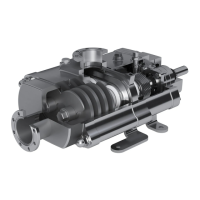

 To Next Page