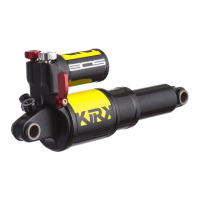
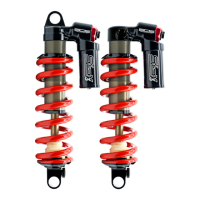
The BOS VOID2 is a high-performance mountain bike rear shock designed to provide optimal suspension and handling for various riding styles and terrains. It features a three-way adjustable damping system, allowing riders to fine-tune rebound, low-speed compression, and high-speed compression to match their weight, bike geometry, and personal preferences.
Function Description:
The primary function of the BOS VOID2 shock is to absorb impacts and vibrations from the terrain, providing a smoother and more controlled ride. It achieves this through a combination of air spring and hydraulic damping. The air spring supports the rider's weight and provides initial travel, while the hydraulic damping system controls the speed at which the shock compresses and extends, preventing harsh bottom-outs and uncontrolled rebound. The three-way adjustable damping system allows for precise control over these characteristics, ensuring the bike remains stable and responsive in diverse riding conditions. The shock is designed to integrate seamlessly with various bike frames, with options for adjusting the air valve position to ensure compatibility.
Usage Features:
- Air Pressure Adjustment: The VOID2 shock requires precise air pressure settings based on the rider's weight and the bike's rear suspension geometry. Riders can connect a shock pump to the Schrader valve on the upper part of the body and inflate it to the recommended pressure. BOS recommends using their digital gauge shock pump for greater accuracy.
- Equalizing Air Chambers: After setting the air pressure, it is crucial to equalize the air chambers for correct shock function. This involves placing the travel checker O-ring 11mm from the shock seal, sitting on the bike to compress the suspension until the seal reaches the O-ring, and then allowing it to extend fully. The process is completed by slowly cycling the shock 15 times over the first 11mm of its travel.
- SAG Setting: SAG (Static Air Gap) is the amount of travel used by the suspension under the rider's weight. BOS recommends a SAG percentage of 30-35%, depending on usage and riding style. To measure SAG, riders slide the O-ring to the dust seal, sit on the bike in a horizontal position with feet on pedals, and allow the suspension to compress. After dismounting without further compression, the distance between the O-ring and the seal is measured. Air pressure is adjusted in 15psi steps to achieve the desired SAG, with equalization of air chambers after each adjustment. Increasing air pressure reduces SAG, while decreasing it increases SAG.
- Low-Speed Compression (LSC) Adjustment: The LSC knob (A) affects the shock's performance over small bumps and during the initial part of the travel. Turning the knob clockwise hardens the LSC, which is beneficial for rolling terrain with large compressions and kickers. Turning it counter-clockwise softens the LSC, which can be useful on steep gradients.
- High-Speed Compression (HSC) Adjustment: The HSC knob (B) primarily influences the shock's response to harsh impacts like jump landings and rough sections. It should be soft enough to utilize full travel without frequent bottom-outs. Turning the knob clockwise hardens the HSC, suitable for tracks where bottoming out is common. If the shock doesn't achieve full travel, softening the HSC by turning the knob counter-clockwise is recommended.
- Rebound Adjustment: The rebound knob (C) controls the speed at which the shock extends after compression. Proper rebound adjustment helps maintain the bike's chassis position, preventing it from feeling "sunken down" or too high. Slowing down the rebound (clockwise turn) is useful if the bike pushes the rider forward on slopes or during braking. Speeding up the rebound (counter-clockwise turn) is recommended if the bike feels too low at the back or the front tends to drift offline. BOS suggests setting a fast rebound to keep the chassis balanced and avoid the bike sitting low in its travel.
- Air Volume Adjustment: The VOID2 features progressivity adjustment by adding or removing O-rings inside the air can. This allows riders to fine-tune the spring rate in the last third of the stroke. Adding O-rings increases the end-stroke spring rate, providing better chassis control and preventing bottom-out, especially if the shock is set up for comfort and grip. Removing O-rings decreases the end-stroke rate, ensuring full travel usage when the shock is responsive with a high chassis balance. Each O-ring added increases the end-stroke spring rate by 2%. The typical range is 0 to 4 O-rings, but can extend up to 10 depending on the bike.
- Air Valve Adjustment: The air valve can be rotated around the air can and positioned towards or away from the piggyback to ensure maximum compatibility with different bike frames. This adjustment involves placing the shock head in a soft-jawed vice, deflating the shock, unscrewing the air can, rotating the valve sleeve, and then reassembling and re-inflating the shock.
Maintenance Features:
- Daily Cleaning: It is essential to clean the shock after each ride to prolong the life of the seals. This involves wiping the body and seal with a clean, soft rag. Degreasers, solvents, abrasive materials, or power washers should never be used on the seals.
- Occasional Lubrication: The exterior of the seal can be occasionally lubricated with fork oil.
- Service Schedule:
- Cleaning: After each ride for both recreational and racing use.
- Oil Service: Once a year for both recreational and racing use.
- Full Service: Every two years for recreational use, and once a year for racing use.
- Professional Service: Oil changes and full services should be performed at an official BOS service center. These centers are equipped to identify and resolve damaged or worn parts, especially for extreme shocks or premature wear on structural elements like the body, mounting kits, and shaft. Using only BOS-provided O-rings for air volume adjustments is crucial, as their dimensions and material are specifically chosen for this purpose.

 Need help?
 General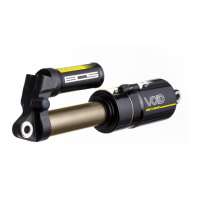

 To Next Page