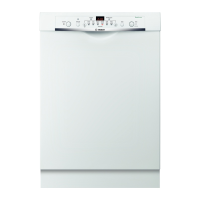
This document serves as a Quick Start & Safety Guide for a Bosch dishwasher, specifically models in the SHE3AR**** series. It outlines essential information for safe operation, proper usage, and basic maintenance, encouraging users to refer to the full Use and Care Manual for comprehensive details.
Function Description
The Bosch dishwasher is designed for washing household dishware and kitchenware that are rated as dishwasher safe. It offers various wash cycles tailored to different levels of dirt and types of dishes, along with options to enhance cleaning and drying performance. The appliance is electronically grounded for safe operation and includes features to prevent tip-over hazards during installation.
Usage Features
The dishwasher's operation begins by pressing the On/Off button, selecting a desired cycle and option, and then pressing Start.
Loading Tips for Optimal Cleaning:
- Lower Rack: Plates and bowls should be loaded leaning inward. Larger items like pots and pans should be placed upside down.
- Upper Rack: Designed for small plates, glasses, and cups. A cup shelf is provided, which also functions as stemware support.
- Cutlery Basket: Sharp items such as knives and skewers should be loaded pointing down to prevent injury.
- General Loading: Avoid overcrowding dishes and ensure that water spray is not blocked to maintain wash performance. Do not place objects in the detergent tray or block it with dishes.
Detergent and Rinse Aid:
- Detergent: Users can use detergent tabs, fresh powdered detergent, or liquid detergent. For the Glass cycle, 1-1.75 Tbsp. of detergent or glassware-protected detergent tabs are recommended. The dispenser lid should slide closed easily.
- Rinse Aid: Essential for enhanced drying results and shine. Rinse aid should be added before first use and when the "Refill Rinse Aid" indicator illuminates. The reservoir is accessed by lifting a tab, and liquid rinse aid is poured into the oval, avoiding the air vent. Excess rinse aid should be wiped up. The amount of rinse aid dispensed can be adjusted across six levels to prevent streaks or improve drying.
Cycles and Options:
The dishwasher offers several cycles to accommodate different cleaning needs:
- Heavy: For baked-on or greasy dishes, utilizing a longer cycle and higher temperature. Examples include baked-on lasagna casseroles.
- Auto: Adjusts time and intensity automatically based on soil sensing, suitable for everyday loads.
- Normal: A cycle designed to save energy and water, ideal for everyday loads.
- Express: For fresh, lightly soiled dishes, reducing overall wash time.
- Delicate: Lowers temperature and shortens cycle length to protect delicate dishes and glasses.
- Half Load: Cleans small loads with less energy, time, and water, requiring less detergent. Suitable for small loads of glasses, plates, and cups.
Available options include:
- Delay: Allows users to delay the start of the cycle for up to 24 hours.
- Sanitize: Increases cycle length and temperature for disinfection, suitable for items like cutting boards and bottles.
- Child Lock: Activated by holding a specific button for 3 seconds until "CL" appears on the display, locking the control panel. Holding the button for 3 seconds again deactivates it.
Adjusting Settings:
Beyond the standard cycles and options, users can adjust specific settings:
- Press On/Off.
- Hold the selection buttons (>) and START until "d:0x" appears on the display.
- Release both buttons.
- Press the selection button (>) to navigate to the desired setting.
- Press the selection button (<) to choose the specific setting.
- Press the Start button to save the changes.
Adjustable settings include:
- Rinse Aid (r:05-r:06): Controls the amount of rinse aid dispensed, affecting drying performance.
- Intensive Drying (d:00-d:01): Improves drying for glasses and plastic by increasing temperature and length.
- Auto Power Off (P:00-P:02): Determines if the unit shuts off automatically after a cycle, either after 1 minute (P:01) or 2 hours (P:02).
Everyday Tips:
- Scrape off food from dishes but do not pre-rinse them.
- Adjust the upper rack height as needed to accommodate larger items.
Maintenance Features
Regular maintenance helps ensure optimal performance and longevity of the dishwasher.
- Exterior Cleaning: Surfaces should be cleaned with a damp cloth and mild soap. Abrasives, bleach-based cleaners, stainless steel cleaner (on black stainless or anti-fingerprint surfaces), harsh chemicals, or steam cleaning products should not be used, as they can damage the exterior door panel.
- Filter System Cleaning: The filter system should be cleaned 3-12 times a year, depending on usage.
- Unscrew the Large Object Trap and remove the entire filter system.
- Remove the micro-filter from the fine filter.
- Rinse the filters under running water and clean them with a soft brush.
- Reinstall the filter system in reverse sequence, ensuring arrows are aligned.
- Water Supply: It is recommended to familiarize oneself with the procedure to shut off the incoming water supply and power supply.
- Freezing Temperatures: Do not allow water to remain in the dishwasher systems during extended periods of freezing temperatures, as this can damage the water fill valve and other components.
- Detergent Dispenser: Never pour detergent into the salt dispenser, as it will destroy the water softening system.
- Rinse Aid Dispenser: Do not overfill to avoid oversudsing or clogging. Wipe up any spills immediately.
Troubleshooting (Frequently Asked Questions):
- Food left on dishes: Check for adequate clearance between dishes, ensure nothing is blocking the spray arm, and confirm the filter is clean. An intensive cleaning cycle may be needed.
- Long cycle time: Sensors may increase cycle time for heavy soil, or incoming water may not be hot enough, requiring the dishwasher to heat it.
- Error codes (E:XX): These indicate specific issues. For example, E:22 suggests water in the sump due to a blocked or dirty filter. The full Use and Care Manual provides a list of error codes.

 Need help?
 General


 To Next Page