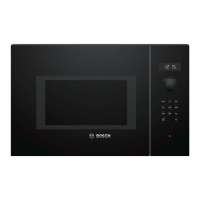
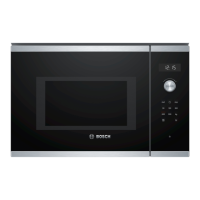
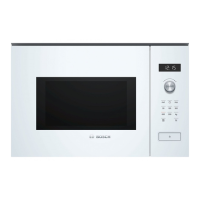
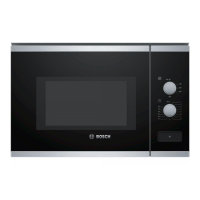
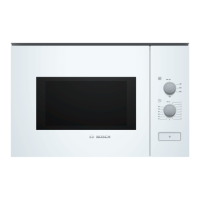
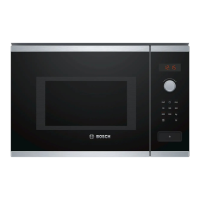
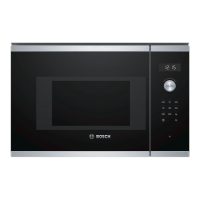
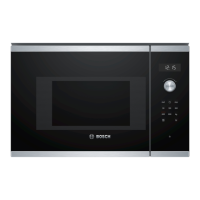
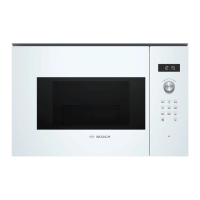
This document is the user manual and installation instructions for a Bosch Microwave Oven, covering models BFL554MB0B, BFL553MS0A, BFL554MS0B, BFL553MB0B, BFL553MS0B, and BFL553MW0B. It provides comprehensive guidance on safe operation, intended use, material damage prevention, environmental protection, basic operation, memory functions, automatic programs, basic settings, cleaning, troubleshooting, disposal, and installation.
Function Description
The Bosch Microwave Oven is designed for preparing meals and drinks, offering various microwave power settings for defrosting, cooking, and heating food and liquids. It operates as a Group 2, Class B product, meaning it produces microwaves for heating food and is suitable for private households. The appliance features a control panel with touch fields, a rotary selector, and a display to configure functions, set times, and monitor operating status. An automatic door opener provides convenient access to the cooking compartment.
The microwave offers several power settings:
- 90 W: For defrosting delicate foods.
- 180 W: For defrosting food and continuing cooking.
- 360 W: For cooking meat and fish or heating delicate foods.
- 600 W: For heating and cooking food.
- 900 W: For heating liquids.
It includes a cooling fan that operates as needed, even when the oven is switched off, to maintain optimal temperature. Condensation may occur during cooking, which is normal and should be wiped away.
Usage Features
The appliance supports both manual microwave operation and automatic programs.
Manual Operation:
Users can set the desired microwave power and cooking duration using the rotary selector and touch fields. The cooking process can be paused by opening the door or pressing the "stop" button, and resumed by closing the door and pressing "start." The operation can be cancelled by pressing "stop" twice or opening and then pressing "stop" once.
Memory Function:
A memory function allows users to save settings for frequently prepared dishes. This feature enables quick recall and start of saved programs, simplifying repetitive cooking tasks. Settings can be saved with or without immediate start.
Automatic Programs:
The microwave offers automatic programs for defrosting and cooking various foods, simplifying the process by automatically selecting optimum settings.
- Defrosting Programs (P01-P04): These programs are designed for defrosting minced meat, pieces of meat, chicken/chicken pieces, and bread. Users need to weigh the food and place it in microwave-safe shallow dishes without covers. The manual provides instructions on handling defrosted food, including draining liquids, separating pieces, and allowing standing time for even temperature distribution.
- Cooking Programs (P05-P07): These programs are for cooking rice, potatoes, and vegetables. Users need to weigh the food, place it in microwave-safe cookware with a lid, and add water according to manufacturer instructions. The manual advises stirring food during the program and allowing standing time for uniform temperature.
Basic Settings:
The appliance allows users to customize basic settings, such as the clock and signal duration. The clock can be set after connecting to power or after a power cut. The signal duration (short or long) can also be adjusted. The clock can be hidden to reduce standby power consumption.
Safety Features:
The manual emphasizes numerous safety precautions:
- Risk of fire: Never store combustible objects in the cooking compartment, remove food remnants, and avoid heating food in heat-retaining packaging or with low water content at high power. Do not use the microwave to dry food or heat cooking oil alone.
- Risk of burns: Accessories and cookware become very hot; use oven gloves. Hot steam may escape when opening the door. Do not pour water into a hot cooking compartment.
- Risk of scalding: Accessible parts become hot; avoid touching them. Keep children at a safe distance. Be cautious with liquids due to delayed boiling; always place a spoon in the container when heating liquids.
- Risk of injury: Scratched glass can crack; avoid harsh cleaners. Keep hands away from door hinges. Handle the glass turntable with care. Use only microwave-safe cookware to prevent cracking or sparking.
- Risk of electric shock: Damaged power cords are dangerous; avoid contact with hot parts, sharp edges, or kinks. Never remove the casing.
- Risk of suffocation: Keep packaging material and small parts away from children.
- Risk of explosion: Do not heat liquids or food in tightly sealed containers. Prick the yolk of eggs and the skin of foods like apples, tomatoes, potatoes, and sausages before microwaving to prevent bursting.
Maintenance Features
Cleaning and Servicing:
Regular cleaning is crucial for efficient and long-lasting appliance operation.
- Cleaning Products: Only suitable cleaning agents should be used. Avoid harsh, abrasive, or high-alcohol content cleaners, hard scouring pads, or metal scrapers. Specific recommendations are provided for different surfaces (smooth surfaces, stainless steel, glass). New sponge cloths should be thoroughly washed before use.
- Cooking Compartment: Clean with hot soapy water or a vinegar solution. For heavy soiling, use oven cleaner when the compartment is cold. Unpleasant odors can be eliminated by heating a cup of water with lemon juice.
- Turntable: Remove and clean with hot soapy water and a soft dishcloth, ensuring it engages correctly upon reinsertion.
- Appliance Front: Clean with hot soapy water and a dishcloth. For stainless steel fronts, use special stainless steel cleaning products.
- Control Panel: Clean with a microfibre cloth or a soft, damp cloth.
- Door Panels: Clean with a soft dishcloth and glass cleaner.
- Cleaning Aid: A cleaning aid function softens dirt by vaporizing soapy water, making it easier to wipe away. This involves heating a cup of soapy water with a spoon at 600 W for 3 minutes, then wiping and drying the compartment.
Troubleshooting:
The manual provides a troubleshooting guide for minor faults, advising users to check common issues like power supply, circuit breakers, door closure, and microwave settings before contacting customer service. It also warns against improper repairs and recommends professional service for defective appliances.
Installation Instructions:
Detailed instructions are provided for safe installation, including:
- Checking for transit damage and removing packaging.
- Ensuring fitted units are temperature-resistant (up to 90 °C) and adjacent fronts (up to 65 °C).
- Avoiding installation behind decorative doors or kitchen unit doors to prevent overheating.
- Performing cut-out work before installation and removing shavings.
- Emphasizing that only licensed professionals should connect appliances without plugs.
- Warnings against sharp edges during installation and the use of extension cables or multiple socket strips.
- Detailed dimensions and clearances for installation in a tall unit.
- Steps for securing spacers and screwing the appliance into the unit, ensuring central alignment and proper clearance to adjacent appliances.
The document also includes information on product registration for benefits, customer service contact details, and disposal guidelines for old appliances.


 To Next Page
 General
 Weight and Dimensions