Need help?
Do you have a question about the Bosch DWP94BC50B and is the answer not in the manual?
Packaging material is dangerous to children. Never allow children to play with it.
Risk of poisoning from flue gases due to inadequate fresh air when using exhaust air mode with heat-producing appliances.
Fatty deposits in the grease filter may catch fire. Clean regularly and avoid naked flames near the appliance.
Appliance parts become very hot during operation. Keep children at a safe distance.
Sharp edges inside, items may fall, LED lights can dazzle. Wear protective gloves.
Defective appliance. Incorrect repairs. High-pressure cleaners are hazardous.
Lists common problems, their possible causes, and solutions.
Marking guidelines and drilling instructions for wall mounting.
Warnings regarding fire risk from grease deposits and necessary clearances.
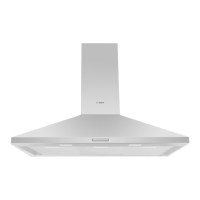
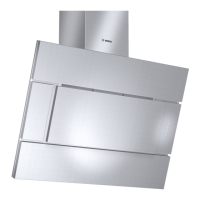
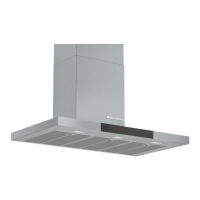
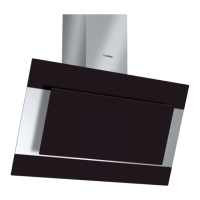
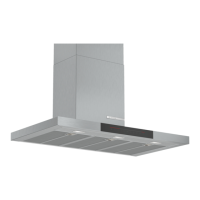
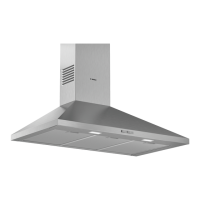
This document describes an extractor hood, a kitchen appliance designed to remove smoke, grease, and odors from the cooking area. The appliance can operate in two primary modes: exhaust air mode and circulating-air mode, offering flexibility based on kitchen setup and ventilation requirements.
The core function of the extractor hood is to maintain air quality in the kitchen by drawing in air during cooking. In exhaust air mode, the air is cleaned by grease filters and then expelled to the exterior through a pipe system. This mode is highly effective for completely removing cooking fumes from the home. For optimal performance in this mode, a short, straight exhaust air pipe with a large diameter (preferably 150 mm, but at least 120 mm) is recommended. The exhaust air must not be conveyed into a functioning smoke or exhaust gas flue or a shaft used for ventilating rooms with heat-producing appliances without proper consent from a heating engineer. If the exhaust air is conveyed through an outer wall, a telescopic wall box should be used.
In circulating-air mode, the drawn-in air is cleaned by both grease filters and an activated carbon filter before being recirculated back into the kitchen. This mode is suitable for kitchens where external venting is not feasible. An activated carbon filter is essential for binding odors in this mode. The appliance's unrestricted operation is possible if it is operated exclusively in circulating-air mode.
The appliance features a fan with multiple settings (1, 2, 3) to adjust the extraction intensity according to the cooking fumes. A lower fan speed consumes less energy, so it's recommended to adjust the speed to the intensity of the cooking fumes and only use intensive mode when necessary. If intensive cooking fumes are present, a higher fan speed should be selected promptly to prevent fumes from spreading. The lighting can be operated independently of the ventilation system.
To maximize effectiveness, it is recommended to switch on the extractor hood when cooking begins and switch it off several minutes after cooking has finished. If multiple fan speed buttons are pressed, the highest selected fan setting will always apply. Individual fan settings can be switched off by pressing the corresponding buttons.
The appliance is designed for domestic use and should not be left unattended during operation. It can be used by children over 8 years old and persons with reduced physical, sensory, or mental capacities, or lack of experience/knowledge, provided they are supervised or instructed on safe use and understand the risks. Children must not play with the appliance.
Regular cleaning and maintenance are crucial for the appliance's efficiency and safety. The metal mesh grease filters, which trap fatty deposits, must be cleaned regularly to prevent fire hazards. It is recommended to clean them every two months. The grease filters can be cleaned either by hand using hot soapy water and a brush, or in a dishwasher using normal domestic dishwashing detergents at a temperature of no more than 50 °C. When cleaning in the dishwasher, avoid cleaning heavily soiled filters with cookware and ensure sufficient space around them. Slight discoloration of the filters may occur in the dishwasher but does not affect performance. When cleaning the filters, the filter holder in the appliance should also be wiped with a damp cloth.
The appliance's surfaces, including stainless steel, painted surfaces, aluminum, plastic, glass, and controls, require specific cleaning methods. Stainless steel surfaces should be cleaned with hot soapy water and a soft cloth, always in the direction of the grain. Special stainless steel cleaning products can also be used. Painted surfaces, aluminum, and plastic should be cleaned with hot soapy water and a soft cloth. Glass surfaces can be cleaned with glass cleaner and a soft cloth, but glass scrapers should not be used. Controls should be cleaned with hot soapy water and a damp cloth, but never with a wet cloth to prevent moisture ingress into the electronic circuitry. Harsh, abrasive, or alcohol-containing cleaning agents, hard scouring pads, pressure washers, steam cleaners, descaling products, aggressive all-purpose cleaners, and oven spray should be avoided on all surfaces.
Before using the appliance for the first time, any protective film on its parts must be removed to prevent surface damage. When cleaning, the appliance should be allowed to cool down, and the mains plug should be pulled out or the circuit breaker switched off to prevent electric shock. Protective gloves should be worn when cleaning components inside the appliance due to sharp edges.
The LED lights are designed to be replaced only by the manufacturer, customer service, or a qualified technician. The light emitted by LED lights can be very dazzling, and direct viewing for more than 100 seconds should be avoided.
To ensure the appliance's longevity and prevent corrosion, it should always be switched on during cooking to avoid condensation build-up. Faulty bulbs should be replaced promptly to prevent overloading of other bulbs. The exhaust duct should be installed with a slight downward slope (1°) away from the appliance to prevent damage from returning condensate. Design elements should not be pulled, objects placed on them, or hung from them to avoid damage.
 General
| Width | 90 cm |
|---|---|
| Number of Speeds | 3 |
| Lighting | LED |
| Filter Type | Metal Grease Filter |
| Control Type | Mechanical |
| Installation Type | Wall-mounted |
| Type | Chimney |

 To Next Page