10 | English
Bodyfiller/
plaster hardness
Wall/
ceiling
internal/external
air flow
Suction power Speed setting Sanding sheet grit
Extremely hard Wall/ceiling on uneven sur-
faces
6 4–6 From P100
on even surfaces 1–3
Working Advice
u Pull the plug out of the socket before carrying out any
work on the power tool.
u Always wait until the power tool has come to a com-
plete stop before placing it down.
u Do not put the power tool down on its side. This could
permanently warp the sanding pad.
u This power tool is not suitable for bench-mounted use.
It must not be clamped into a vice or fastened to a work-
bench, for example.
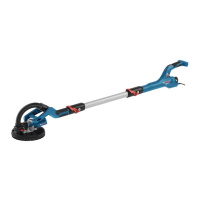
Sanding Surfaces
Switch the power tool on, place the entire sanding surface
against the surface of the workpiece and apply moderate
pressure as you move the sander over the workpiece.
The material removal rate and sanding result are primarily
determined by the choice of sanding sheet, the preselected
speed setting and the contact pressure.
Only immaculate sanding sheets achieve good sanding per-
formance and make the power tool last longer.
Be sure to apply consistent contact pressure in order to in-
crease the lifetime of the sanding sheets.
Excessively increasing the contact pressure will not lead to
increased sanding performance, rather it will cause more
severe wear of the power tool and of the sanding sheet.
Do not use a sanding sheet for other materials after it has
been used to work on metal.
Use only original Bosch-sanding accessories.
Sanding Close to Edges (seefiguresF–G)
Thanks to the removable brush segment, you can reduce the
lateral distance between the wall/ceiling and the sanding
pad.
– Press and hold the locking mechanism(12) for the brush
segment(18).
– Swivel the brush segment(18) forwards and remove it.
– To insert, hook the brush segment(18) onto the oppos-
ite side of the locking mechanism(12), and swivel it to-
wards the sanding head(11) until it clicks into place.
Adjusting the Internal/External Airflow
Depending on the vacuum pressure, the perceived tool
weight can be reduced.
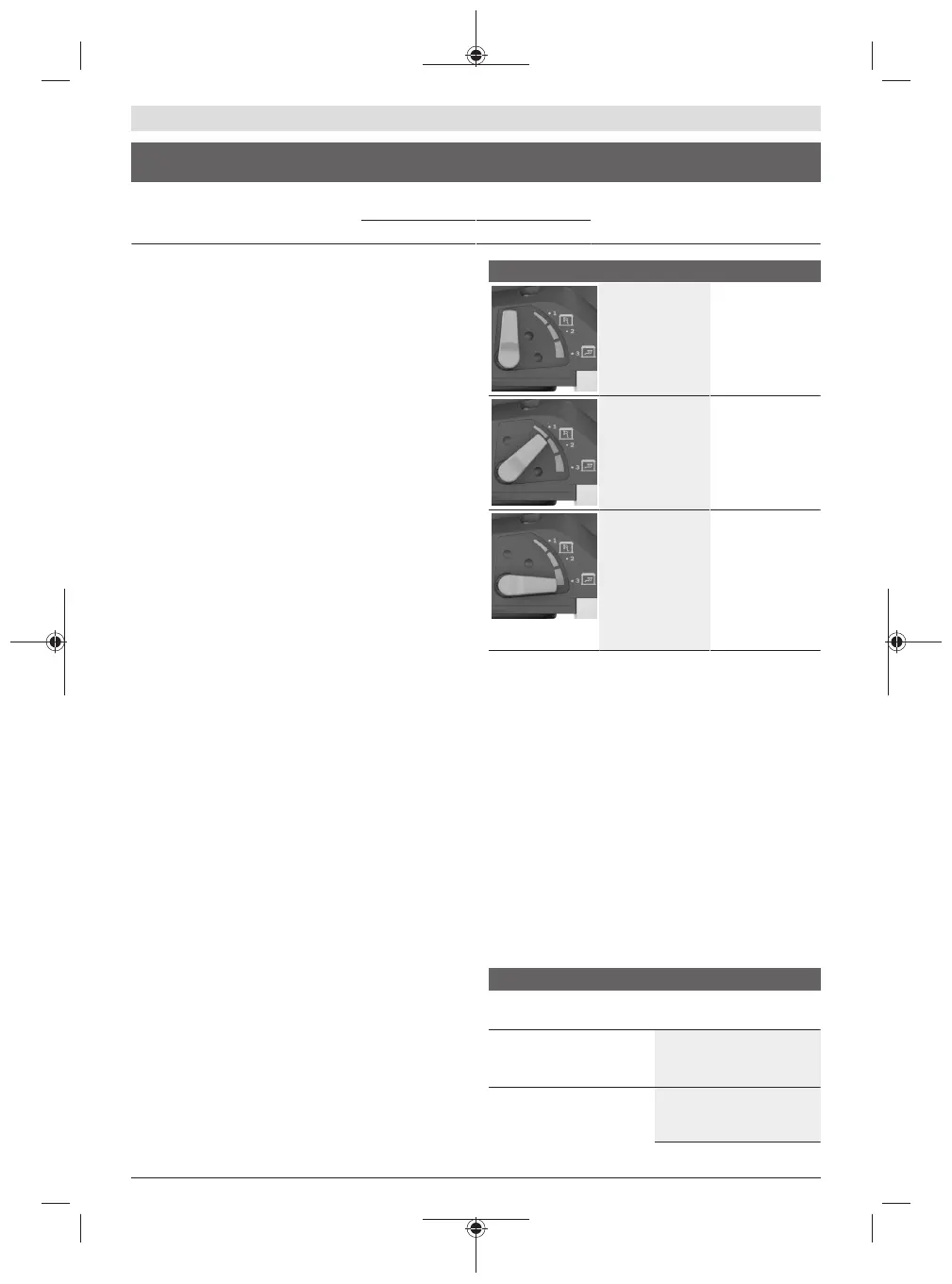
You can switch between different air flow operating modes
depending on the intended use. Turn the suction power ad-
justing lever(13) to one of the 3positions.
Switch position Type of airflow Use
External airflow Ideal for sanding
walls at high sand-
ing speeds and
without vacuum
pressure
Mixed external
and internal air-
flow
Medium sanding
performance with
vacuum pressure
effect
Mixed external
and internal air-
flow
Ideal for sanding
ceilings at low
sanding speeds
but with high va-
cuum pressure
(suction power)
for a low perceived
weight
Adjusting suction power
You can adjust the suction power to achieve your preferred
balance between sanding speed and suction power. This
regulation is only possible when the internal airflow is activ-
ated (position in the table above).
Adjust the suction power with the thumbwheel(1):
– 1−5: Low to high suction power, suitable for sanding ceil-
ings
– 6: Highest suction power, suitable for sanding walls
Start with a low suction power (position1) and increase
slowly, until there is a noticeable contact pressure.
High suction power allows low-fatigue sanding of ceilings
and walls. An excessively high suction power can cause the
power tool to vibrate, which can make handling more diffi-
cult.
Errors – Causes and Corrective Measures
Cause Corrective measure
The drywall sander does not run smoothly or jolts across
the surface.
The suction effect is too
strong.
Reduce the suction power or
switch to external dust ex-
traction, if necessary.
The bodyfiller material and/
or substrates are hard.
Reduce the suction power or
switch to external dust ex-
traction, if necessary.
1 609 92A 76U | (25.02.2022) Bosch Power Tools


 To Next Page
 Loading...