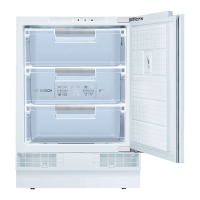
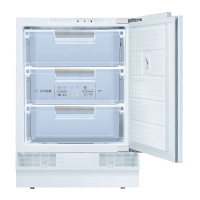
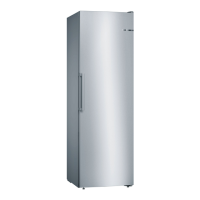
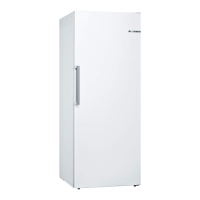
This document describes the Bosch GUN21.. Freezer, an under-counter appliance designed for freezing food and making ice cubes in private households and enclosed domestic environments, up to an altitude of 2000m above sea level.
Function Description:
The freezer compartment allows for storing frozen food, freezing fresh food, and making ice cubes. The temperature can be set between -16 °C and -24 °C, with -18 °C or lower recommended for long-term storage of perishable food. The low temperatures slow down or stop spoilage. The appliance features a fully automatic NoFrost system, eliminating the need for manual defrosting in the freezer compartment. It also includes a 2-star freezer area for temporary storage of non-delicate food (e.g., ice cubes) for up to 14 days, with temperatures between -12 °C and -16 °C depending on the main freezer compartment setting.
Important Technical Specifications:
The appliance's permitted room temperature depends on its climate class, which can be found on the rating plate. For climate class SN, the permitted room temperature is 10 °C to 32 °C; for N, 16 °C to 32 °C; for ST, 16 °C to 38 °C; and for T, 16 °C to 43 °C. The appliance is fully functional within these ranges and can operate at temperatures as low as 5 °C for SN climate class without damage.
Niche dimensions are crucial for installation: a recommended niche depth of 560 mm (minimum 550 mm) and an inside niche width of at least 600 mm are required. The weight of the appliance can be up to 40 kg, so the subfloor must be sufficiently stable.
Freezing capacity, refrigerant type, cubic capacity, and other technical specifications are detailed on the rating plate. Information about the model can also be found online via the EU EPREL product database.
The appliance is network-capable with Home Connect functionality, supporting WLAN home networks (Wi-Fi). It operates on 2.4 GHz band (2400–2483.5 MHz) with max. 100 mW and 5-GHz band (5150–5350 MHz + 5470-5725 MHz) with max. 150 mW.
Usage Features:
The control panel allows users to configure all functions and view the operating status.
- Switching On/Off: The appliance is switched on or off by pressing the "3 sec." button for three seconds.
- Temperature Setting: The freezer compartment temperature is adjusted by repeatedly pressing the ">" button until the desired setting is displayed. The recommended temperature is -18 °C.
- Super Freezing:
- Automatic Super Freezing: Activates when fresh food is placed in the bottom frozen food container (starting from the right-hand side), cooling the compartment to a much lower temperature for quicker freezing. "super" lights up, and increased noise may occur. It automatically switches to normal operation after freezing.
- Manual Super Freezing: Can be switched on four to six hours before placing 2 kg or more of food to freeze as cold as possible. Activated by repeatedly pressing ">" until "super" lights up. It switches to normal operation after approximately 54 hours.
- Sabbath Mode: Disables non-essential functions (automatic/manual Super freezing, alarm, interior lighting, audible signals, control panel messages) for use on the Sabbath. Activated by pressing and holding ">" for 15 seconds until an audible signal sounds and ">" lights up. It switches to normal operation after approximately 80 hours.
- Alarms:
- Door Alarm: Sounds and ">" lights up if the door is open for a while. Interior lighting flashes after 10 minutes. Can be switched off by closing the door or pressing ">".
- Temperature Alarm: Activates if the freezer compartment becomes too warm. This can occur when the appliance is first switched on, large quantities of fresh food are added without Super freezing, or the door is left open too long. It can be switched off by pressing ">".
- Home Connect: Allows control of appliance functions via a mobile device using the Home Connect app. Users must set up a connection to their WLAN home network (Wi-Fi) and the app. Home Connect settings can be reset by pressing and holding the Wi-Fi button for six seconds until the Wi-Fi symbol goes out.
- Making Ice Cubes: Use the ice cube tray, filling it with drinking water up to 3/4. If stuck, loosen with a blunt implement or hold under flowing water.
- Food Storage Tips: Store food in airtight packaging, avoid contact between fresh and frozen food, place food over the entire area of frozen food containers, and ensure containers are pushed in fully for air circulation. Allow warm food to cool before storing.
- Freezing Fresh Food Tips: Freeze fresh, undamaged food in portions. Cooked food is preferred over raw. Vegetables should be washed, chopped, and blanched. Fruits should be washed, pitted, and possibly peeled, with sugar or ascorbic acid solution added. Suitable foods include baked items, fish, meat, poultry, eggs (without shells), cheese, butter, quark, ready meals, and leftovers. Unsuitable foods include lettuce, radishes, eggs in shells, grapes, raw apples/pears, yogurt, sour cream, crème fraîche, and mayonnaise.
- Shelf Life of Frozen Food: The imprinted freezer calendar indicates maximum storage duration at -18 °C. Examples: fish, sausages, prepared meals, baked goods (up to 6 months); poultry, meat (up to 8 months); vegetables, fruit (up to 12 months).
- Defrosting Frozen Food: Animal-based food (fish, meat, cheese, quark) should be defrosted in the refrigerator compartment. Bread should be defrosted at room temperature. Food can also be prepared for immediate consumption in the microwave, oven, or on the hob. Do not refreeze food that has defrosted or started to defrost unless cooked first.
Maintenance Features:
Regular cleaning and servicing are important for efficient long-term operation.
- Preparing for Cleaning: Switch off the appliance, disconnect it from the power supply (unplug or switch off circuit breaker), remove all food (store in a cool place, use ice packs if available), and remove all fittings and accessories.
- Cleaning the Appliance: Clean the appliance, fittings, accessories, and door seals with a dishcloth, lukewarm water, and a pH-neutral washing-up liquid. Dry thoroughly with a soft, dry cloth. Do not use steam or high-pressure cleaners, hard scouring pads, abrasive detergents, or products with high alcohol content. Never clean fittings or accessories in a dishwasher.
- Removing Fittings: Frozen food containers can be removed by pulling them out as far as they go, then lifting them at the front and pulling them out.
- Defrosting: The NoFrost system ensures the freezer compartment remains frost-free, so manual defrosting is not required.
The manual emphasizes several safety warnings:
- Risk of Electric Shock: Incorrect installation, damaged power cords, use of external switching devices, or trapped cables can be dangerous. Only connect to a properly installed earthed socket.
- Risk of Explosion: Sealed ventilation openings or damaged cooling circuits can lead to flammable gas/air mixtures. Keep ventilation openings clear. Do not store flammable propellants or explosive substances.
- Risk of Fire: Electrical devices inside the appliance (heaters, ice makers) can cause fire. Do not operate such devices. Using extended power cords or non-approved adapters is dangerous.
- Risk of Injury: The appliance is heavy; do not lift alone. Carbonated drink containers may burst if stored in the freezer.
- Risk of Suffocation: Keep packaging material and small parts away from children.
- Risk of Cold Burns: Avoid prolonged contact with frozen food and cold surfaces. Do not put frozen food directly into the mouth.
- Risk of Harm to Health: Prolonged open door can increase temperature. Clean surfaces regularly. If empty for extended periods, switch off, defrost, clean, and leave the door open to prevent mold. Do not refreeze defrosted food unless cooked.
- Damaged Appliance: Do not operate a damaged appliance or power cord. Unplug immediately or switch off the fuse. Contact customer services for repairs, using only genuine spare parts.
Environmental Protection and Saving Energy:
- Packaging Disposal: Packaging materials are recyclable; sort and dispose of components separately.
- Saving Energy: Keep the appliance out of direct sunlight and away from heat sources (30 mm clearance from electric/gas cookers, 300 mm from oil/solid-fuel cookers). Never cover or block ventilation grilles. Open the door briefly and close carefully. Do not cover internal ventilation openings. Transport purchased food in a cool bag and store quickly. Allow warm food to cool before storing. Leave space between food and the back panel.

 Need help?

 To Next Page
 General