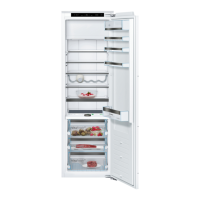
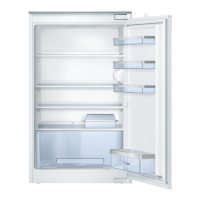
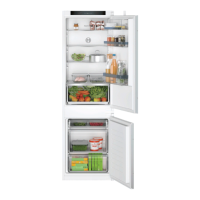
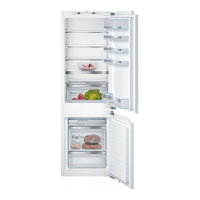
This document is a user manual for a Bosch KIF81.. Refrigerator.
Function Description
The Bosch KIF81.. Refrigerator is a fully fitted appliance designed for chilling food in private households and enclosed domestic environments, up to an altitude of 2000 m above sea level. It features a refrigerator compartment and a cool-fresh compartment, each with adjustable temperature settings and specific storage recommendations to optimize food preservation. The appliance is equipped with a control panel for configuring all functions and monitoring its operating status. It also includes an alarm system, particularly a door alarm, to alert users if the door is left open for an extended period.
Important Technical Specifications
The appliance's technical specifications, including refrigerant type, cubic capacity, and other details, can be found on its rating plate. The climate class (SN, N, ST, T) determines the permitted room temperature for optimal operation, ranging from 10 °C to 43 °C depending on the class. The appliance is designed for a niche depth of 560 mm (minimum 550 mm) and an inside niche width of at least 560 mm. The weight of the appliance can be up to 70 kg, requiring a sufficiently stable subfloor. It contains a light source from energy efficiency class F, which should only be replaced by trained specialist staff. The volume of refrigerant is indicated on the rating plate, and the appliance should be installed in a space with a volume of at least 1 m³ per 8 g of refrigerant.
Usage Features
Control Panel:
The control panel allows users to:
- Switch the appliance on or off.
- Set the temperature of the refrigerator compartment (recommended 4 °C) using the
</> buttons.
- Activate or deactivate "Super cooling" mode, which cools the refrigerator compartment as cold as possible, useful before storing large quantities of food.
- Switch off the warning signal for the door alarm.
- Adjust the cool-fresh compartment temperature, with a standard setting of 0 (around 0 °C) and options to set it warmer or colder (from -3 to +3).
Refrigerator Compartment:
- Temperature can be set from 3 °C to 8 °C.
- Ideal for dairy products, eggs, prepared meals, pastries, open preserves, and hard cheese.
- Features different chill zones due to air circulation: the coldest zone is on the partition and in the door rack for large bottles, while the warmest zone is at the very top of the door.
- Tips for storing food include only storing fresh and undamaged items, keeping food covered or in air-tight packaging, avoiding placing food directly against the back wall, allowing warm food and drinks to cool before storage, and observing best-before dates.
Cool-Fresh Compartment:
- Maintains a temperature of around 0 °C, keeping fresh food fresh up to three times longer than the refrigerator compartment.
- Suitable for highly perishable food like fish, meat, and sausages.
- Storage times vary by food type (e.g., fresh fish up to 3 days, poultry/meat up to 5 days, salad greens up to 21 days, soft cheese up to 30 days).
Storage Features:
- Shelf: Removable and re-insertable to vary storage as needed.
- Variable Shelf: Front section can be slid below the rear part to accommodate tall items like cans or bottles.
- Extendable Shelf: Pulls out for improved overview and quicker food removal.
- Fruit and Vegetable Container: Stores fresh produce loose or in air-tight packaging. Humidity can be adjusted via a controller on the partition (low, medium, high humidity settings) based on the type and amount of food.
- Butter and Cheese Compartment: Dedicated space for butter and hard cheese.
- Door Rack: Adjustable for various items.
- Egg Tray: For safe egg storage.
- Bottle Holder: Prevents bottles from falling when the door is opened/closed.
Maintenance Features
Cleaning and Servicing:
- Preparation: Before cleaning, switch off the appliance, disconnect it from the power supply, remove all food (store in a cool place, use ice packs if available), allow any hoarfrost to defrost, and remove all fittings, accessories, partition, cover, and telescopic rails.
- Cleaning Process: Clean the appliance, fittings, accessories, components, and door seals with a dishcloth, lukewarm water, and a mild pH-neutral washing-up liquid. Dry thoroughly with a soft, dry cloth.
- Important Cleaning Notes: Do not use steam- or high-pressure cleaners, hard scouring pads, abrasive detergents, or cleaning products with high alcohol content. Never clean fittings or accessories in a dishwasher to prevent deformation or discoloration. Ensure rinsing water does not drip into lighting or controls.
- Reassembly: After cleaning, insert all fittings and appliance components, then electrically connect the appliance and switch it on.
Defrosting:
- Both the refrigerator compartment and the cool-fresh compartment defrost automatically.
Troubleshooting:
- The manual provides a troubleshooting guide for common issues such as the appliance not cooling, LED lighting not working, error codes (E or d) on the display, warning signals/alarms, temperature discrepancies, and unusual noises.
- For issues like the appliance not cooling with displays lit, a self-test can be performed.
- If the appliance or power cord is damaged, it must be unplugged immediately, and customer service should be contacted. Repairs should only be carried out by trained specialist staff using genuine spare parts.
Storage and Disposal:
- Taking out of operation: Switch off, disconnect from power, remove all food, defrost, clean, and leave the door open to ensure ventilation.
- Disposing of old appliance: Unplug, cut the power cord, and dispose of environmentally friendly. Instructions are provided to prevent children from locking themselves inside. The appliance is labelled according to European Directive 2012/19/EU for WEEE.

 Need help?
 General

 To Next Page