EasyManua.ls Logo

Bosch KIN86 Series - User Manual

Bosch KIN86 Series
28 pages
Print Icon
To Next Page IconTo Next Page
Loading...
Register your
new device on
MyBosch now and
get free benefits:
bosch-home.com/
welcome
Fridge-freezer
KIN86..
[en] Information for Use

Table of Contents

Question and Answer IconNeed help?

Do you have a question about the Bosch KIN86 Series and is the answer not in the manual?

Summary

Safety

Safe installation

Safe installation

Details crucial safety precautions and warnings regarding the correct installation of the appliance.

Safe use

Safe use

Provides guidelines for safe operation and handling, including warnings for electric shock, suffocation, and explosion.

Damaged appliance

Damaged appliance

Outlines safety procedures and warnings for operating or handling a damaged appliance or power cord.

Installation and connection

Criteria for the installation location

Guidance on selecting a suitable installation location, including ventilation and temperature considerations.

Connecting the appliance to the electricity supply

Connecting the appliance to the electricity supply

Instructions on how to safely connect the appliance to a power source.

Familiarising yourself with your appliance

Control panel

Control panel

Explains the functions and operation of the appliance's control panel and indicators.

Basic operation

Switching on the appliance

Step-by-step guide on how to connect and switch on the appliance.

Operating tips

Provides general advice for optimal appliance operation and user experience.

Switching off the appliance

Instructions on how to properly switch off the appliance.

Setting the temperature

Guide on how to adjust the temperature settings for the refrigerator compartment.

Additional functions

Super function

Explanation and operation of the Super function for intensive cooling.

Alarm

Freezer compartment

Defrosting

Defrosting in the refrigerator compartment

Explanation of the automatic defrosting process in the refrigerator compartment.

Cleaning and servicing

Cleaning the appliance

Instructions for cleaning the appliance's interior, exterior, and door seals safely.

Cleaning the condensation channel and drainage hole

How to clean the condensation channel and drainage hole to ensure proper function.

Troubleshooting

Appliance not cooling, displays and lighting lit

Troubleshooting steps when the appliance is not cooling, but displays and lights are active.

Power failure

Actions to take during and after a power outage to protect food and the appliance.

Conducting an appliance self-test

Instructions on how to perform a self-test to diagnose potential faults.

Overview

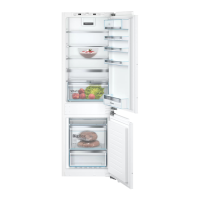
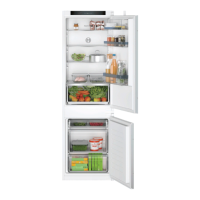
This document is the instruction manual for a Bosch Fridge-freezer, model KIN86... It provides comprehensive information for safe operation, installation, maintenance, and troubleshooting.

Function Description

The appliance is designed for chilling and freezing food, as well as making ice cubes. It is intended for full integration into a kitchen environment and for use in private households. The fridge-freezer features separate compartments for refrigeration and freezing, allowing for optimal storage conditions for various food types. The freezer compartment utilizes a fully automatic NoFrost system, eliminating the need for manual defrosting.

Important Technical Specifications

The appliance's technical specifications, including refrigerant type, cubic capacity, and energy efficiency class, are detailed on the rating plate (refer to "Appliance", Fig. 1/5, Page 13). The climate class, also found on the rating plate, determines the permitted room temperature for operation:

  • SN: 10 °C to 32 °C
  • N: 16 °C to 32 °C
  • ST: 16 °C to 38 °C
  • T: 16 °C to 43 °C

The appliance is fully functional within these ranges, and SN class appliances can operate down to 5 °C without damage. The weight of the appliance can be up to 65 kg, requiring a stable subfloor for installation. The product contains a light source from energy efficiency class E, which should only be replaced by trained specialist staff.

Usage Features

Control Panel: The control panel allows users to configure all functions and monitor the operating status. Key controls include:

  • Super function button: Activates/deactivates the Super function for intensive cooling.
  • Temperature setting button (>): Adjusts the refrigerator compartment temperature.
  • Alarm indicator (>): Lights up when an alarm is active.
  • Temperature display: Shows the set temperature in °C.
  • On/Off button (①): Switches the appliance on or off.

Refrigerator Compartment:

  • Temperature range: Can be set from 2 °C to 8 °C. The recommended temperature is 4 °C.
  • "OK" sticker: (Not included with all models) Indicates if the refrigerator compartment has reached the safe temperature range of +4 °C or colder.
  • Chill zones: Air circulation creates different temperature zones. The coldest zone is the storage container, ideal for highly perishable foods like fish and meat. The warmest zone is at the top of the door, suitable for items like hard cheese and butter.
  • Shelves: Adjustable and removable for flexible storage.
  • Bottle shelf: Securely stores bottles and can also be removed or re-inserted.
  • Storage container: Maintains lower temperatures (occasionally below 0 °C) for highly perishable food.
  • Fruit and vegetable container with humidity control: Allows adjustment of air humidity (low or high) to extend the freshness of produce. Low humidity is for fruit or mixed items, or when the appliance is very full. High humidity is for vegetables or when the appliance is not very full.
  • Butter and cheese compartment: Dedicated storage for butter and hard cheese.
  • Door racks: Adjustable and removable for customized storage.

Freezer Compartment:

  • Temperature range: Long-term storage should be at -18 °C or lower.
  • Freezing capacity: The rating plate indicates the quantity of food that can be frozen within a specific period.
  • Super function: Activates intensive cooling for both compartments, recommended 4-6 hours before freezing 2 kg or more of fresh food. This function helps utilize the full freezing capacity.
  • Maximizing volume: All fittings except the bottom frozen food container can be removed to stack maximum amounts of frozen food.
  • Tips for freezing fresh food: Freeze fresh, undamaged food in portions. Wash, chop, and blanch vegetables; wash, pit, and peel fruit (adding sugar or ascorbic acid solution if desired). Suitable foods include baked items, fish, seafood, meat, game, poultry, eggs without shells, cheese, butter, quark, ready meals, and leftovers. Unsuitable foods include lettuce, radishes, eggs in shells, grapes, raw apples, pears, yogurt, sour cream, crème fraîche, and mayonnaise.
  • Packing frozen food: Use airtight packaging to prevent flavor loss and drying out. Label with contents and freezing date.
  • Shelf life: Frozen food at -18 °C has specific storage times (e.g., fish/prepared meals up to 6 months, poultry/meat up to 8 months, vegetables/fruit up to 12 months).

Alarms:

  • Door alarm: Sounds if the appliance door is left open for a while, with the alarm indicator lighting up and interior lighting flashing after 10 minutes. Can be switched off by closing the door or pressing the '>' button.
  • Fan alarm: Activates if the freezer compartment fan fails, indicated by flashing LEDs on the temperature display and a warning signal. Can be silenced by pressing the '>' button, but customer service should be contacted.

Maintenance Features

Cleaning:

  • Preparation: Switch off the appliance, disconnect from power, remove all food (store in a cool place with ice packs), and remove all fittings and accessories.
  • Appliance cleaning: Use a dish cloth, lukewarm water, and a pH-neutral washing-up liquid. Dry thoroughly.
  • Condensation channel and drainage hole: Regularly clean with a cotton bud to ensure proper drainage and prevent odors.
  • Fittings and accessories: Can be removed for thorough cleaning. Do not clean in a dishwasher to prevent deformation or discoloration.
  • Safety precautions: Do not use steam or high-pressure cleaners. Prevent rinsing water from dripping into lighting or controls. Avoid hard scouring pads, abrasive detergents, or high-alcohol cleaning products.

Defrosting:

  • Refrigerator compartment: Defrosts automatically. Condensation runs into a drainage hole and evaporation pan.
  • Freezer compartment: Features a fully automatic NoFrost system, so manual defrosting is not required.

Troubleshooting: The manual provides a troubleshooting guide for common issues like the appliance not cooling, LED lighting not working, temperature discrepancies, wet refrigerator compartment base, and appliance noises. It advises on self-test procedures and when to contact customer service.

Storage and Disposal:

  • Taking out of operation: Switch off, disconnect from power, remove all food, clean, and leave the door open for ventilation.
  • Disposing of old appliance: Valuable raw materials can be recycled. Emphasizes safety for children by leaving shelves and containers inside and keeping children away from the redundant appliance. Instructions for environmentally friendly disposal are provided, aligning with European Directive 2012/19/EU (WEEE).

Customer Service: Provides information on obtaining genuine spare parts for at least 10 years from the market placement date. Details on warranty terms and contact information for customer service are included, requiring the product number (E-Nr.) and production number (FD) found on the rating plate.

Bosch KIN86 Series Specifications

General IconGeneral
BrandBosch
ModelKIN86 Series
CategoryRefrigerator
LanguageEnglish

Related product manuals