Need help?
Do you have a question about the Bosch KSV series and is the answer not in the manual?
Ensure correct connection to a properly installed earthed socket and avoid damaged power cords.
Keep ventilation openings clear to prevent flammable gas/air mixtures.
Do not use extension cords or unapproved adapters; they may overheat.
Avoid moisture ingress, intense heat/humidity, and use steam/high-pressure cleaners.
Keep packaging material and small parts away from children.
Do not use unapproved devices for defrosting or store flammable products.
Do not operate electrical devices within the appliance.
Avoid refrigerant escape, do not damage tubes, and do not lean on the appliance.
Observe hygiene, store food properly, and clean regularly to prevent mould.
Never operate a damaged appliance or pull the power cord to unplug.
Keep ignition sources away, ventilate, switch off, and unplug if tubes are damaged.
Repairs must be by trained staff using genuine parts. Contact Customer Service for cord damage.
Ensure adequate space, stable subfloor, and correct room temperature based on climate class.
Insert the mains plug into a nearby socket and ensure it is properly inserted.
Detailed explanation of buttons for alarm, temperature setting, and Super cooling.
Troubleshoot issues when the appliance is not cooling but displays are lit.
Guidance for when error codes 'E' or 'd' appear on the display.
Diagnose and resolve issues with significant temperature differences from the setting.
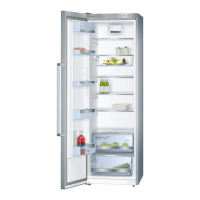
This document serves as a user manual for a Bosch Refrigerator, specifically models in the KSV series. It provides comprehensive instructions for safe operation, installation, maintenance, and troubleshooting, ensuring optimal performance and longevity of the appliance.
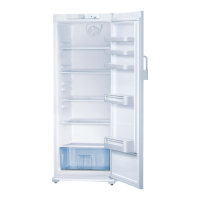
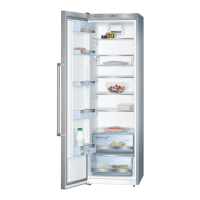
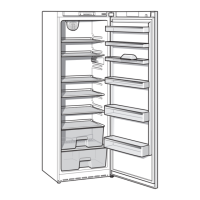
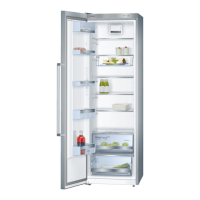
The Bosch Refrigerator is designed for chilling food in private households and enclosed domestic environments, up to an altitude of 2000 meters above sea level. Its primary function is to maintain a cool temperature, preserving the freshness and quality of various food items. The appliance features a refrigerator compartment with adjustable temperature settings, typically ranging from 2 °C to 8 °C, with a recommended temperature of 4 °C for general use. It includes specialized storage zones such as a butter and cheese compartment, door racks, and fruit and vegetable containers, some with humidity control, to cater to different food storage needs. The "Super cooling" function allows for rapid cooling of the refrigerator compartment, ideal for quickly chilling large quantities of newly added food. An alarm system, including a door alarm, alerts users to potential issues, such as an open door, to prevent temperature fluctuations and energy waste.
The manual refers to the rating plate for specific technical data, including refrigerant type, cubic capacity, and climate class. The climate class dictates the permitted room temperature for optimal operation:
The refrigerator is operated via a control panel that allows users to switch the appliance on/off, set the temperature, and activate/deactivate the "Super cooling" function. The temperature display shows the set temperature in °C. The door alarm can be silenced by closing the door or pressing the alarm button. For efficient use, it's recommended to allow warm food and drinks to cool before storing, and to thaw frozen food in the refrigerator compartment to utilize its low temperature. The fruit and vegetable container with humidity control offers enhanced preservation, allowing fresh produce to be stored for up to twice as long. The humidity can be adjusted using a controller: low humidity for fruit or a very full container, and high humidity for vegetables or mixed items. The internal layout is flexible, with height-adjustable shelves and door racks that can be repositioned to accommodate various item sizes.
Regular cleaning and servicing are crucial for maintaining the appliance's efficiency. The manual outlines a detailed cleaning process:
 General
| Brand | Bosch |
|---|---|
| Model | KSV series |
| Category | Refrigerator |
| Language | English |

 To Next Page