Need help?
Do you have a question about the Bosch WQG233D0ES and is the answer not in the manual?
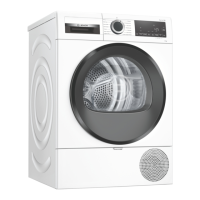
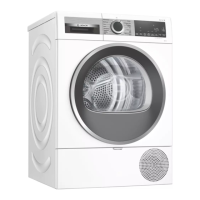
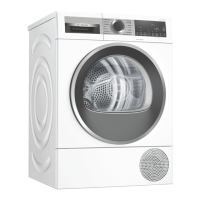
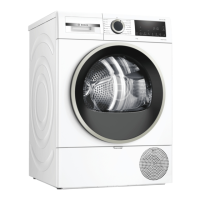
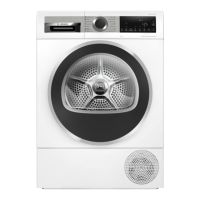
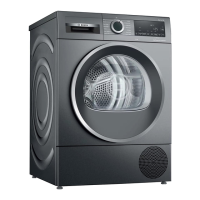
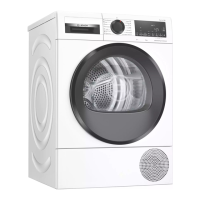
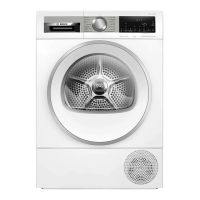
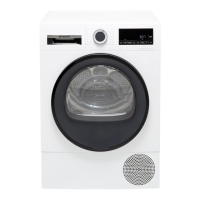
This document describes the Bosch WQG233D0ES Tumble Dryer, a home appliance designed for drying and freshening up water-washed fabrics suitable for dryers. It is intended for use in private households and enclosed domestic environments, up to an altitude of 4000m above sea level.
The Bosch WQG233D0ES is a heat pump tumble dryer that utilizes humidity sensors to measure residual moisture in laundry during drying cycles. Programmes conclude once a preset dryness level is achieved. The appliance also features automatic cleaning, where condensation water is used for this purpose. Users can choose between automatic programmes and timed programmes, with the latter having a defined or adjustable duration.
Control Panel and Display: The appliance features a control panel with a programme selector and various buttons, along with a display that shows current settings, options, and operating status. The display provides information such as programme duration, "Ready in" time, recommended load, dryness level, and active functions like crease reduction or gentle drying.
Programmes: The dryer offers a range of programmes tailored for different fabric types and drying needs:
Dryness Levels: Each automatic programme has a specified dryness level (e.g., Extra seco, Seco, Seco). These levels define how damp or dry the laundry will be after the programme. Users can adjust the dryness level by selecting +1, +2, or +3 for certain automatic programmes to achieve desired dryness.
Additional Functions (Buttons):
Loading and Unloading: Laundry should be prepared by emptying pockets, closing fasteners, tying belts, and separating items. The maximum load capacity for each programme should be observed to prevent impaired function. The drum lighting goes out automatically.
Condensation Drainage: Condensation water is collected in a container, which needs to be emptied regularly. Alternatively, a water drain hose can be connected to the waste water system for continuous drainage.
Fluff Filter: The two-part fluff filter collects fluff during drying and must be cleaned regularly after each programme or when indicated by the display. Failure to clean the filter can impair appliance functionality.
Filter System on the Base Unit: The base unit contains a filter system that collects fluff and protects the appliance. This system should be cleaned when indicated by the display, or regularly even without a notification. The filter mat can be removed and cleaned under warm, running water.
Moisture Sensor: The moisture sensor measures laundry dampness and adjusts programme duration. It should be cleaned regularly to remove residue from limescale, detergents, and care products, as buildup can impair functionality.
General Cleaning: The housing and controls should be wiped with water and a damp cloth. Detergent or spray residues should be removed immediately. Leaving the appliance door open after use allows residual water to dry, reducing odours.
Base Unit Cleaning: The base unit, where the heat exchanger is located, can be opened for cleaning. The heat exchanger cover and fins should be carefully cleaned with a soft brush and vacuum cleaner, ensuring not to deform or damage the fins. The air inlet grille should also be cleaned.
Transportation and Disposal: For transportation, the appliance should be left to rest for two hours after moving. The condensation container should be emptied, and the water drain hose secured. When disposing of the old appliance, it should be unplugged, the power cord cut, and the appliance door lock damaged to prevent children from locking themselves inside. The refrigerant circuit should not be damaged. Packaging materials are recyclable.

 To Next Page
 General