Need help?
Do you have a question about the Bosch WQG24201AU and is the answer not in the manual?
This document is a user manual and installation guide for the Bosch WQG24201AU Tumble Dryer.
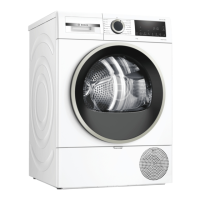
The Bosch WQG24201AU Tumble Dryer is designed for drying and freshening up water-washed fabrics suitable for dryers. It operates in private households and enclosed domestic environments, up to an altitude of 4000m above sea level. The appliance uses humidity sensors for automatic programs to measure residual moisture and ends the cycle once the set dryness level is reached. It also features timed programs for specific drying durations. The dryer utilizes condensation for automatic cleaning, collecting water in a condensation container, or draining it directly into a waste water system via a water drain hose.
Control Panel and Display: The appliance features a control panel with a programme selector and buttons to configure functions and view operating status on a display. The display shows information such as programme duration, remaining time, recommended load, programme end time, and various status indicators (e.g., childproof lock, condensation container, fluff filter, cooling process, drying status).
Programmes: The dryer offers a range of automatic and timed programmes:
Dryness Levels: Each automatic programme has a specified dryness level (e.g., Iron Dry, Cupboard Dry, Cupboard Dry Plus). Users can adjust these levels for some programmes to achieve desired dryness (e.g., +1, +2, +3 for drier results).
Additional Functions/Buttons:
Loading and Unloading: Laundry should be prepared by removing items from pockets, brushing off soil, sorting by colour and textile, closing fasteners, and placing small/delicate items in a mesh bag. The laundry should be loaded unfolded into the drum and spun in a washing machine beforehand. Laundry can be added or removed during a programme by pressing Start/Pause, opening the door, and then resuming.
Energy Saving Mode: The appliance automatically switches to an energy-saving mode if not used for an extended period, indicated by all displays going out and the Start/Pause button flashing. It reactivates upon use.
Fluff Filter: The fluff filter collects lint during drying and should be cleaned regularly after each drying programme or when a notification appears on the display. Cleaning involves removing the two-part filter from the door, opening it, removing fluff, cleaning under warm running water, drying, reassembling, and reinserting.
Filter System on the Base Unit: The base unit contains a filter system that protects the appliance from fluff. This system should be cleaned regularly, even without a notification, though not necessarily after every cycle. Cleaning involves opening the maintenance flap, carefully removing the filter mat, cleaning it under warm running water, and reinserting it. A soft brush can be used for the heat exchanger cover, and a vacuum cleaner with a brush attachment for the fins.
Condensation Container: The condensation container collects water during drying. If the water drain hose is not connected, the container must be emptied when full or when a notification appears. Emptying involves pulling out the container, pouring out the water, and reinserting it.
Moisture Sensor: The moisture sensor measures laundry dampness. Residue from limescale, detergents, and care products can build up, so it should be cleaned regularly with a sponge. Hard or rough objects, abrasive cleaners, or steel wool should not be used to avoid damage.
General Cleaning: The housing and controls should be wiped with water and a damp cloth. Detergent or spray residues should be removed immediately. Leaving the appliance door open after use allows residual water to dry, reducing odours.
Troubleshooting: The manual provides a comprehensive troubleshooting guide for common issues such as creasing, programmes terminating, water leaks, long drying times, and appliance not starting. It offers solutions like checking load size, programme selection, filter cleanliness, water drain hose connection, and power supply.


 To Next Page
 General