7. Transport
7.1. Transporting the wheelchair
To transport the wheelchair as convenient as possible, all detachable
parts (footrests, wheels, accessories) must be removed and the wheelchair
folded.
7.2. Seat in disabled vehicle
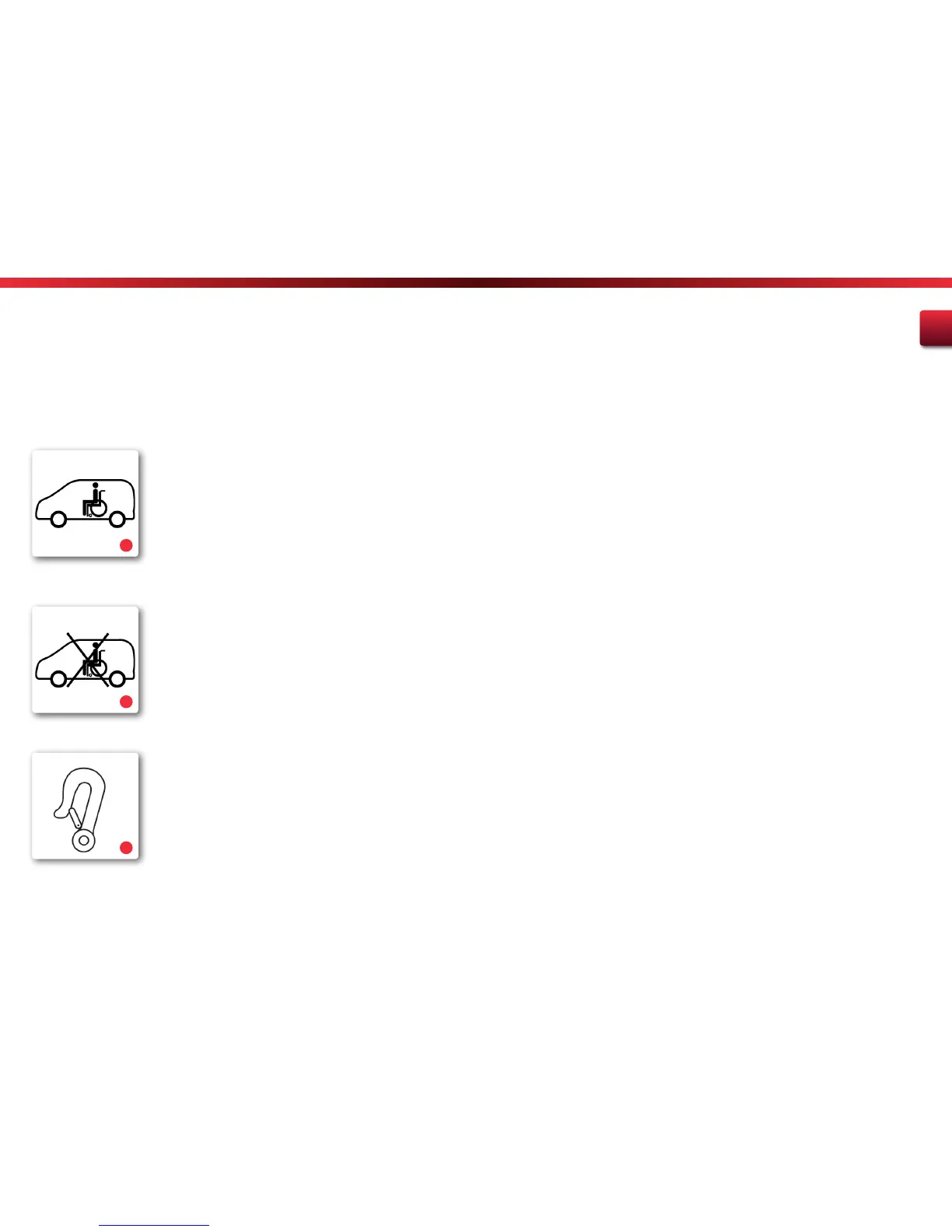
You can determine whether or not your wheelchair is approved for use
as a seat in a vehicle for transporting disabled people by referring to
the symbols on the CE sticker on the product (Fig. A, B, C).
All products approved by B+B for use as seats in vehicles are tested
in accordance with ISO 7176-19. The tests in accordance with ISO
7176-19 were performed using restraint systems from AMF-Bruns. The
correct mounting of the restraint system is a prerequisite for the safe
transportation of the products in a vehicle for transporting disabled
people and the basis for the approval.
The restraint systems from AMF-Bruns provide the ideal points for the
provision of restraint force for the purpose of securing the products in
the vehicle for transporting disabled people (known by the German
term „Kraftknoten“, which is defined in the standard DIN 75078-2).
For the purpose of providing restraint in the vehicle for transporting
disabled people, the products must only be secured at these specific
points („Kraftknoten“ points). If possible, use a permanently installed
car seat and its belt system. Stow the wheelchair in the luggage space.
The person responsible for the transportation should be familiar with
the current regulations for transportation as well as with the method of
operating the vehicle for transporting disabled people and the restraint
system. Anchored 4-point restraint systems must be used to secure the
wheelchair in the vehicle. If you have any queries about securing your
product in a vehicle for transporting disabled people, please contact
the B+B customer service.
A
B
C
B: Not suitable as seat in
disabled vehicle
A: Suitable as seat in disa-
bled vehicle
C: Fixing point restraint
system
8. Maintenance tips for users
8.1. Cleaning and disinfection
• The frame and the paneling of the wheelchair can be cleaned with
a moist cloth. You can use a mild detergent for more stubborn dirt
• The wheels can be cleaned with a wet synthetic fiber brush (do not
use a wire brush!)
• Push handles, arm pads, and seat and back pads can be washed
off. Use mild detergent.
• Use a disinfectant listed by VAH for disinfection.
Observe our included overview of the most important care, hygiene and
maintenance work.
8.2. Check before use
8.2.1. Brake Inspection
• Make sure your brakes are operating properly before each use.
• It should not be possible to push the wheelchair away while the
brakes are activated.
• The wheelchair should be easy to drive without grinding noises and
with good direction stability when the brakes are released.
• If you notice unusual behaviour when braking, inform your quali-
fied mobility dealer immediately and do not use the wheelchair.


 To Next Page