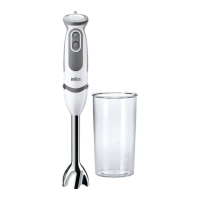
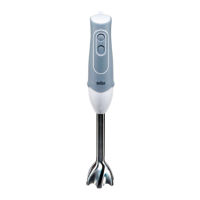
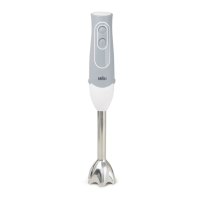
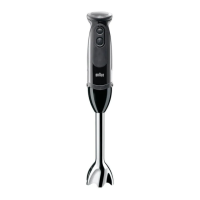
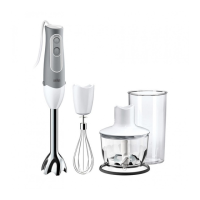
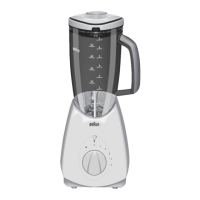
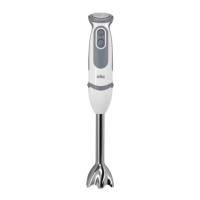
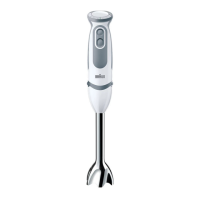
This document describes the Braun MultiQuick 5 Hand Blender, Type 4165, model MQ535. It is a versatile kitchen appliance designed for household use, capable of performing various food preparation tasks.
The hand blender's primary function is blending, making it ideal for preparing dips, sauces, soups, mayonnaise, and baby food. It is also suitable for mixing drinks and milkshakes. For optimal blending results, the highest speed setting is recommended. The blending shaft (5) connects to the motor part (3) and is immersed in the ingredients to be processed. Operation involves pressing the "I" or "II" speed switches (1, 2) and gently moving the blender up and down to achieve the desired consistency. After use, the EasyClick release buttons (4) allow for easy detachment of the motor part from the blending shaft. The maximum continuous operation time for blending is 45 seconds, followed by a 3-minute rest period to allow the motor to cool down. When blending hot foods, it is crucial to remove the pot from the stove to prevent splashing and allow the food to cool slightly to avoid scalding. The hand blender should not be placed on a hot stove after use.
Another key feature is the whisk accessory (6), which includes a gearbox (6a) and a whisk (6b). This accessory is specifically designed for whipping cream, beating egg whites, and preparing sponge cakes and ready-mix desserts. Similar to blending, the highest speed setting yields the best results for whisking. The whisk (6b) attaches to the gearbox (6a), which then connects to the motor part (3) until it locks securely. After use, the motor part is detached using the EasyClick release buttons (4), and the whisk is removed from the gearbox. For whipping cream, 400 ml of chilled cream (minimum 30% fat, 4-8°C) is recommended, starting at speed "I". Using fresh, chilled cream helps achieve a greater and more even volume. The maximum processing time for salads is approximately 1 minute, while thicker mayonnaise may require up to 2 minutes. To achieve optimal results when whisking, the whisk should be tilted slightly and moved in a clockwise direction. To prevent liquid splashes, especially at the beginning, it is advisable to use a slow speed and a deep container or saucepan. Before beating egg whites, ensure the whisk and mixing cup are completely clean and free of fat. A maximum of 4 egg whites should be beaten at a time.
The chopper accessory (8), with a capacity of 500 ml, is another valuable component. It consists of a lid with gear (8a), a blade (8b), a bowl (8c), and an anti-slip rubber ring (8d). This accessory is perfectly suited for chopping meat, hard cheese, onions, herbs, garlic, vegetables, bread, crackers, and nuts. However, it should not be used to process extremely hard foods such as unshelled nuts, ice cubes, coffee beans, grains, or hard spices like nutmeg, as this could damage the blades. Before chopping, food should be cut into small pieces, and bones, tendons, and gristle should be removed from meat to prevent blade damage. The anti-slip rubber ring (8d) must always be placed at the bottom of the chopping bowl. To assemble, carefully remove the plastic cover from the sharp blade (8b), always holding it by the upper plastic part. Place the blade onto the center pin in the chopping bowl (8c), pressing down and gently rotating to lock it. Add the food to the chopping bowl, cover it with the lid (8a), and connect the chopper to the motor part (3) until it locks securely. During operation, hold the motor part with one hand and stabilize the chopping bowl with the other. For harder foods like Parmesan cheese, use the full speed. A maximum processing time of 30 seconds is recommended for chopping. To prevent overheating and potential damage, allow the motor to cool for at least 3 minutes between operations if the motor speed decreases or strong vibrations occur.
Maintenance and cleaning are straightforward. Before first use and after each use, all parts that come into contact with food should be thoroughly cleaned with water and detergent. Always unplug the appliance before cleaning. The motor part (3) and gearbox (6a) should only be wiped with a damp cloth and must not be immersed in water or any other liquid. The lid (8a) can be rinsed under running water but should not be immersed or cleaned in a dishwasher. All other parts are dishwasher-safe. Abrasive cleaning agents that could scratch the surface of the parts should not be used. The anti-slip rubber ring at the bottom of the chopping bowl can be removed for thorough cleaning. If processing foods with high pigment content (e.g., carrots), the accessories may become discolored; this can be removed by wiping with vegetable oil.
Safety is paramount. The blades are very sharp and must be handled with utmost care to avoid injury, especially when removing, emptying, or cleaning the bowl. This appliance can be used by individuals with reduced physical, sensory, or mental capabilities, or lack of experience and knowledge, if they have been given supervision or instruction concerning safe use and understand the hazards involved. Children must not play with the appliance or use it, and should be kept away from the appliance and its mains cord. The appliance must always be switched off and unplugged when left unattended, before assembly, disassembly, cleaning, and storage. If the supply cord is damaged, it must be replaced by the manufacturer, its service agent, or similarly qualified persons to avoid a hazard. Before plugging into a socket, verify that the voltage matches the voltage printed on the bottom of the appliance. This appliance is designed for household use only and for processing normal household quantities. It should not be used for any purpose other than its intended use as described in the manual, as misuse may cause potential injury. No part of the appliance should be used in a microwave. All parts should be cleaned before first use or as required, following the instructions in the Care and Cleaning section. Stop using the device if it is damaged. If the device falls into liquid, unplug it before reaching into the liquid.
The materials and accessories that come into contact with food conform to EEC regulation 1935/2004. The product should not be disposed of with household waste at the end of its useful life but should be taken to appropriate collection points provided in your country.



 To Next Page

 General