15
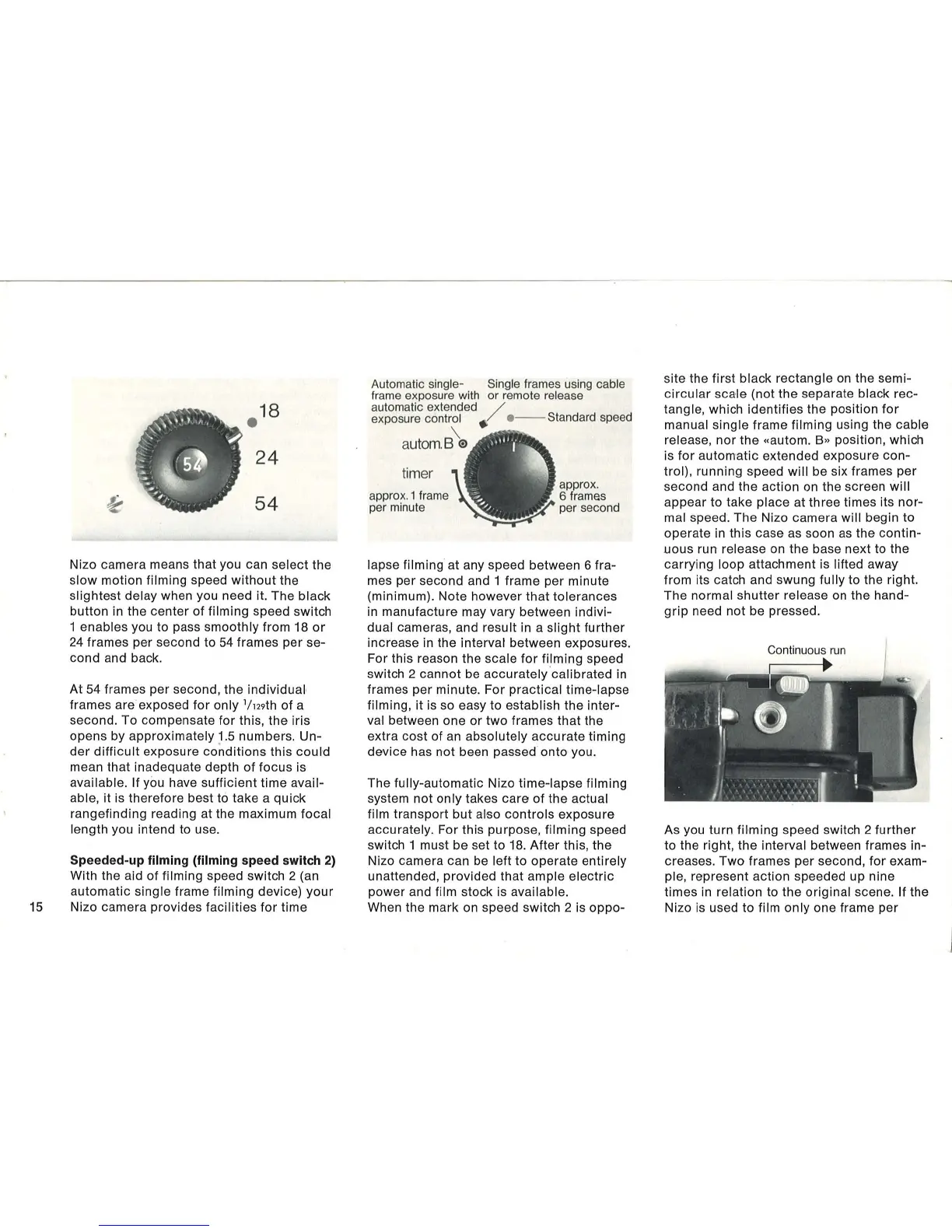
Nizo camera means that you can
select
the
slow
motion filming speed
without
the
slightest delay when you need it. The black
button in the
center
of filming speed switch
1 enables you to pass smoothly from 18
or
24
frames per second to
54
frames per se-
cond
and back.
At
54
frames per second, the individual,
frames are' exposed
for
only
l/129th
of a
second. To compensate for this, the iris
opens by approximately
1.5 numbers. Un-
der
difficult
exposure
conditions
this
could
mean that inadequate depth of focus is
available.
If
you have sufficient time avail-
able,
it
is therefore best to take a
quick
rangefinding reading at the maximum focal
length
you intend to use.
Speeded-up filming (filming speed switch 2)
With the aid of filming speed switch 2 (an
automatic
single frame filming device)
your
Nizo camera provides facilities for
time
Automatic
si
ngle-
Sing
le frames u
si
ng
ca
bl
e
fr
ame
ex
p
os
u
re
wi
th
or
re
mote
re
l
ease
au
to
m
at
ic
ex
ten
de
d /
exposu
re
co
ntr
ol
• .
--
S
ta
nd
ar
d sp
ee
d
\
au
to
m.B
®
t
im
er
a
ppr
ox
. 1 f
ra
me
per mi
nut
e
a
ppro
x.
6 fram
es
pe
r seco
nd
lapse filming at any speed between 6 fra-
mes per second and 1 frame per minute
(minimum). Note however
that
tolerances
in manufacture may vary between indivi-
dual cameras, and result in a
slight
further
increase in the
interval between exposures.
For this reason the
scale
for
filming
speed
switch 2 cannot be
accurately
'calibrated in
frames per minute. For
practical
time-lapse
filming, it
is
so easy to establish the inter-
val between one
or
two frames that the
extra cost of
an
absolutely
accurate
timing
device has not been passed onto you.
The fully-automatic Nizo time-lapse
filming
system not
only
takes
care
of the actual
film
transport
but
also
controls
exposure
accurately. For this purpose,
filming
speed
switch
1 must
be
set to 18. After this,
the
Nizo camera can be left to operate entirely
unattended, provided that ample
electric
power and film stock is available.
When the mark on speed switch 2 is oppo-
site the first
black rectangle on the semi-
circular
scale
(not
the
separate black rec-
tangle, which identifies the position
for
manual single frame filming using the cabl'e
release,
nor
the «autom. 8» position, which
is
for
automatic extended exposure con-
trol). running speed will be six frames per
second and the action on the screen
will
appear to take place at three times its
nor
-
mal speed. The Nizo camera will beg'in to
operate in this case as soon
as
the contin-
uous run
release on the base next to the
carrying
loop
attachment is lifted away
from its catch and swung
fully to the right.
The
normal
shutter
release
on
the hand-
grip
need not be pressed.
• •
;--".
~
0·
II I
. 'I ,
• . I
' . .
....
';C~"
f. ' .
)1
.,
..
'
...
\'
..
\\
' ,
.
,.
As you turn
filming
speed switch 2
further
to the right, the interval between frames in-
creases.
Two
frames per second,
for
exam-
ple, represent action speeded up nine
times in
relation to the original scene, If the
Nizo is used to
film
only
one frame per


 To Next Page
 Loading...