EasyManua.ls Logo

Brave VH1724GC - User Manual

Brave VH1724GC
62 pages
Print Icon
To Next Page IconTo Next Page
Loading...
1
ITEM NUMBER: __________________
SERIAL NUMBER: ________________
MVH1724A.2
MODELS:
VH1724GC
VH1730GC
VH1737GX
Owners Manual
Instructions for Assembly, Testing, Operation,
Servicing and Storage
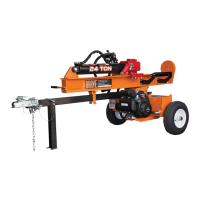
24, 30, & 37 Ton Log Splitters: Outdoor hydraulic powered machine
that splits wood logs.
WARNING
READ and UNDERSTAND this manual completely before using log splitter.
All operators of this equipment must read and completely understand all safety information, operating instructions, maintenance
and storage instructions. Failure to properly operate and maintain the log splitter could result in serious injury to the operator and
bystanders from moving parts that can crush or cut, flying objects, burns, fire or explosion, escaping high pressure hydraulic fluid,
or carbon monoxide poisoning in particular, be aware of the following hazards.
Crush and Cut Hazards
Moving parts can crush and cut hands and fingers. Keep hands clear of endplate, wedge, logs, and log dislodger/strippers
while splitting.
High Pressure Hydraulic Fluid Hazards
High fluid pressures and temperatures are developed in hydraulic log splitters. Hydraulic fluid escaping through even a pin-
size hole opening can puncture skin and cause severe blood poisoning. Inspect hydraulic system regularly for possible leaks.
Never check for leaks with your hand while the system is pressurized. Seek medical attention immediately if injured by
escaping fluid.
Fire Hazards
If your log splitter is intended for use near an ignitable forest, brush, or grassy covered land, the engine exhaust should be
equipped with a spark arrestor. See the "Specifications" section of this manual to determine if your splitter already has a spark
arrestor. If not equipped, call Brave Product Support for ordering information.
Keep a class ABC fire extinguisher with you.
STOP!
ADD OIL TO ENGINE BEFORE USING: Engine is shipped without oil. DO NOT start log splitter without first adding oil.
ADD HYDRAULIC OIL: Your log splitter was shipped without hydraulic oil. Refer to Periodic Maintenance section of this manual
for instructions on filling the hydraulic reservoir
PRIME THE PUMP: The pump on your log splitter needs to be primed before use. Refer to Initial Setup section for instructions.
INSPECT COMPONENTS: Closely inspect to make sure no components are missing or damaged.
See Initial Unpacking and Set-up for instructions and for whom to contact to report missing or damaged parts.

Any Questions, Comments, Problems or Parts Orders
Call Brave Product Support 1-800-350-8739

Questions and Answers

Summary

Hazard Signal Word Definitions

About Your Log Splitter

Safety Label Locations

Machine Component Identification

Initial Setup

Inspect Log Splitter Components

Inspect all log splitter components for damage or missing parts before proceeding.

Add Oil to Engine

Add SAE 10W-30 oil to the engine up to the 'FULL' mark on the dipstick.

Add Hydraulic Oil to Reservoir

Fill the hydraulic reservoir with the specified hydraulic oil type and ensure the level is full.

Lubricate Beam

Apply grease to the top and underside of the beam where wear pads travel.

Moving and Towing to the Job Site

Before Each Use - Inspection;Maintenance

Engine Off; Relieve Pressure

Ensure engine is off, spark plug disconnected, and hydraulic pressure is relieved before inspection.

Remove Debris

Clear debris from engine, muffler, and moving parts to prevent hazards and wear.

Fuel Tank; Lines

Check fuel tank and lines for leaks, as any leak is a fire hazard.

Mechanical Parts

Verify all nuts and bolts are tight to ensure safe working condition.

Hydraulic System

Visually inspect hoses, tubing, clamps, pump, and cylinder for damage or leaks.

Hydraulic Oil Level

Check the hydraulic oil level and fill as needed, ensuring the level reads full.

Engine

Inspect and perform engine maintenance according to the engine owner's manual.

Spark Arrestor Muffler

Clean and inspect the spark arrestor muffler regularly and replace if damaged.

Tires

Ensure tires are fully inflated and in good repair for towing.

Shields; Guards

Replace all guards and shields after servicing the log splitter.

Before Each Use - Fueling

Before Each Use - Work Site Selection and Set-Up

Splitting Operation

Put on Protective Clothing; Gear

Wear safety glasses, boots, gloves, and hearing protection; avoid loose apparel.

Lock and Block

Ensure the support leg is locked down and wheels are blocked to prevent movement.

Set to Horizontal or Vertical

Position the splitter in either horizontal or vertical mode for splitting logs.

Load Log

Load logs onto the beam with the bark side, ensuring correct orientation and keeping hands clear.

Extend Wedge

Move the control lever to extend the wedge and split the log.

Stop Wedge

Release the control lever to stop the wedge movement once the log is split.

Important STUCK LOG Procedure

Follow procedure to safely remove a log stuck on the wedge.

Return Wedge

Move control lever to return the wedge to its starting position.

Remove Split Wood

Move split logs away from the splitter to prevent trip hazards.

After use

Turn off engine, remove debris, return to horizontal, and allow to cool.

Storage

Periodic Maintenance

Engine Maintenance

Perform engine maintenance as specified in the engine owner's manual.

Hydraulic Oil Change

Change hydraulic oil annually or every 100 hours following specific procedures.

Oil Filter Change

Change return line filter after first 50 hours and every 250 hours thereafter.

Spark Arrestor Muffler

Clean and inspect the spark arrestor muffler regularly and replace if damaged.

Troubleshooting

Specifications

Parts Breakdown - Exploded View - Rev A

Summary of Important Safety information for Operation

Introduction

Read the operator's and engine manuals, instruct operators, and use only for intended purpose.

Prohibition Against Modifications

Never modify or alter the splitter; this voids warranty and creates hazards.

Operator Restrictions

Only trained operators over 16 years old should use the splitter.

Safety in Moving and Towing the Log Splitter

Follow safety instructions for moving and towing the heavy log splitter.

General Safety While Moving

Secure in horizontal position, engine off, no riding, no cargo, use towing vehicle on hills.

Safety During Towing

Review towing instructions, ensure secure attachment, and check tires.

Safety - Before Use

Read manual, review safety rules, know how to stop, and use proper PPE.

Personal Protective Equipment

Always wear eye protection, boots, gloves, and hearing protection.

Safety During Inspection;Maintenance

Inspect and repair before each use: engine off, clear debris, check fuel, mechanical parts, hydraulics.

Safety During Fueling

Handle gasoline with extreme care outdoors; never refuel a hot engine.

Safety in Work Site Selection

Select a level, dry surface, outdoors, away from hazards, and ensure fire safety.

Safety - During Use

Follow rules for safe operation: use safety equipment, proper speed, know how to stop, avoid sparks/fumes.

Safety in Loading, Operating, and Unloading

Handle logs safely, keep hands clear, use correct operator position, and follow procedures.

Loading;Unloading

Safely load, split, and unload logs, managing split log piles and avoiding hazards.

Safety - After use

Turn off engine, remove debris, cool engine, store properly, and perform periodic maintenance.

Assembly Instructions

Step 1 - Wheels to Axle Assembly

Assemble wheels onto the axle, ensuring proper torque and securing with cotter pins and dust caps.

Step 2 - Tow bar Assembly to Axle Assembly

Attach the tow bar assembly to the axle assembly using bolts and nuts, torquing to specification.

Step 3 - Install Filter

Install the return line filter head and canister onto the hydraulic tank return port.

Step 4 - Engine Assembly to Axle Assembly

Mount the engine assembly onto the axle mount and secure it with bolts and nuts.

Step 5 - Attach suction hose

Connect the suction hose from the pump to the axle assembly fitting.

Step 6 - Stand beam upright

Carefully stand the beam assembly upright in a vertical position on level ground.

Step 7-Beam Assembly to Axle Assembly

Align and attach the beam assembly to the axle assembly using the pivot pin.

Step 8 - Beam rest to beam

Attach the beam rest to the beam assembly using bolts and nuts.

Step 9 - Block and Rotate

Block the wheels and rotate the beam assembly to the horizontal position.

Step 10 - Handle to Beam

Attach the handle weldment to the front plate of the beam using bolts and nuts.

Step 11 - Install Valve

Install the valve onto the straight fitting and attach the valve plate.

Step 12 - Install Handle on Valve

Slide the valve handle into the clevis slots and secure with pins.

Step 13 - Install Valve Outlet Fitting

Install the valve outlet fitting onto the valve port, ensuring correct orientation and torque.

Step 14 - Install Cylinder Hose Fitting

Install the cylinder hose fitting onto the valve port, ensuring correct orientation and torque.

Step 15 - Install Valve Inlet Fitting

Install the valve inlet fitting onto the valve port, ensuring correct orientation and torque.

Step 16 - Install Cylinder Hose

Route and connect the cylinder hose to the cylinder hose fitting and valve.

Step 17 - High Pressure Hose

Route and connect the high-pressure hose from the pump outlet to the valve inlet fitting.

Step 18 - Install Log Cradles

Install the log cradles onto the beam using bolts and nuts.

Step 19 - Low Pressure Return Hose

Route and connect the low pressure return hose from the filter to the valve outlet fitting.

Available Accessories

Limited Warranty

Product Registration Form

Brave VH1724GC Specifications

General IconGeneral
BrandBrave
ModelVH1724GC
CategoryLog Splitter
LanguageEnglish

Related product manuals