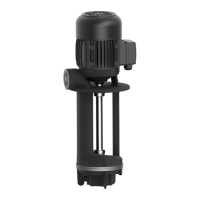
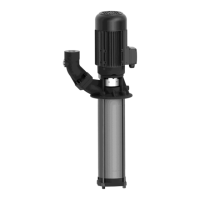
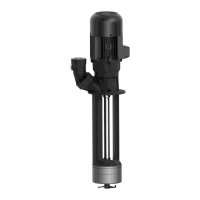
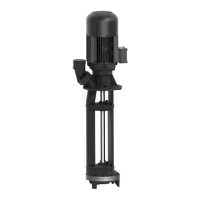
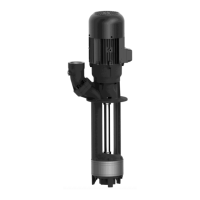
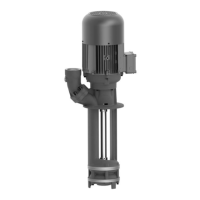
The Brinkmann Immersion Pumps, specifically the TS12...24 series, are designed for the supply of coolant in CNC machine tools. These pumps are characterized by their compact design and ability to achieve relatively high pressure. They are single or two-stage centrifugal pumps where the impeller is directly fixed on the driving shaft extension. The TS series pumps feature open impellers on both sides, contributing to their high-pressure capability within a compact unit. It is crucial that these pumps are protected against coarser impurities in the coolants, indicating their suitability for filtered coolant only. The pump and motor form a compact and space-saving unit, designed for vertical mounting with the pump end immersing into the tank and the motor extending vertically above it.
Function Description:
The primary function of the TS series immersion pumps is to deliver coolant to CNC machine tools. This includes applications where coolant supply is required through the tool holder, driving spindle, or for tools with internal cooling. The pumps are designed to operate within specific limits, as detailed in the "Limit of Application" table. They are not suitable for dry running, and a minimum delivery volume of 1% of Q max. must be maintained. The pumps are intended for continuous operation within their specified parameters. Any operation outside these design limits is not approved and may lead to damages for which the manufacturer is not responsible.
Important Technical Specifications:
The TS12...24 series encompasses various models with differing performance characteristics:
- Mediums: Cooling emulsions, cooling- and cutting-oils.
- Kinetic Viscosity: Up to 45 mm²/s.
- Temperature of Medium: 0...80 °C (up to 150 °C for special makes).
- Particle Size in Medium: 2 mm for TS12...15, and 3 mm for TS21...24.
- Min. Delivery Volume: 1% of Q max.
- Dry Running: Not suitable for dry running.
- Switching-on Frequency per Hour: Max. 200 for motors less than 3 kW.
- Ambient Temperature: 40 °C.
- Set-up Altitude: 1000 m.
- Motor: Surface-cooled, compliant with DIN IEC 34 and EN 60034 (protection degree IP 55).
- Noise Emissions: Measured at 1 m distance, ranging from 54 dBA for TS12/13/14 models to 67 dBA for TS24 models.
Specific models and their data:
- TS12/110-300: Max. del. pressure 2.3 bar, Max. del. volume 27 l/min, Power 0.32/0.365 kW.
- TS13/110-300: Max. del. pressure 2.5 bar, Max. del. volume 38 l/min, Power 0.32/0.365 kW.
- TS14/110-300: Max. del. pressure 3.5 bar, Max. del. volume 38 l/min, Power 0.48/0.55 kW.
- TS15/190-220: Max. del. pressure 9.7 bar, Max. del. volume 39 l/min, Power 1.1/1.27 kW.
- TS21/110-350: Max. del. pressure 3.7 bar, Max. del. volume 63 l/min, Power 0.75/0.86 kW.
- TS22/110-350: Max. del. pressure 5.4 bar, Max. del. volume 68 l/min, Power 1.1/1.27 kW.
- TS24/140-220: Max. del. pressure 8.8 bar, Max. del. volume 60 l/min, Power 1.9/2.18 kW.
Immersion depths (h) vary by model and range from 110 mm to 350 mm. Weights range from 5.7 kg to 28 kg depending on the model and immersion depth.
Usage Features:
- Installation: Pumps must be mounted securely without tension in piping or tank. The inlet should be positioned far enough from the tank bottom to prevent blockage by deposits. Pipe bends are recommended over pipe angles for optimal flow. The pipework must be qualified for the hydraulic pressure.
- Electrical Connection: All electrical work must be performed by qualified service personnel. The pump must be disconnected from the power source and verified to be de-energized before any work. An motor overload protection must be installed and correctly set according to the pump's nameplate.
- Start-up: After electrical connection, briefly start the motor (max. 30 sec.) to check the rotation direction against the arrow on the motor top. If incorrect, two power leads must be swapped.
- Liquid Level: The maximum liquid level must be approximately 30 mm below the mounting flange, and the minimum liquid level must be 45 mm before starting the motor. Insufficient liquid level can cause the pump to not pump.
- Operation with VFDs: When Variable Frequency Drives (VFDs) are used, interfering signals might occur, and non-sinusoidal supply voltage from a VFD might lead to elevated motor temperatures.
- Safety: Guards for moving parts must not be removed during operation. Leakage of hazardous fluids must be drained away. The pump's stability is only ensured when properly mounted. The female threads on the motor must not be used for lifting the entire pump and motor assembly.
Maintenance Features:
- General Maintenance: All servicing, inspection, and assembly work must be performed when the machine is at a standstill and disconnected from the power supply. Pumps conveying hazardous media must be decontaminated prior to work.
- Motor: The motor surface must be kept free of dirt to ensure proper cooling. The motor shaft spins in permanently greased ball bearings (with special grease and increased bearing play) and does not require special maintenance.
- Troubleshooting: A comprehensive troubleshooting guide is provided, covering issues such as motor not starting, overload trips, high power consumption, motor overheating, pump not pumping, insufficient flow/pressure, and running noise/vibration. Remedies include checking fuses, replacing impellers or bearings, cleaning pump mechanisms, checking application, and verifying power supply.
- Spare Parts: Spare parts are available from the supplier. When ordering, details such as pump type, pump number, voltage, frequency, power, and the item number of the specific spare part are required.
- Disposal: Local and national regulations for disposal of the pump and packaging materials must be complied with. The pump must be completely drained and decontaminated before disposal.

 Need help?
 General

 To Next Page