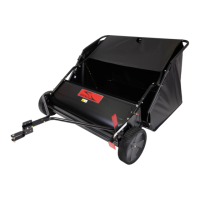
The Brinly LS2-42BH1-G Lawn Sweeper is a pull-behind attachment designed for lawn care and home applications, specifically for sweeping debris such as grass clippings, leaves, and other light materials. It is engineered for dependability and performance, with a focus on ease of assembly, operation, and maintenance.
Function Description:
The lawn sweeper attaches to a towing vehicle (such as a lawn tractor or ATV) via a hitch plate. As the vehicle moves, the sweeper's wheels drive a brush assembly that rotates to pick up debris from the lawn. The collected material is then thrown into a rear-mounted hamper for easy collection and disposal. The sweeper features an adjustable brush height to accommodate various lawn conditions and material types, and a hamper that can be emptied by pulling a rope from the operator's seat of the towing vehicle.
Important Technical Specifications:
- Model: LS2-42BH1-G
- Maximum Towing Speed: 5 mph
- Hamper Capacity: 20 cu. Ft.
- Maximum Hamper Weight: 120 lbs
- Empty Weight: 75 lbs
- Maximum Towed Weight: 195 lbs (with wet grass)
- Brush Height Adjustment: Adjustable from 1/4" to 3-1/4" across 10 lock arm positions.
- Settings 1-3: 1/4" to 1" (6.5mm to 25mm) for extremely low-cut grass and light material.
- Settings 3-6: 1" to 2" (25mm to 50mm) for mowed lawns under normal conditions or light leaves.
- Settings 6-10: 2" to 3-1/4" (50mm to 82mm) for high grass, heavy leaves, or heavy grass clippings.
- Required Tools for Assembly: 1/2" Wrench (2), 9/16" Wrench (2), 7/16" Wrench (1), Pliers, Gloves, Safety Glasses, Flat-Tip Screwdriver (1).
Usage Features:
- Assembly: The sweeper comes with an organized skinpack of hardware for assembly. The process involves attaching tow tubes to the brush housing, measuring and adjusting the hitch plate height, assembling the hamper frame, and connecting the hamper to the brush housing. Special attention is given to not overtightening fasteners during initial steps to allow for proper alignment. The pull rope and handle assembly is designed for easy dumping from the towing vehicle.
- Hitch Plate Height Measurement: A crucial step in assembly is measuring the towing vehicle's hitch plate height to ensure correct clevis assembly mounting, which affects the sweeper's levelness and performance.
- Adjusting Brush Height: The brush height is adjusted via a Lock Arm and Height Adjustment Handle. It's recommended to start with a higher setting and gradually reduce it until optimal sweeping performance is achieved, avoiding excessive wheel skipping or slipping.
- Leveling the Hamper: The Hamper Stop can be adjusted to ensure the hamper assembly remains clear of the ground and is approximately level. The tow tubes should be parallel with the ground for optimal performance.
- Operating Speed: The operating ground speed directly impacts how material is thrown into the hamper. A speed of approximately 3 mph (a brisk walk) is recommended for best results, ensuring material is thrown to the back of the hamper. Maximum operating speed is 5 mph.
- Emptying the Hamper: The hamper is emptied by pulling a rope and handle from the towing vehicle's seat, tilting the hamper forward. It's important to park the towing vehicle and set the parking brake before dumping. Overfilling, especially with wet material, should be avoided as it makes dumping more difficult.
- Wind Screen: The hamper features a wind screen that can be configured in two positions: fully open (for little to no wind) or half-closed (for medium wind) to prevent material from blowing out of the hamper.
- Transport Position: The sweeper can be adjusted to a transport position by loosening the knob and moving the Lock Arm to the 10th position, raising the brushes off the ground.
- Storage: The sweeper can be tipped upright and stored against a wall to minimize space. This involves removing loose material, detaching the hamper assembly, collapsing the hamper, adjusting brush height to position 10, and positioning the sweeper and collapsed hamper against a wall.
Maintenance Features:
- General Preventative Maintenance:
- Regular cleaning of the hamper with a water hose and ensuring it's dry before storage.
- Checking all moving parts for wear and freedom of movement.
- Tightening all fasteners as required.
- Inspecting for rust on painted surfaces and touching up damaged areas.
- Routine lubrication of the Dowel Pin and Drive Pinion twice a year (fall before storage, spring before first use).
- Checking Drive Pinions and Dowel Pins for wear and replacing as needed.
- Annual lubrication of the Wheel Axles.
- Brush Section Replacement: Detailed instructions are provided for replacing brush sections, including using a rubber mallet to tap the metal rail of the brush section and ensuring correct orientation.
- Wheel & Drive Gear Maintenance:
- Disassembly and inspection of components like cotter pins, machine bushings, wheels, wheel axles, retaining rings, flat washers, and drive pinions.
- Cleaning dirt and debris from inside the wheel and dust cover.
- Inspecting components for damage and wear.
- Lubrication of the Dowel Pin and Brush Axle.
- Reassembly and lubrication of the drive gear system, ensuring correct orientation of drive pinions (Left and Right hand specific).
- Dust Cover & Bearing Retainer Maintenance: Instructions for removing and reassembling the dust cover and bearing retainer, including the use of E-rings and lock nuts. Lubrication of the Dowel Pin hole and Wheel Axle is also covered.
- Troubleshooting Guide: A comprehensive section addresses common issues such as the sweeper not picking up material (brush height too low/high, brush drive system problem), material going over the top of the hamper (speed too fast, wind screen needed), sweeper wheels not moving/skipping/locking up (brush height too low, sticking/worn drive dowels/pinions, incorrect drive pinion assembly), hamper dragging on the ground (tow bars not level), and hamper orientation being too high (hamper mount tubes assembled upside down).
The manual emphasizes safety precautions throughout, using safety-alert symbols and keywords like DANGER, WARNING, and CAUTION. Key safety points include:
- Ensuring combined weight of towing vehicle and operator is greater than maximum towed weight.
- Not exceeding maximum towing capacity or drawbar pull rating.
- Towing at speeds less than 5 mph and using caution on rough terrain, slopes, and near drop-offs.
- Avoiding sudden changes in speed or direction.
- Keeping children, bystanders, and pets at a safe distance.
- Not carrying passengers on the attachment or towing vehicle.
- Wearing substantial footwear and avoiding loose clothing.
- Regularly inspecting and maintaining the equipment.
- Specific warnings regarding the hamper pull rope to prevent injury, such as not wrapping it around body parts, not using it while the vehicle is moving, and securing it after dumping.
- Ensuring the hamper is empty before attaching or removing the sweeper.
- Using safety glasses and solvent-proof gloves during maintenance.

 Need help?
 General

 To Next Page