28
5.3 CHIMNEY
The chimney is very important for the proper operation of the stove and it has two functions:
• Evacuate the smoke and the gas safely out of the house.
• Provide a draft enough to the stove or insert.
The draft also affects the intensity of the combustion and the heating performance of your equipment. A good draft of the fireplace needs a
reduced regulation of the air for the combustion, while a lack of draft needs a good regulation of the air for the combustion.
Therefore, it is essential that it is made perfectly and that it is subjected to maintenance operations in order to keep it in good conditions.
(Many of the claims due to malfunctioning reasons refer exclusively to a bad draft).
It is necessary to comply with the following requirements for the proper operation of the stove:
• The interior section must be preferably circular.
• It must be thermally insulated along its entire length in order to prevent condensation (the smoke is liquefied by heat shock) and even
more if the installation is outside the house.
• If we use metallic pipe for the installation outside the house, it is compulsory to use thermal insulated pipe. It consist of two concentric
pipes and, between them, there is a thermal insulator. Moreover, we will avoid condensation problems.
• It should not have bottlenecks (enlargements or reductions) and it must be vertical with deviations not higher that 45º.
• If it has been used previously, it must be clean.
• Respect the technical data of the instructions manual.
The optimum draft varies between 10 and 14 (Pascal). The measuring must be always made with the equipment hot (nominal heating power).
A lower value causes a bad combustion causing carbonic deposits and excessive smoke generation, having leaks and, even worse, an
increase of the temperature that could damage the structural components of the stove. When pressure exceeds 15 Pa it will be necessary
reduce it by installing an additional draft
regulator.
To check if the combustion is correct,
control if the smoke out the chimney is
transparent. If the smoke is white it means
that the equipment is not properly regulated
or the used pellet that is being used is
too wet. However, if the smoke is grey or
black it means that the combustion is not
completed (it is necessary a greater amount
of secondary air).
The connection of the stove must be done
with rigid aluminized steel pipes or stainless steel pipes. It is forbidden to
use flexible metallic pipes or fibre cement pipes because they damage
the safety of the connection as they are subject to jerks and breaks, which
causes smoke looses.
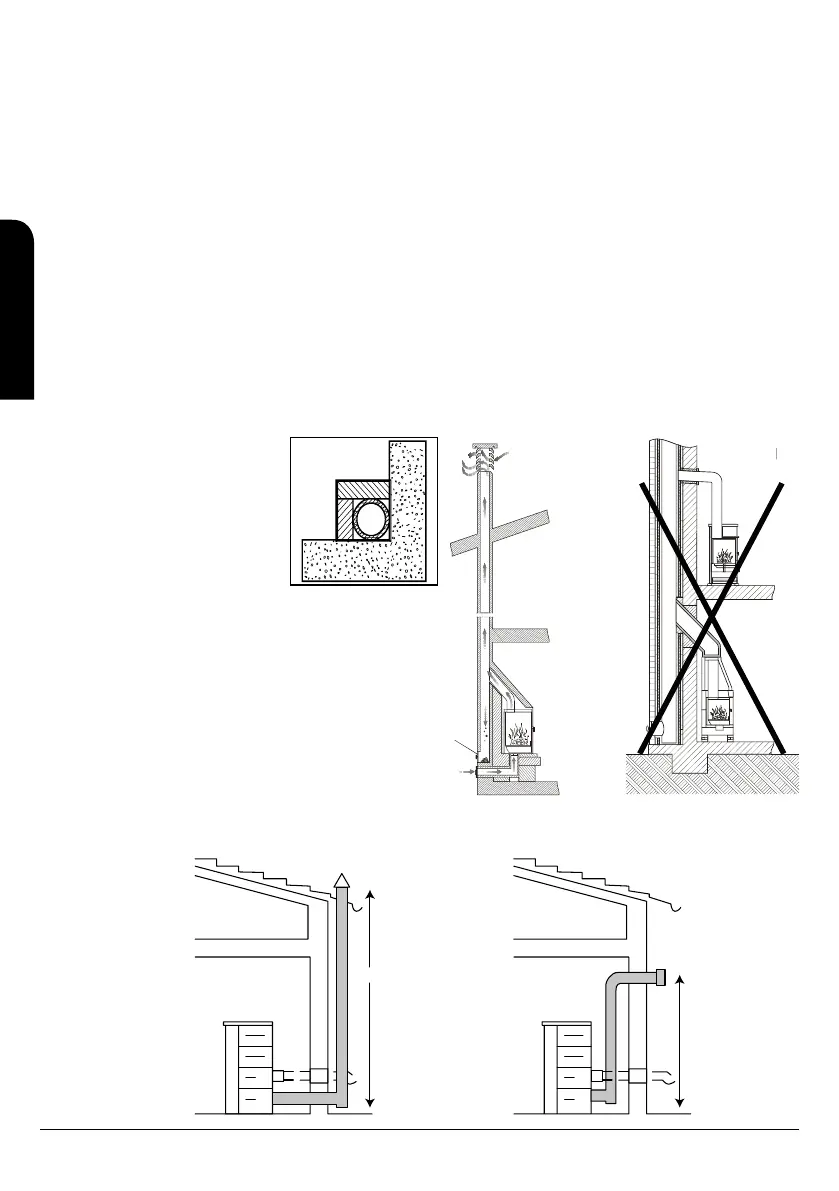
Materials that are prohibited for the chimney and, therefore, damage
the proper functioning of the equipment are: fibre cement, galvanized
steel and rough and porous interior surfaces. An example of solution is
described below:
(1) Stainless steel AISI 316 chimney with double insulated chamber and
material resistant up to 400°C. Efficiency 100% optimum (see drawing
D9).
All stoves that send smoke to the exterior should have their own chimney.
Never use the same chimney for several equipments at the same time
(see drawing D10).
As far possible, avoid
horizontal sections. The
horizontal section will not
be longer than 3 meters.
It must be installed a “T”
with hermetic cover at the
stove exit smoke that allows
the regular inspection or
the heavy dust download.
There will not be more than
4 changes of direction,
including the register “T” for
the cleaning.
In drawing D11 are
represented the basic
requirements for the
chimney installation of the
stove:
D9
D10
D11
Altura mínima 1.5 m
Altura mínima 1.5 m
INSTALLATION, OPERATING AND SERVICING INSTRUCTIONS RADIOFREQUENCY SERIES
EN



 To Next Page