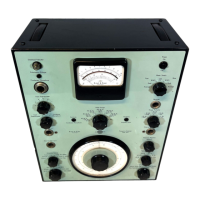
1023.2
Checking Procedure
Generator to
"Off'
Compressor Speed to
"30
dB/s"
Compressor Speed
to
"10
dB/s"
Compressor Speed to
"Off"
Modulation
Frequency to
"1
Hz"
Modulation
Frequency
to
"16
Hz"
2-2
Disconnect the
15
n resistor and check the distortion
with
a Frequency Analyzer like f.
inst.
Type
2010.
With
10
V RMS on
"Load"
output the second and third harmonics should remain
at
least
60
dB
below
10
V corresponding to
0,1%
of
distortion. (At frequencies from
20
Hz to
20
kHz,
and
0,15%
at
10Hz).
The remaining noise on
"Load"
output
should be at least
70dB
below
10V
RMS.
Connect
"Load"
output
to the
input
of a
Voltmeter/Amplifier
and AC
output
of
the
Voltmeter
to
"Compressor
Input"
on
1023.
Adjust
Output
Voltage
for
a
19dB
deflection on the
10V
range
of
the
Voltmeter/Amplifier.
Adjust
Compressor Voltage for the same 1 9 dB deflection corresponding to 0 dB compres-
sion,
When
increasing the
amplification
of
the
Voltmeter/Amplifier
by
10
steps
to
60dB,
the de-
flection
on the
Voltmeter/Amplifier
should
remain
at
19
dB.
At
60dB
of
compreSSion the noise
from
the Compr.
Amplifier
will
cause a
slight
instable
reading
which
can be avoided by using a selective
Voltmeter/Amplifier.
Select
60
dB
of
compression.
When
the plug
for
"Compressor
Input"
is taken out, the
Voltmeter
on 1
023
will
move
slowly
up
to
a final deflection
of
approx.
-1
dB, at it should take 4
to
5 s
to
reach
this
final deflec-
tion.
Connect an Oscilloscope (Time Base
0,5
ms)
to
monitor
the
output
signal
from
1023
which
should be
tuned
to appr
lX.
1000
Hz.
The
Oscilloscope should
now
show
a sine wave signal
which
is changing in frequency + and
-10%
referred
to
the
center
frequency of
1000
Hz.
The
± 10% frequency deviation should remain
but
with
a
much
faster repetition.
5.75



 To Next Page
 Loading...