Averaging Time Control
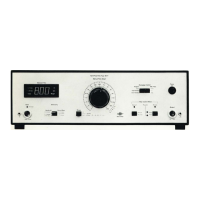
This ability, allows the Type 1617
to vary the averaging time of the
Measuring Amplifier Type 2607 or
the Narrow Band Analyzer Type
2120 during the course of the fre-
quency scan. The advantage is that
the averaging time can be kept as
short as possible to maintain an ac-
ceptable analysis time, while being
long enough at lower frequencies to
achieve optimum measuring accu-
racy, i.e. to maintain a good confi-
dence level. The best analysis condi-
tions are obtained when the product
of bandwidth B (in Hz) and averag-
ing time T (in s) is held constant
throughout the scan. Therefore the
Type 1617 is equipped with averag-
ing time programs which can be se-
lected according to test conditions
to maintain the BT product as near
constant as possible and give a con-
stant confidence level.
At higher frequencies, if a con-
stant BT product is to be main-
tained, the averaging time becomes
so short that the writing speed of
the Recorder will be the practical li-
mitation on the speed of the analy-
sis. Therefore the shortest averag-
ing time that can be selected by the
programs in the Type 1617 is
0,1 s. However, some high fre-
quency signals like the noise or vi-
bration from a slowly rotating ma-
chine may have a low repetition fre-
quency that causes low frequency
modulation as shown in Fig.7,
where 0,1 s averaging time is too
short. To allow satisfactory averag-
ing times to be selected for this
type of signal, a choice of three min-
imum times (0,1 s, 1,0 s, and 10 s)
is provided on the Type 1617. Fig.8
is a chart indicating the averaging
times and change-over frequencies
in the nine programs available, to-
gether with the minimum and maxi-
mum averaging times.
When operating with variable av-
eraging times, selection of the re-
quired program is made with the
two Averaging Control switches on
the front panel, and the Recorder
Averaging Time switch on the rear
panel must also be set to "Variable
Averaging Time". Table 3 shows
how the programs can be selected
by suitable combination of the Pro-
gram and Minimum Time switch po-
sitions. The programs are obtained
Averaging Time
(s)
100
30 -
10
3
1
0,3
0,1
C,F,J Slow Random
B,E,H Fast
Random
1;1
A,D Sine
1
its
A
G,H,J
1,0 5
B
D,E,F
0,1 s
A,B,C
5 10 20 50 100 200
500 1 k 2k 5k 10k 20k
Switchover Frequency tHz1
Fig.8. Averaging times and changeover frequencies
Minimum Av. Time(s) 0.1
,o
10
Slow Random
Fast Random
Sine
E
(G)
Table 3. Selection of the required averaging
time program
via the 15 lead AVERAGING TIME
CONTROL socket on the rear panel.
With a Level Recorder, automatic
averaging time control functions as
follows. The scan starts with the Re-
corder being held for a period of
five times the programmed averag-
ing time for the band, during which
time the pen comes up to the cor-
rectly averaged level. Then a long
averaging time is selected that
keeps the output constant while the
Recorder draws the trace by advan-
cing the paper at high speed to the
next frequency band. The Filter
steps to the next band in the se-
quence, and the programmed aver-
aging time is selected, after which
the Recorder hold period begins
again.
161041
Using an X-Y Recorder, where
the X-axis is controlled by the DC
ramp output from the Type 1617,
the Recorder pauses for five times
the averaging time, and then takes
eight steps through each third-
octave band.
Figs.9, 10, and 11 show analysis
of the same input signal recorded
using three different methods to il-
lustrate their relative merits.
Built-in IEC Interface
The Type 1617 is fully program-
mable via a built-in interface that sat-
isfies the requirements of the pro-
posed IEC Standard Digital Interface
for Programmable Instrumentation.
This permits the filter frequency
bandwidths, and averaging time to
be varied in an arbitary sequence,
and recording initiated to suit any
particular measuring program. It
also permits on-line changes to be
made to accomodate new events as
they occur.
W130iel IS Naar B,uel6 6per eruel 6 Km,
Itpinocioop000ciouoD000n000rioacr000000naocici0000nou000cc
BrOel&Kjaar Polentionanel Ra•04:—W-01) Recur.. ilai-Lowee Lin Greg _Vim, 611, Speed.- 119.—carn,sec Paper eel -nlark sec
Afro- - - 10 75
Icop..h., 60 2
c111 dB
Ali 401'
40 20
Meseunna Obj
Fined
Acerag.ng-
7,n. —3° t5
1/3 XLDVE— -
Tim e used 250
-24) 30
25 Hz - 40 kHz, --
0. A, 0. C, Lin
....•....••
OP 1124
50
40
10 20 = 60 100
Mull ply Frequency Seale by
16.
200 SOO 1000 2000 6000 0000 20000 400000 5 B C
2 roL vol
dB
512"2112 A 15 C 765042
Fig.9 Frequency analysis with Level Recorder and fixed averaging time
6



 To Next Page
 Loading...