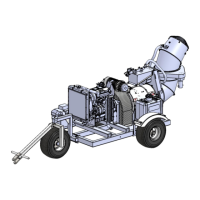
The Buffalo Turbine BT-CKB5EFI is a debris blower designed for efficient and trouble-free operation, primarily in the turf care industry. This manual provides comprehensive instructions for its operation, maintenance, and troubleshooting.
Function Description
The BT-CKB5EFI is a powerful debris blower that utilizes a turbine to generate a high-velocity air stream, effectively moving debris such as leaves, grass clippings, and other light materials. It is designed to be towed, making it suitable for various outdoor applications where mobility and high-volume air movement are required. The device is equipped with an EFI (Electronic Fuel Injection) Kohler Engine, ensuring efficient fuel consumption and reliable performance.
Important Technical Specifications
The BT-CKB5EFI features a robust design with specific dimensions and capabilities:
- Length: The frame size is 28" wide X 48" long.
- With nozzle: 102"
- Without nozzle: 82"
- With nozzle installed but without trailer arm: 69"
- Without nozzle and trailer arm installed: 48"
- With axle and tires: 48"
- Width: 48"
- Height: 38.5" (with axle and tires)
- Weight: 470 lbs
- Electrical System: 12 Volt battery / 300 CCA
- Fuel Capacity: 6 gallon (unleaded fuel only)
- Input Power: EFI CH749 Kohler Engine (EFI does not have a choke)
- Input RPM: Up to 3900 RPM (more fuel economy when run below 3600 RPM)
- Outlet Size: Approximately 12"
The device incorporates a wireless remote system for convenient operation, allowing users to control the blower from a distance. This system includes a receiver (BT PN 3585) and a transmitter (BT PN 3586) with 6 buttons, operating at a supply voltage of 12VDC and an IP65 class. The system description indicates that the machine is set to run at idle speed (1250 RPM), normal high throttle (3600 RPM), and maximum high throttle (3900 RPM). The control system manages engine speed, throttle plate actuation, and various safety interlocks.
Usage Features
The BT-CKB5EFI is designed for ease of use and safety. Key operational aspects include:
- Field Operation:
- Starting Blower Unit: The engine starts at a lower engine speed with nozzle pointed down or away. The air stream direction can be changed by pressing the nozzle buttons on the transmitter.
- Stopping Blower Unit: Shutting off the engine above 1/4 throttle by turning the key switch to the OFF position to avoid engine backfire.
- Operating RPM: The manufacturer recommends running the unit at an RPM that will ensure efficient operation.
- Storage: When storing the blower unit, it's important to prepare the machine by following specific steps, including cleaning, checking for damage, and ensuring proper storage conditions.
- Pre-Operation Checks: Before each use, a series of checks must be performed, including inspecting all wheel bolts, axle nuts, and trailer mounting bolts, checking all other fasteners and hardware, and ensuring the set screw (nozzle pulley) is tightened.
- Remote Control: The wireless remote system allows for convenient control of the blower's functions, including starting, stopping, and adjusting the nozzle direction. The pairing procedure for the transmitter and receiver is detailed, ensuring proper communication.
- Safety Decals: The blower unit is equipped with various safety decals that provide warnings and instructions for safe operation. These include warnings for eye protection, ear protection, and general safety precautions.
Maintenance Features
Regular maintenance is crucial for the longevity and optimal performance of the BT-CKB5EFI. The manual outlines a comprehensive maintenance schedule and specific procedures:
- Maintenance Section:
- Maintenance Safety: Emphasizes the importance of safety precautions during maintenance, such as setting the blower on a level surface, stopping the engine, setting the park brake, removing the ignition key, and wearing appropriate protective gear.
- Fluids: Specifies that engine oil per the manufacturer's specification and a Teflon spray type lubricant on the nozzle base and slides are required for freer rotation.
- Service Checklist: A detailed checklist for scheduled maintenance hours (8 hours or daily, 40 hours or weekly, 200 hours or annually) is provided. This includes tasks such as removing debris, checking engine oil and fill level, checking air filter and pre-cleaner, checking coolant areas, checking tire pressure, checking clamp band bolt, checking coupling, inspecting battery terminals, removing battery and clean debris, lubricating nozzle base slides, checking set screw (nozzle pulley), and washing and cleaning the unit.
- Moreflex Coupling Parts: Instructions for installation and critical alignment of the Moreflex coupling are provided, including torque specifications and warnings about cracks in the rubber composition.
- Blower Assembly: Recommendations for mounting the blower assembly onto the frame are given, emphasizing proper alignment using a gauge to ensure the crankshaft and blower shaft are parallel.
- Parts Reference: Detailed diagrams and tables list all parts with their corresponding part numbers, descriptions, and quantities, facilitating easy identification and ordering of replacement parts. This includes specific references for different serial number ranges.
- Troubleshooting: A comprehensive troubleshooting guide is included, addressing common issues such as the unit not engaging, engine cranks but does not start, unit cranks and starts but shuts off immediately, engine lights stay on, engine does not shut off, delay present, engine slowdown, throttle not speeding up, throttle not slowing down, blower nozzle does not rotate, blower nozzle only 1 direction, and blower nozzle slows after continuous rotation. Each symptom is accompanied by items to check and possible remedies.
The manual also includes information on warranty registration, emphasizing the importance of completing and submitting the warranty registration form to ensure coverage. Warranty terms cover defects in material and workmanship under normal use and service for a period of 10 years from the date of purchase. It also specifies that pre-approval is required for all warranty repairs.

 Need help?
 General

 To Next Page