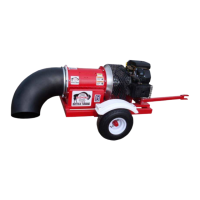
The Buffalo Turbine BT-MEGA is a powerful debris blower designed for efficient material movement across various terrains and applications. This manual provides comprehensive instructions for its operation, maintenance, and safety, ensuring optimal performance and longevity.
Function Description
The BT-MEGA is engineered to move high volumes and velocities of air, making it highly effective for clearing leaves, grass clippings, aeration plugs, and other debris. It can also be used for drying wet areas. The unit features a remote-controlled nozzle that allows operators to adjust the air stream direction (clockwise or counter-clockwise) and engine throttle (increase or decrease) from a distance, enhancing operational flexibility and safety.
Important Technical Specifications
- Model: BT-MEGA Series
- Length:
- 112" With nozzle
- 92" Without nozzle
- 50" With nozzle installed but Without trailer arm
- 50" Without nozzle and trailer arm installed
- Width:
- 56" With fender/axle mount and tires
- 36.5" Without fender/axle mount and tires
- Height: 45" With fender/axle mount and tires
- Weight: 716 lbs
- Electrical System: 12 Volt battery
- Fuel Capacity: 12 gallon Unleaded Fuel only
- Input Power: CH1000 Kohler Engine
- Input RPM: Up to 4300 RPM
- Outlet Size: Approximately 12"
- Wireless Remote System:
- Receiver (BT PN 3573): 12VDC supply voltage, 0-10V analog ramp range, 8A ACI functional relays, 2405-2480 MHz transmit frequency, 16 frequency channels, IP65 class.
- Transmitter (BT PN 3024): 3 x 1.5V AAA alkaline batteries, approx. 15 hours operating time with continuous usage.
Usage Features
- Remote Control Operation: The BT-MEGA is equipped with a wireless remote system, allowing the operator to control the nozzle rotation and engine throttle. This feature enhances safety by keeping the operator away from moving parts and debris.
- Adjustable Air Stream: The nozzle can be rotated clockwise or counter-clockwise, providing precise control over the debris movement. The nozzle stops turning when the transmitter button is released.
- Throttle Control: The remote allows for increasing or decreasing the engine's throttle. Releasing the throttle buttons will maintain the control voltage at a proportional value between 0 and 10 volts. Simultaneously pressing both throttle buttons returns the variable output to 0 volts, setting the engine to low idle.
- Starting Procedure: Always start the engine at a lower speed with the nozzle pointed down or away.
- Stopping Procedure: Shut off the engine above ½ throttle by turning the key switch to the off position to prevent engine backfire. Allow the blower fan to come to a complete stop before disconnecting from the tow vehicle.
- RPM Adjustment: The unit can operate at a slower RPM if it effectively moves debris. Increase engine RPM as needed for heavier or wet materials.
- Wind Awareness: Always try to blow with the wind for optimal efficiency.
- Versatile Applications: Suitable for moving leaves, grass clippings, aeration plugs, and debris, as well as drying wet areas.
- Optional Nozzles: Various aluminum nozzles are available, including 12", 15", and 20" extensions, 10" and 12" round nozzles, 12" and 19" rectangular nozzles, and a fishtail nozzle for wide-angle air distribution. Flexible nozzle assemblies are also available for rough terrain.
- Towing Options: D.O.T. trailers and 2" ball receiver hitches are available for transport.
- Fork Pockets: Optional fork pockets (Part# 3894) facilitate moving blowers around jobsites and for bed mount/skid mount applications.
- Corded Control: Corded control options (Part# 2788 for KB4 Model, Part# 2787 for Mega, Diesel Models) are available as an alternative to wireless.
- Rotation Bearing Kit: An optional rotation bearing kit (Part# 3838) increases rotation speed and reduces load on the rotation motor.
- Exhaust Guard Kit: An exhaust guard kit (Part# 2988) is available for Model: KB.
Maintenance Features
- Safety Decals: The unit is equipped with various safety decals indicating warnings for eye and ear protection, keeping hands, feet, and clothing away from moving parts, and not operating without guards. Operators must familiarize themselves with these decals.
- Pre-Operation Checks: Before starting, ensure all guards and shields are properly installed. Clear the area of people and pets.
- Regular Inspections: Annually review all safety-related items with personnel operating or maintaining the blower.
- Protective Gear: Always wear appropriate protective gear, including a hard hat, slip-resistant shoes, protective glasses or goggles, heavy gloves, wet weather gear, and hearing protection, especially for prolonged exposure to excessive noise.
- Maintenance Safety: Always set the blower on the ground, stop the engine, set the park brake, remove the ignition key, and wait for all moving parts to stop before performing any service, adjustment, or repair. Support the machine with blocks or safety stands when changing tires or working beneath it.
- Battery Maintenance:
- Changing Batteries: For the remote transmitter, remove the clip and battery cover (2 screws each), remove old batteries (starting with the middle one), insert new 3 x 1.5V AAA alkaline batteries (starting left or right), and replace the cover.
- Battery Precautions: Do not recharge, short circuit, disassemble, deform, or heat batteries. Avoid direct soldering. Insulate terminals when discarding. Store in a cool, dry place away from direct sunlight and high temperatures.
- Greasing Interval: Grease the fittings on new Mega Blowers after the first 8 hours of operation. Flange bearing (1) requires approximately 2 shots of grease every 40 hours. DO NOT OVER GREASE.
- Fluids: Use NLGI2 grease only for flange bearing. Change oil per the Manufacturer's specification (see Engine owner's manual). Apply Teflon spray lubricant on the nozzle base and slides for freer rotation.
- Belt Maintenance:
- Replacement: After prolonged use, the belt may stretch and wear. To replace, remove the guard around belts and pulleys, loosen the pushover bolt and nut, remove the old belt, install new 3/5VX500 belts, tighten the pushover bolt to achieve proper tension, and re-check belt tension and pulley alignment. Belt tension should be 35 lbs at 1/4" deflection for the powerband belt.
- Service Checklist (8 hrs or daily):
- Remove all debris between the blower wheel fan and stationary vanes.
- Check engine oil and fill to proper level (do not overfill).
- Check air filter and precleaner.
- Clean debris from air intake and other cooling areas on the engine.
- Check tire pressure (Max. 50 PSI).
- Check Clamp Band Bolt for tightness.
- Service Checklist (40 hours or weekly):
- Flange bearing greasing.
- Inspect battery terminals for corrosion, broken wires, or loose connections.
- Remove battery and clean debris from inside the battery box.
- Nozzle base slides (Teflon spray).
- Check set screw (nozzle pulley) for tightness.
- Wash and clean any dirt or grime buildup on blower wheel fan blades to minimize vibration and maintain peak performance.
- Service Checklist (200 hrs or annually):
- Storage:
- Select a dry, level, debris-free storage area.
- Thoroughly wash the machine to remove all debris and residue.
- Run the machine at low RPM to dry components.
- Touch up paint chips and scratches to prevent rusting.
- Inspect for worn or failed components and order replacements.
- Store in an enclosed building or cover with a waterproof tarpaulin if stored outdoors.
- Store away from human activity and keep children away.
- Troubleshooting: A dedicated section provides solutions for common issues like no airflow, reduced airflow, machine vibration, and control problems. It emphasizes turning off the engine, removing the key, and disconnecting the battery before servicing.
The BT-MEGA is a robust and user-friendly debris blower, designed for efficiency and durability, with clear guidelines for safe and effective operation and maintenance.

 Need help?
 General

 To Next Page