Specifications
Trouble Shooting
I
f y
ou ar
e unable t
o connec
t t
o a network
, check the follo
wing.
•
I
s
t
h
e
p
o
w
e
r
ca
b
l
e
co
n
n
e
ct
e
d
co
r
re
ct
l
y
?
Al
s
o
,
i
s
t
h
e
p
o
w
e
r
ca
b
l
e
p
l
u
g
g
e
d
i
n
t
o
a
n
o
u
t
l
e
t
o
r
s
u
r
g
e
p
ro
t
e
ct
o
r
?
•
I
s
t
h
e
E
t
h
e
r
n
e
t
ca
b
l
e
co
n
n
e
ct
e
d
co
r
re
ct
l
y
?
Are
a
n
y
ca
b
l
e
s
d
i
s
co
n
n
e
ct
e
d
o
r
b
ro
k
e
n
?
•
I
s
t
h
e
l
i
n
k
/
a
ct
L
E
D
o
n
?
I
f
n
o
t
,
m
a
n
u
a
l
l
y
s
e
t
t
h
e
co
m
m
u
n
i
ca
t
i
o
n
m
o
d
e
o
f
t
h
e
co
n
n
e
ct
e
d
d
e
v
i
ce
t
o
1
0
0
M
b
p
s
h
a
l
f
d
u
p
l
e
x
o
r
1
0
M
b
p
s
h
a
l
f
d
u
p
l
e
x.
Federal Communication Commission Interference Statement
This equipment has been tested and found to comply with the limits for a
Class B digital device, pursuant to Part 15 of the FCC Rules. These limits are
designed to provide reasonable protection against harmful interference
in a residential installation.
This equipment generates, uses and can radiate radio frequency energy
and, if not installed and used in accordance with the instructions, may
cause harmful interference to radio communications. However, there is no
guarantee that interference will not occur in a particular installation.
If this equipment does cause harmful interference to radio or television
reception, which can be determined by turning the equipment off and
on, the user is encouraged to try to correct the interference by one or
more of the following measures:
- Reorient or relocate the receiving antenna.
- Increase the separation between the equipment and receiver.
- Connect the equipment into an outlet on a circuit different from that
to which the receiver is connected.
- Consult the dealer or an experienced radio/TV technician for help.
This device complies with Part 15 of the FCC Rules. Operation is subject to
the following two conditions: (1) This device may not cause harmful
interference, and (2) this device must accept any interference received,
including interference that may cause undesired operation.
2014.10
Check Buffalo’s website (www.buffaloamericas.com) or the product catalog
for information about the latest products or compatible models.
Standards
Flow Control
Operating
Environment
Weight
External Dimensions
Power Consumption
Power
Connector
Compatible Cables
(*) (**)
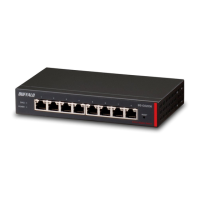
Ports
IEEE802.3ab (1000BASE-T)
IEEE802.3u (100BASE-TX)
IEEE802.3 (10BASE-T)
IEEE802.3x (when operating at full duplex)
Back pressure (when operating at half duplex)
8 (all ports support Auto MDI-X)
RJ-45 8-pin connector (Shield type)
AC 100-240V 50/60Hz
Max. 4.0 W
180 x 102 x 30 mm; 7.1” x 4” x 1.2”
(excluding protruding parts)
540g (1.19 lb.)
Operating temperature: 0–50 ℃ (32-122 °F)
Operating humidity: 10-85 % (no condensation)
Standards
VCCI Class B, FCC Class B, Canada IC Class B, UL
Transmission
Speeds
1000 Mbps (1000BASE-T)
100 Mbps (100BASE-TX)
10 Mbps (10BASE-T)
Switching Method
Store and forward
Jumbo Frames
Up to 9,216 bytes
(including 14 byte header + 4byte FCS)
Access Method
CSMA/CD
Data Transfer Speed
(Throughput)
1,488,095 packets/second (1000BASE-T)
148,810 packets/second (100BASE-TX)
14,881 packets/second (10BASE-T)
Switching Fabric
16 Gbps
MAC Address Table
8,000 (self-learning)
Buffer Memory
128 KBytes
Aging Time
Approx. 300 seconds
Other
Loop detection
Power saving (***)
* This unit automatically detects and adjust for straight or crossover
Ethernet cables, so either type of cable may be used.
** Site-terminated Ethernet cables are not recommended. Always use
preassembled cables.
*** This function automatically recognizes the port link status and the
length of Ethernet cables, then adjusts the operating power accordingly.
This also adjusts the power when the data is not transmitted (the device
connected to this switch should be compatible with IEEE802.3az EEE).
1000BASE-T: Enhanced category 5 or higher
UTP/STP cables
100BASE-TX:
Category 5 or higher UTP/STP cables
10BASE-T:
Category 3 or higher UTP/STP cables
Transfer Encryption
Method
8B1Q4/4D-PAM5(1000BASE-T)
4B5B/MLT-3(100BASE-TX)
Manchester encoding(10BASE-T)


 To Previous Page
 Loading...