4.3.4 Single Operation
When operating under power without passengers, sit not on ination tubes
or seat, weight should be as far forward and in the middle as practical. Avoid
heavy weights near the transom. Rapid acceleration should be avoided to
prevent the possibility of backward ipovers.
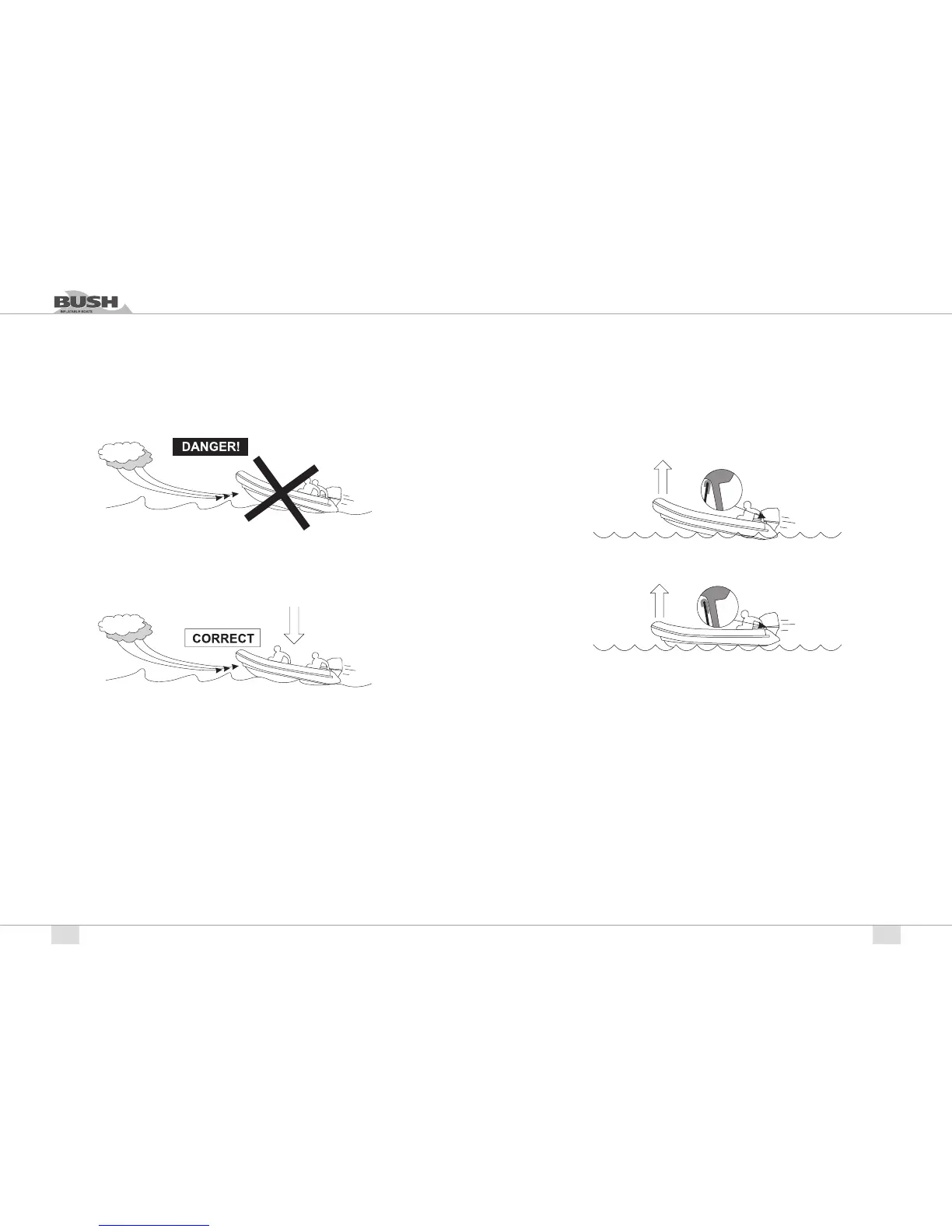
Wind and wave conditions can be highly dangerous for your inatable. You
can easily be ipped over if the load in the boat is not distributed in the bow
of the boat and wind and tide are against. Especially the models with inat-
able oor should be driven carefully in headwind and waves.
Distribution of load and weight take the bow down to a safe situation. The
anti-cavitations plate on the engine should be about 30-50 mm under the
bottom of the transom.
If your outboard is too high on the transom, you will experience a lot of cavi-
tations (air bubbles and slippage around the propeller). If your outboard is
too low on the transom it will create drag and it will throw up water into the
boat. In both cases you end up with loss of speed, so try to nd the ideal
position before you nally bolt your engine to the transom (consult your en-
gine supplier).
At all speeds it is advisable to keep the boat level. Prevent the bow from
pointing up, and prevent the bow from pointing down towards the water. Use
the weight of the people on board to achieve the level position. Adjust your
engine angle (see below)
REMEMBER:
• An outboard tilted too far from the transom will drive the boat with a bow
up attitude which is both very dangerous and inefcient.
An outboard tilted too close to the transom will drive the bow section too
deep into the water which ends up in loss of speed and/or cavitation.
Occasional checks should be made to the motor attachment screws. 1.
Loose screws will cause erratic boat operation and possible loss of en-
gine overboard.
Make a thorough review of the motor’s manual before operation.2.
On board loads should be monitored to avoid chafng or puncturing the 3.
boat’s skin.



 To Next Page